Hindu family brainwashed and induced for religious conversion by Christian pastor; Hindu deities called mere stones and religious symbols discarded
 Delhi, India
 10 November, 2020
Case Summary
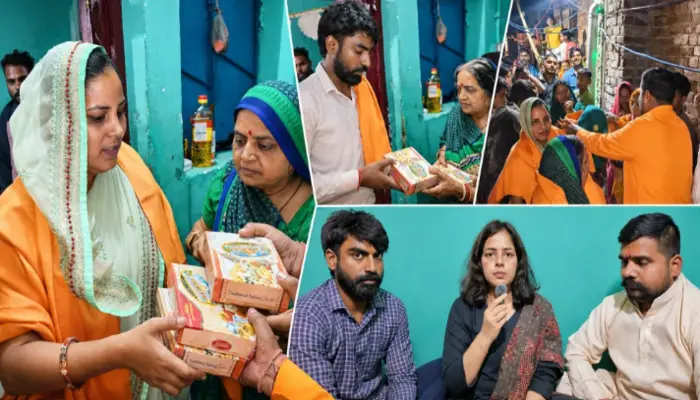
In Azadpur, Delhi, a Hindu family was brainwashed and induced to convert to Christianity by a Pentecostal pastor named Ashish, who exploited their distress over a family member’s illness by promising miraculous healing through prayers to Jesus Christ. Over the course of six years, the pastor influenced the family to abandon their Hindu faith, discard religious symbols and participate in Christian rituals, including baptism. During this period, he also denigrated Hindu deities, abused Hindu religious beliefs and practices, and portrayed Hindu gods as mere stones while asserting the superiority of Christianity. On 11 November 2026, ten members of a Hindu family from Azadpur, Delhi, formally returned to Vedic Sanatana Dharma, six years after they had embraced Christianity under the influence of a Pentecostal pastor named Ashish. The family members who returned included Asha Devi and her husband Badri, their younger son Naveen and his wife Manisha, their elder daughter-in-law Vibha, and five children. Vibha’s husband, Pappu, who was Naveen’s elder brother, had passed away the previous year after battling severe depression and other health issues. The family’s association with pastor Ashish began when Pappu was suffering from severe depression and ill health. Ashish, a Pentecostal pastor who operated in the Azadpur colony under the guise of conducting music classes, also organised faith-healing gatherings / Changai Sabhas. He approached Hindu households experiencing difficulties and drew them into these gatherings by promising relief from illnesses and financial problems, including debts, through prayers to Jesus Christ. Although Pappu was already receiving medical treatment, the pastor began attributing even minor improvements in his health to prayers to Jesus Christ, gradually persuading the Hindu family to move away from medicines and rely increasingly on Christian prayers for his recovery. Asha, Manisha and Vibha began attending the gatherings every Sunday and gradually came under the pastor’s influence. During this period, Asha was instructed to discard symbols associated with her Hindu faith as a condition for the pastor’s prayers to work. Under his influence, she threw away an ancestral silver murti of Bhagwan Krishna. Vibha recounted how Ashish repeatedly denigrated Hindu deities, describing them as nothing more than stones that could neither speak nor help people. He contrasted them with Jesus Christ, whom he portrayed as having died for humanity’s sins and therefore being the only one worthy of worship. He specifically mocked the Shivling, saying that it merely consumed milk and water, while presenting Christ as superior. The pastor also told the family that the Christian God manifested as the Pavitra Aatma and could cure illnesses. According to Naveen, the pastor also made him remove a pendant bearing the image of Bhagwan Shiva that he wore before performing theatrical faith-healing practices involving the laying on of hands. Approximately four years before the family’s return to Hinduism, Ashish took the women of the family, including Asha and Vibha, to Punjab for a baptism ceremony. There, they were made to immerse themselves in a water tank and affirm that Jesus Christ was the Son of God and the only one worthy of worship. The pastor also employed Pappu’s wife, Vibha, to bring potential converts to his religious gatherings, thereby involving her in bringing other people under his influence. Despite Pappu’s ongoing medical treatment and the pastor’s promises of miraculous healing, Pappu succumbed to his illness the previous year. The family subsequently suffered another tragedy when Pappu’s elder son also passed away. Naveen also lost his livelihood after his tea café was lost in a dispute with a group. Despite these devastating circumstances and the failure of the promised miraculous healing, the family remained under the pastor’s influence and had been led to believe that reverting to Hinduism would result in even worse consequences. Against this backdrop, the ground team of Sudarshan Vahini, supported by the Sewa Nyaya Utthan Foundation, founded by Sanjeev Sanskrit and Swati Goel Sharma, approached the Hindu family and began counselling its members. The initiative involved ground-level efforts by individuals including Vinod, Mohit Sanatani and Vaid Satish, alongside the teams of Rashtra Jyoti and Sewa Nyaya. Following a series of counselling sessions, the family gradually recognised the nature of the teachings they had been exposed to and agreed to leave the influence of Pentecostalism, which they came to understand as being rooted in superstition and adharma. On 11 November 2026, all ten family members formally announced their return to Vedic Sanatana Dharma amid the chanting of Vedic mantras and the Hanuman Chalisa. Naveen stated that the family had embraced the philosophy of Karmaphal and rejected the teachings about heaven, hell and Judgement Day that the Pentecostal pastor had previously introduced them to. Meanwhile, the Sewa Nyaya Utthan Foundation initiated a complaint seeking an inquiry into the activities of pastor Ashish in the Azadpur area. In a video published on 18 November 2026, Swati Goel Sharma interviewed Naveen and Vibha, who described how the pastor had approached their family during a period of illness and distress, used promises of healing to draw them into his gatherings, encouraged them to abandon medical treatment in favour of prayers, denigrated Hindu deities, and facilitated the baptism of the women in Punjab. Sharma described the activities as part of a wider pattern in which Pentecostal groups targeted financially distressed Hindu families through promises of healing and other forms of assistance. She also stated that such groups had expanded their activities beyond the Northeast and tribal regions of Assam, Chhattisgarh, Madhya Pradesh and Gujarat into Punjab and other parts of North India, including Delhi. Rashtra Jyoti and Sewa Nyaya further stated that they had worked to expose such activities, secure action against pastors, shut down conversion operations and facilitate the return of families to Hinduism, while also pursuing a legal challenge in the Supreme Court against attempts to repeal anti-conversion laws.
Why it is Hate Crime ?
This case has been added to the tracker under the primary category of - Predatory Proselytisation. Within it, the sub-category selected here is - Conversion/ attempts to convert by inducement. Predatory Proselytisation is not just limited to threat, harassment, force and violence, but it also has contours of stealth. In several cases, the Hindu victim is exploited to convert, with non-Hindus taking advantage of their poverty. In such cases, the Hindu victim who is suffering financially is offered monetary benefits, including lucrative offers for jobs, health treatment, education, etc, to induce the victim into changing his/her religion. In such cases, the religious identity of the victim and the aim to disenfranchise him from his faith form the heart of the crime. Also, taking advantage of and exploiting an individual’s economic vulnerabilities is widely acknowledged as exploitation, forms of which are often penalised by law. Such cases therefore are considered religiously motivated hate crimes since the victim’s religious identity forms the very heart of the crime itself. The other sub-category selected here is - Attempting to convert/converting by denigrating Hinduism. In several cases, Hindus are converted or an attempt is made to convert Hindus by denigrating their faith, Hinduism. In such cases, the Hindus associate with the non-Hindu perpetrators often by choice and then, the attempt to convert them by insulting their faith, showing the faith down etc begins. An example of this would be a non-Hindu gathering where the Hindus are attending the gathering of their own free will. However, once they attend the gathering, there is an explicit attempt to convert them by abusing their faith and hailing the faith of the perpetrator. The denigration of the Hindu faith is often based on misrepresentation of the Hindu faith, its doctrine and scriptures and insult to espoused traditions if not blatant lies about Hindu beliefs and ways. Such conversions or attempts at conversions are driven by animosity towards the Hindu faith and are therefore documented as religiously motivated hate crimes. The other primary category selected here is - Hate speech against Hindus. Within it, the sub-category selected here is - Anti-Hindu slurs, mocking faith. Anti-Hindu slurs and the deliberate mocking of the Hindu faith owing to religious animosity involve the usage of derogatory terms, stereotypes, or offensive references to religious practices, symbols, or figures. One of the common anti-Hindu slurs used against Hindus is “cow-worshipper” and “cow piss drinker”. The intention of using this term is to demean and mock Hindus as a group and their religious beliefs since Hindus consider the cow holy. Additionally, some symbols and the slurs attached to them have a historical context that exacerbates the insult, hate, stereotyping, dehumanisation and oppression against Hindus. Cow worship has been used for centuries to denigrate Hindus, insult their faith and oppress Hindus specifically as a religious group. There has been overwhelming documentation about how cow slaughter has been used to persecute Hindus with cow meat being thrown in temples and places of worship. There has also been overwhelming documentation where cow meat (beef) has been force-fed to Hindus to either forcefully convert them to Islam or denigrate their faith. Apart from cow worship, the Swastika – which holds deep religious significance for the Hindus – has also been misinterpreted and distorted to use as a slur against Hindus. Similarly, the worship of the Shivling has been used by supremacist ideologies and religions to denigrate Hindus owing to religious animosity. Such slurs and denigration stem out of inherent animosity and hate towards Hindus and their faith, therefore, it is categorised as hate speech targeted at Hindus specifically owing to their religious identity. The case demonstrated a pattern of targeted religious exploitation in which a Hindu family was subjected to sustained psychological manipulation and pressure to abandon its religious identity. The pastor’s approach was particularly significant because he capitalised on the family’s vulnerability during a period of serious illness, bereavement and financial hardship to influence their religious beliefs. Offering incentives or making false promises, especially when directed at vulnerable individuals in need, shows that these incentives are not acts of kindness or charity. Instead, they are calculated moves to exploit vulnerable Hindus because of religion. By providing inducements or promising healing in exchange for conversion, the accused were effectively blackmailing those who might have been desperate for assistance or hope. Such instances are seen in many cases where members of Christian missionary groups target socially and economically vulnerable Hindus to further their agenda of religious conversions. This form of coercion strips people of their agency and dignity and results in coerced conversions. These are not random or isolated incidents, but rather cases deeply rooted in religious animosity towards Hindu victims. Rather than engaging with the family on the basis of informed religious choice, he used their desperation for a sick family member’s recovery to establish religious dependence, gradually making adherence to Christianity appear necessary for their well-being. The attribution of even minor improvements in Pappu’s health to Christian prayers, alongside the gradual discouragement of medical treatment, reinforced this dependence and made the family increasingly reliant on the pastor’s religious assurances. This indicated the exploitation of vulnerability as a means of influencing the religious identity of an entire Hindu household. The use of Changai Sabhas (faith-healing gatherings) was central to the pastor's method of influencing Hindu families. These gatherings were presented as occasions where illnesses, financial difficulties and other personal hardships could be overcome through prayers to Jesus Christ. The Changai Sabha format, often described publicly as a faith healing gathering, is a well-recognised tool in organised Christian proselytisation networks. These meetings usually employ songs, testimonies and emotionally charged prayer sessions to influence and induce vulnerable individuals without openly declaring the underlying objective. The absence of transparency is itself central to the method. People attend believing they are seeking comfort, healing or spiritual support, only to be gradually drawn into teachings that undermine their own religious identity and introduce them to the Christian framework presented as the only path to relief. The religious targeting became more evident through the systematic denigration of Hindu beliefs and the demand that family members distance themselves from their religious identity. The pastor repeatedly disparaged Hindu deities, questioned the significance of Hindu worship and presented Hindu religious practices as inferior and ineffective. This goes beyond religious debate or proselytisation; it constitutes an act of incitement and insult directed at the core beliefs of the Hindu community. Such remarks are designed to demean and undermine the faith of Hindus and intend to create an inferiority complex in the minds of the victims against their own faith. This fosters an environment of hostility and disrespect towards the Hindu community and Hindu deities. These acts of insulting Hinduism stem from Christian theology, which harbours disdain and hatred for polytheistic faiths, and which categorises Hindus as ‘polytheists’, thereby fostering hatred against them. Such actions make the religiously motivated nature of the crime even more evident. The denigration of the Shivling was particularly significant given its profound religious and spiritual importance in Hinduism. The Shivling is a sacred representation of Bhagwan Shiva and is worshipped by Hindus with offerings of milk, water, flowers and other ritual offerings as an expression of devotion. By reducing this sacred form of worship to an object that merely consumed milk and water, the pastor deliberately trivialised a deeply revered Hindu religious practice. Similarly, describing Hindu deities as mere stones that could neither speak nor provide assistance was not simply a theological disagreement but a disparagement of Hindu beliefs and the faith of those who worship them. Such comparisons sought to undermine the family's reverence for their deities while establishing Christianity as superior, thereby attacking the religious dignity and identity of the Hindu family. The nature of the conversion efforts and the wider impact on the Hindu community all indicate a targeted action against Hindus as a collectivity. When individuals or groups focus their efforts on converting members of a particular religion, in this case, Hindus, then it demonstrates a fundamental disregard for the Hindu faith. Conversion, especially when not based on personal conviction but rather on external persuasion or pressure, is not simply about sharing a different belief system. It is an attempt to undermine the values, traditions, and identity of the Hindu community. In this context, the Christian perpetrators specifically targeted Hindus, which demonstrates a lack of respect for Hinduism and its followers. The Christian faith, by its very theological foundations, places a strong emphasis on proselytisation. In pursuit of conversion objectives, Christian evangelists often employ unethical means, ranging from psychological pressure and misinformation to inducements such as money or jobs. In such cases, Christian missionary groups often target and brainwash socially and economically vulnerable Hindus to further their agenda of religious conversions. This form of coercion strips Hindus of their agency and dignity and enforces forced conversions. These are not random or isolated incidents, but rather premeditated efforts to undermine the Hindu faith, persuade Hindus to discard their own faith, and convert to Christianity. Such acts were deeply rooted in religious animosity towards Hindu victims, and thus, this case was added to the tracker. Disclaimer: It is important to clarify that the media report covering this case did not specify the exact date when the Hindu family first came under the influence of the Pentecostal pastor and converted to Christianity. However, it stated that the family had converted to Christianity approximately six years before announcing their return to Vedic Sanatana Dharma on 11 November 2026. Accordingly, an indicative date of 11 November 2020 has been used to document the beginning of the family's conversion-related ordeal. While the report was published on 14 November 2026 and subsequently updated on 18 November 2026, the Hinduphobia Tracker records the case based on the approximate period when the religious exploitation began, rather than the date on which it was reported.
Victim Details
Total Victim
10
Deceased
0
Gender
- Male 2
- Female 3
- Third Gender 0
- Unknown 5
Caste
- SC/ST 0
- OBC 0
- General 0
- Unknown 10
Age Group
- Minor 5
- Adult 5
- Senior Citizen 0
- Unknown 0


Case Status
Complaint filed


Perpetrators Details
Perpetrators
Muslim Extremists
Perpetrators Range
One Person
Perpetrators Gender
male
 Sources



