Hindu idol immersion procession stopped, provocative slogans raised by Muslim men near a mosque in Maharajganj, Uttar Pradesh
 Maharajganj, Uttar Pradesh, India
 12 November, 2023
Case Summary
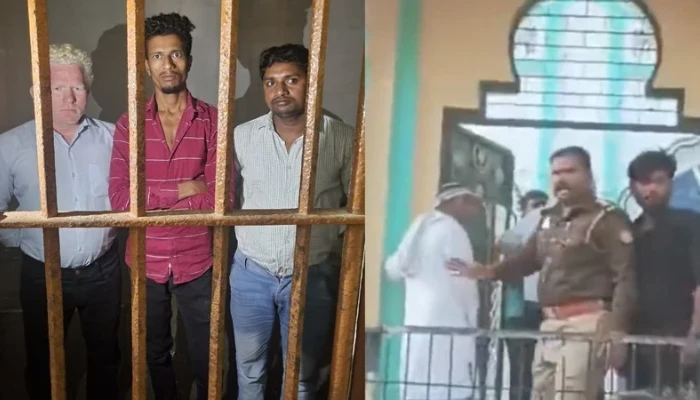
In Mahammadha village in Maharajganj, Uttar Pradesh, an idol immersion procession was stopped by a Muslim crowd near a mosque. Muslim men objected to the procession passing in front of the mosque and pressured the Hindu devotees to take another route. The incident escalated into communal tension, with both sides raising slogans. According to media reports, the incident occurred on 13th November 2023 in Mahammadha village under the Shyamdeurwan police station area of Maharajganj district. Hindu residents of the village had performed Lakshmi-Ganesh Puja during Diwali. Following the puja, devotees took the idols for immersion on a tractor-trolley in the evening. During the procession, the route passed by a mosque in the village. Some Muslims present at the mosque stopped the procession and objected to it passing along that route. They pressured the Hindu devotees to take a different route. This led to an argument, following which the atmosphere in the village became tense. According to reports, Muslims present inside the mosque began raising slogans, to which the Hindu devotees also responded by raising slogans. The situation escalated as crowds gathered at the spot. A video of the incident also circulated on social media, showing a crowd inside the mosque and Hindu devotees standing outside raising slogans of 'Har Har Mahadev' and 'Jai Shri Ram'. Several Muslim women were also visible on the rooftops of nearby buildings. Police personnel at the spot intervened and separated the two groups to prevent the situation from escalating further. Police forces from several police stations were called in, and additional personnel were deployed in the village to maintain law and order. The police registered a case based on a complaint from the organisers of the Lakshmi Puja and arrested three accused for attempting to disturb the peace. Further investigation and legal proceedings were underway. Superintendent of Police Dr Kaustubh stated that the situation was under control and that legal action was being taken against the accused.
Why it is Hate Crime ?
This case has been added to the tracker under the primary category: Attack not resulting in death. The subcategory selected is: Attack on religious procession. The outward celebration and display of religious symbols is an intrinsic part of Hinduism. Religious processions on various festivals are age-old traditions and a way to manifest faith and form a part of the religious practices of Hindus. On several occasions, such religious processions come under attack by non-Hindu mobs, in a manifestation of their animosity towards Hinduism and its practices. The reasons cited for such violent attacks are many and range from crossing a non-Hindu resident-dominated area to playing loud music, crossing from an area where there is a religious structure of another faith, etc. The violent attacks are triggered by the outward display of religiosity by Hindus. The attacks are mainly a manifestation of religious supremacist doctrine,e which believes that idolatry, essentially the Hindu faith, deserves to be annihilated, since the very tenets of Hinduism, its practices,s and traditions are considered a sin in those doctrines. Since these attacks emanate from intrinsic and doctrinal animosity towards Hindus and Hinduism, it is considered a religiously motivated hate crime under this category. The other subcategory selected: Attack against Hindu devotees. Hindu devotees are among the easiest targets of religiously motivated hate crimes because, during the festival/procession/puja, etc.c, for non-Hindus it is easy to profile them as victims based on religion. Hindu devotees come under attack on several occasions by individual non-Hindus or mobs of non-Hindus owing to their animosity against Hinduism, its symbols, and tradition/practices. There are several instances of Hindu devotees being attacked while they worship in temples or temporary religious structures, during religious processions, doing bhajan/kirtan/puja in their own homes, in the residential society, etc. These attacks are perpetrated by non-Hindus primarily because of their animosity towards Hindus and their faith. In some cases, the trigger for the violence may be non-religious; however, two elements make these hate crimes. First, the Hindus who come under attack are attacked violently while indulging in religious activity. Whether they are in a place of worship or not is immaterial to the crime. When individuals are attacked while indulging in religious practices, the attack in itself is a hindrance to their freedom to practice religion and therefore constitutes a hate crime. Secondly, religious supremacist doctrines and ideologies deem religious practices of Hindus to be offensive ab initio since they are considered “sinful” by these ideologies, worthy of being annihilated by force or coercion. Driven by these religious supremacist ideologies and doctrines, the attacks against Hindu devotees stem from intrinsic animosity towards Hinduism. In some cases, the trigger for the violence may be non-religious; however, it develops into a religiously motivated crime during the course of the violence. Since these attacks stem from animosity towards Hindus and Hinduism, they are considered religiously motivated hate crimes under this category. The other subcategory selected is: Attacked for crossing 'Muslim Area'. One of the reasons that Hindus get attacked unprovoked specifically by Islamists is for crossing ‘Muslim areas’. Essentially, Muslim mobs often attack Hindus crossing or present in certain areas which have a majority Muslim population. It has often been cited as one of the reasons to blame Hindus for attacks against themselves, signalling that Hindus displaying religious symbols, taking our religious processions, or crossing any area which is dominated by Muslim residents is a provocation in and of itself. These areas are mostly ghettoized areas where mobs mobilize quickly to attack Hindus for a variety of reasons,s like playing music during a religious procession, crossing a mosque, wearing a tilak or any other religious symbol in a Muslim-dominated area, praying at a local temple in that area, ea etc. There have been cases where the few local Hindus of that area have been attacked on their way to the Temple for prayers as well, simply because the area is considered a Muslim-dominated area. Several times, it is entirely possible that the immediate trigger for the violence against Hindus was non-religious in nature; however, the violence became religiously motivated in nature because the area was Muslim-dominated and the residents, on the whole, harboured animosity towards Hindus, as evidenced by the actions of the mob, the slogans, and the nature of the attack. Such crimes are motivated by the religious identity of the victims and are therefore classified as hate crimes under this category. The other subcategory selected is Communal Clash/Attack. Communal clash is a form of collective violence that involves clashes between groups belonging to different religious identities. For a communal clash between Hindus and non-Hindus to qualify as a religiously motivated hate crime, the trigger of the violence itself would have to be anti-Hindu in essence. For example, if there is a Hindu religious procession that comes under attack from a non-Hindu mob and, later, in retaliation for the initial attack, Hindus retaliate in self-defence, leading to a communal clash between the two religious communities. While at a later stage both communities are involved in the clash/violence, the initial trigger of the violence was by the non-Hindu mob against the Hindus, a nd therefore, it could safely be termed as anti-Hindu violence. Further, the trigger would also have to be religiously motivated. In the cited example, the attack by the non-Hindu mob was against religious processions and therefore can be concluded to be religiously motivated. In some cases, the trigger may be non-religious; however, it develops into religious violence against Hindus at a later stage. In such cases too, the foundational animosity towards Hindus becomes the motivating factor of the crime, and therefore, it would be classified as a religiously motivated hate crime against Hindus under this category. The second primary category selected is: Attack on Hindu religious representations. The subcategory selected is: Abrahamic religious chanting outside Hindu religious places and/or during Hindu activities. In Hinduism, a temple is the abode of the Deity. The Deity in the Temple is consecrated, thereby making it a real, breathing entity. Hindus believe that not just the Deity but the temple premises itself are sacred to Hindus since Hindus hold the faith that the entire Temple space is an amalgamation of the divine energy of the deity. Similarly, religious activities hold deep significance for Hindus, as they are intricately connected to their spiritual, cultural, and social lives. These practices encompass rituals, festivals, prayers, and pilgrimages that celebrate and honour various deities, fostering a sense of spiritual connection, community, and cultural continuity. Given the central significance of Temples and religious activities in Hindu Dharma, any aggressive Abrahamic chanting outside Temples or during religious activities negates the divinity of the religious space because the chanting itself negates the existence of any God other than the God of the Abrahamic faith. Such chanting is specifically done to negate the faith of Hindus, establish religious supremacy, intimidate the devotees, and mock the faith. Besides temples, such Abrahamic chanting outside any Hindu place of worship or religious structure,e or during any religious activity, has the same effect. Since such acts are rooted in an inherent religious supremacist mentality driven by religious animosity, such crimes would be considered religiously motivated hate crimes under this category. This incident reflected a clear case of religious hostility directed towards Hindus for practising their faith. Hindu devotees were peacefully carrying out the traditional procession for idol immersion following Diwali celebrations, having worshipped Goddess Lakshmi and Lord Ganesha. They were simply performing their religious rituals without disturbing anyone when Muslims stopped the procession near a mosque and pressured them to take another route. It is important to note that the procession was passing along a public village route and did not enter the mosque premises or trespass onto its property. The devotees were following the customary route for their religious procession when they approached the mosque. Despite this, they were stopped and pressured to take another route. Objecting to a peaceful Hindu religious procession on a public road, where devotees were neither entering religious premises nor disturbing anyone, reflected an unreasonable and exclusionary attitude towards the public expression of Hindu faith. This expressed that Hindus were treated as unwelcome and subject to the approval of members of another religious community. The attempt to obstruct the procession was an expression of religious intolerance and an assertion of control over Hindu religious observances. The immersion procession holds deep religious significance for the Hindu devotees. The idols of Goddess Lakshmi and Lord Ganesha had been worshipped during Diwali, and their immersion marked the conclusion of the religious observance. Such rituals are an integral part of Hindu worship and carry profound devotional and cultural significance. Obstructing devotees from carrying out this sacred practice was therefore not merely a dispute over a route; it interfered with their freedom to observe their religious traditions. Particularly disturbing was the raising of provocative slogans during the confrontation. Instead of allowing Hindu devotees to peacefully complete their religious observance, the situation was aggravated through provocative sloganeering from the mosque. Such slogans in the middle of a religious procession created an atmosphere of intimidation and hostility. Further, the fact that Hindus celebrating their festival and carrying out a customary religious ritual became the occasion for confrontation exposed the deep intolerance directed towards the public expression of Hindu faith. It reflected a disturbing mindset in which even the peaceful celebration of a Hindu festival was treated as a provocation. The incident also highlighted an attempt to impose religious restrictions on the movement and religious expression of Hindus in a shared public space. A mosque could not become a ground for dictating the route of a Hindu religious procession or determining how Hindus observed their festivals. Such demands reflected an exclusionary sense of religious entitlement in which Hindu devotees were expected to alter their customary practices to accommodate the objections of another community. The incident was not simply a disagreement over public movement; it involved interference with a Hindu religious observance and the creation of a hostile environment around it. Here, it is important to note that the attack on the Hindu devotees was an unprovoked one. The trigger for the attack was the Hindu's participation in a religious activity. It was only after the Muslim reacted and resorted to communally charged sloganeering that members of the Hindu community retaliated by chanting 'Har Har Mahadev' and 'Jai Shri Ram'. They did not start the provocation. The Hindus acted merely in reprisal, leading to the communal clash. Given these circumstances, the incident was included in the Hinduphobia Tracker as an instance of religiously motivated hostility targeting Hindus for practising their faith.


Case Status
Arrested


Perpetrators Details
Perpetrators
Muslim Extremists
Perpetrators Range
Unknown
Perpetrators Gender
male
 Sources



