Centuries-old idol of Hindu goddess vandalised, shattered into ten pieces in Jaunpur, Uttar Pradesh
 Jaunpur, Uttar Pradesh, India
 16 November, 2026
Case Summary
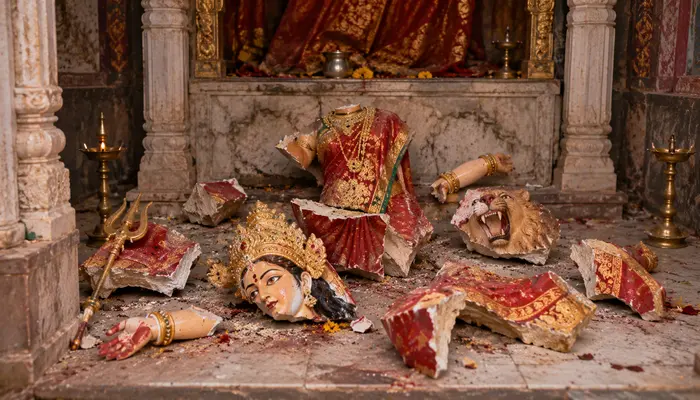
In Jaunpur, Uttar Pradesh, a centuries-old idol of the Hindu goddess Maa Kathia Bhavani was vandalised by unidentified miscreants. The idol was severely damaged, shattered into around ten pieces, and its fragments were scattered at different locations. According to media reports, the incident occurred in Hathera village, under Madiyahu tehsil of Jaunpur, and came to light on the morning of 17 November 2026, when villagers discovered the damaged idol. The idol had been installed beside the Jamalpur-Babatpur link road, near the Ram-Janaki Temple. Upon discovering the desecration, villagers alerted the police through the 112 Police Response Vehicle (PRV) emergency helpline. The Police Response Vehicle (PRV) team reached the spot, inspected the scene and informed Nevdhiya police station. Sub-inspector Rajesh Yadav subsequently arrived with a police team and gathered information from villagers. Police collected all the scattered fragments of Maa Kathia Bhavani's idol and secured them. The sub-inspector told villagers that a replacement idol could be brought and installed and asked them to submit a written complaint for registration of a case. The incident sparked anger among Hindu villagers, who demanded that those responsible be identified and arrested and called for strict legal action against the perpetrators. They also sought the reinstallation of Maa Kathia Bhavani's idol in accordance with Hindu religious rituals. At the time of the report, no formal complaint had been submitted. Acting station in-charge SI Rajesh Yadav stated that the idol had been broken and damaged and that further action would be taken upon receipt of a complaint. Nevdhiya police were investigating the incident. Several villagers, including Anil alias Lalu Prajapati, Rajan Prajapati, Havaldar Prajapati, Rajaram Kanojia, Dr Dayaram Prajapati, Kishan Prajapati, Ravi Patel (Pradhanpati) and Golu Singh, were present at the site following the incident.
Why it is Hate Crime ?
The primary category selected in this case is: Attack on Hindu religious representations. The subcategory selected is: Desecration of Hindu religious symbols. Icons and symbols, or religious representations of a spiritual ideal, are widely revered in Hinduism. Iconography is of vital significance in the Hindu milieu. It helps connect people’s spiritual beliefs with the real world. Iconography within the Hindu faith takes several shapes and forms. Murtis are of most significance to Hindus, to which daily rituals, prayers, and offerings are done. Besides the murtis, there are several other symbols which have deep significance in the Hindu faith – the Om and Swastika for example. Since these Hindu religious symbols hold paramount importance in Hinduism, any desecration of symbols, icons, murtis, religious representations and manifestations, is driven by animosity towards the faith itself which manifests itself through these murtis, icons and symbols. Therefore, any desecration of these Hindu religious symbols and representations is considered religiously motivated hate crimes under this category. This incident is a clear example of a religiously driven offence, as the perpetrators vandalised a sacred idol of a revered Hindu goddess, Kathia Bhavani. In Hinduism, idols (murtis) are consecrated representations of deities and serve as focal points of worship, prayer and devotional communion. Through rituals such as prana pratishtha (consecration), the divine presence of deities is invoked into the murti, which devotees subsequently revere, offer prayers to and approach for blessings. They are therefore not mere physical objects but hold profound spiritual and religious significance. Therefore, vandalising these idols amounted to the desecration of sacred Hindu religious symbols, deeply hurting the religious sentiments of devotees and reflecting contempt for Hindu faith and worship practices. The manner of desecration, with the centuries-old idol smashed into around ten pieces and its fragments scattered across different locations, points to deliberate destruction rather than an accidental mishap. The extent of damage inflicted on a sacred Hindu symbol reflects a conscious act of desecration, demonstrating disregard for its religious sanctity and exposing the depth of hostility towards Hindu faith and worship. At the time of documentation, the perpetrator's identity and religious affiliation remained unknown. Nevertheless, the act committed showcased hostility towards Hinduism and its sacred representations. Therefore, this case is being added to the hate crime database of the tracker. Disclaimer: Hinduphobia Tracker records incident dates based on when the crime occurred, rather than when it was reported in the media. In this case, the exact date of the desecration remains unknown; however, the incident was discovered on 17 November 2026, as stated in the media report. Therefore, 17 November 2026 is being assigned as the indicative incident date for documentation purposes only.


Case Status
Complaint registered


Perpetrators Details
Perpetrators
Unknown
Perpetrators Range
Unknown
Perpetrators Gender
unknown
 Sources



