Hindu woman humiliated for refusing to eat cow meat by Muslim man; told to leave Bangladesh and go to India
 Bangladesh
 17 November, 2026

Case Summary
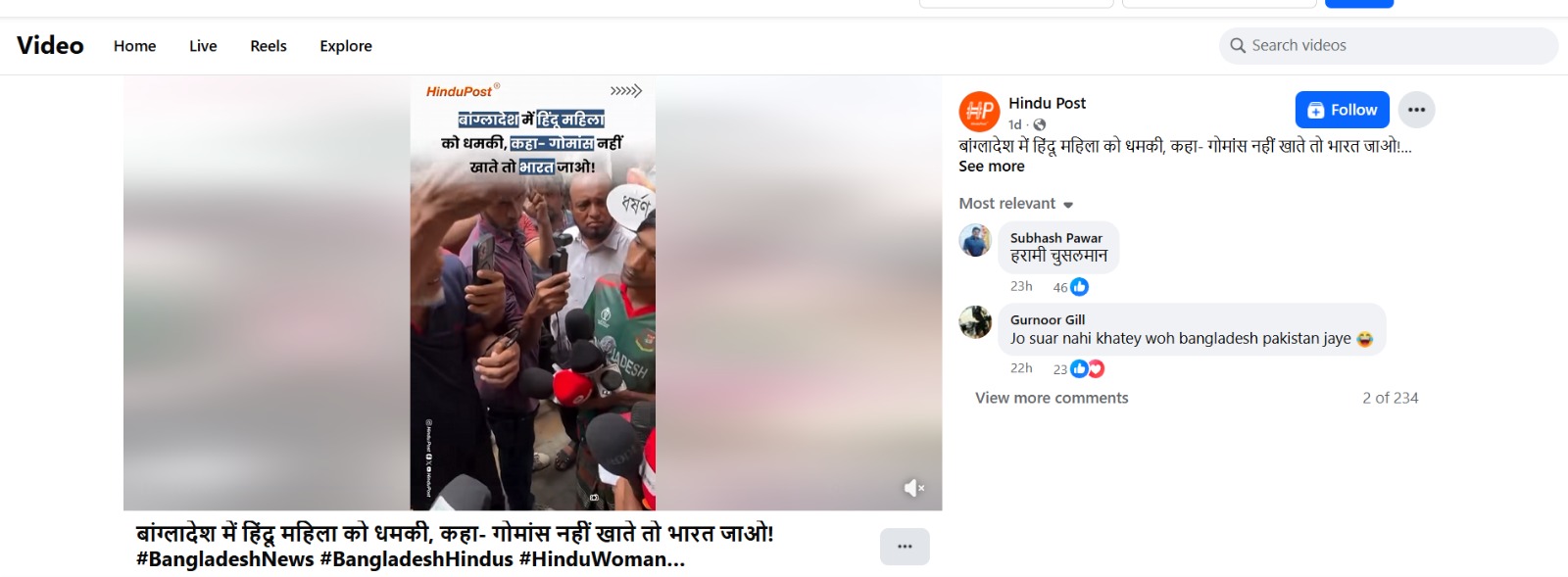
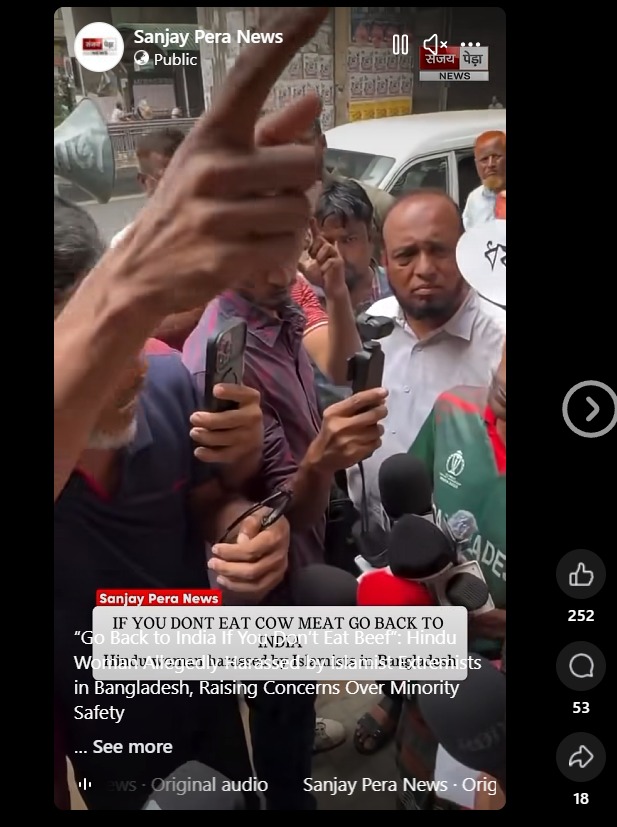
A Hindu woman was humiliated for refusing to eat cow meat by a Muslim man who told her to leave Bangladesh and go to India. The incident came to light after an undated video from Bangladesh went viral on social media, showing a heated argument between a Hindu woman and a Muslim man in front of several media personnel. During the exchange, the Hindu woman stated that they were Hindus and did not eat cow meat. In response, the Muslim man told her that if she could not eat cow meat, she should go to India. The woman objected to this remark, asserting that Bangladesh is the land of the Bengalis and that they, as Bangladeshis, belonged there, referring to it as "Bongobhumi". This incident occurred against the broader backdrop of the historical persecution faced by Hindus in Bangladesh. While the Hindu minority has endured discrimination, targeted violence, and religious hostility over decades, such persecution has intensified in distinct spurts during periods of political and social instability. The latest major escalation began after the ouster of Sheikh Hasina’s government in August 2024, continued after the death of Sharif Osman Bin Hadi in December 2025, and resurfaced in the immediate aftermath of the 13th National Parliamentary Election in 2026. Following the ouster of Sheikh Hasina, multiple incidents involving attacks on Hindu homes, temples and religious institutions were documented, alongside intimidation, arson and mob violence targeting Hindu localities. The Hinduphobia Tracker recorded 336 incidents involving the Hindu minority during this period, reflecting the scale of the escalation and the continuing vulnerability of Hindus in Bangladesh. A further spurt of violence followed the death of Sharif Osman Bin Hadi, a Muslim political activist and student leader known for his anti-Hindu and anti-India rhetoric, in December 2025. In the aftermath, Hindu communities were subjected to retaliatory violence, with Hindu homes and properties selectively attacked and several families forced to flee. Among the victims was Dipu Chandra Das, who was lynched by a Muslim mob over false blasphemy allegations, after which his body was set ablaze. The Hinduphobia Tracker documented 51 incidents of anti-Hindu violence in the period following Hadi’s death alone, further illustrating how existing hostility towards the Hindu minority intensified during moments of communal mobilisation. During the same period, posters and written material calling for the extermination of Hindus were also displayed in public spaces. Such rhetoric, when viewed alongside incidents of arson, vandalism, assault and targeted intimidation, reflected an environment in which hostility towards Hindus was not merely episodic but repeatedly resurfaced in more intense forms during periods of unrest. The most recent escalation followed the 13th National Parliamentary Election in 2026. In the immediate aftermath of the election results, Hindu families in districts including Noakhali, Rangpur, Nilphamari, Sylhet, Thakurgaon and Dinajpur faced attacks involving arson, looting, assault and vandalism of Hindu homes and temples. In several instances, Hindu properties were selectively targeted, and families were threatened with displacement. The present incident therefore occurred within a much longer history of persecution of Hindus in Bangladesh, where hostility towards the community has persisted over time and intensified in repeated spurts. The latest cycle began after the ouster of Sheikh Hasina and continued through subsequent periods of political and communal upheaval, leaving the Hindu minority increasingly vulnerable to targeted violence, intimidation and religious hostility.
Case Images
Why it is Hate Crime ?
This case has been added to the tracker under the primary category of - Hate speech against Hindus. Within it, the sub-category selected here is - Anti-Hindu slurs, mocking faith. Anti-Hindu slurs and the deliberate mocking of the Hindu faith owing to religious animosity involve the usage of derogatory terms, stereotypes, or offensive references to religious practices, symbols, or figures. One of the common anti-Hindu slurs used against Hindus is “cow-worshipper” and “cow piss drinker”. The intention of using this term is to demean and mock Hindus as a group and their religious beliefs since Hindus consider the cow holy. Additionally, some symbols and the slurs attached to them have a historical context that exacerbates the insult, hate, stereotyping, dehumanisation and oppression against Hindus. Cow worship has been used for centuries to denigrate Hindus, insult their faith and oppress Hindus specifically as a religious group. There has been overwhelming documentation about how cow slaughter has been used to persecute Hindus with cow meat being thrown in temples and places of worship. There has also been overwhelming documentation where cow meat (beef) has been force-fed to Hindus to either forcefully convert them to Islam or denigrate their faith. Apart from cow worship, the Swastika – which holds deep religious significance for the Hindus – has also been misinterpreted and distorted to use as a slur against Hindus. Similarly, the worship of the Shivling has been used by supremacist ideologies and religions to denigrate Hindus owing to religious animosity. Such slurs and denigration stem out of inherent animosity and hate towards Hindus and their faith, therefore, it is categorised as hate speech targeted at Hindus specifically owing to their religious identity. The second primary category selected here is - Attack not resulting in death. Within it, the sub-category selected here is - Attacked for Hindu identity. In several cases, Hindus are attacked merely for their Hindu identity without any perceived provocation. A classic example of this category of religiously motivated hate crime is a murder in 2016. 7 ISIS terrorists were convicted for shooting a school principal in Kanpur because they got ‘triggered’ seeing the Kalava on his wrist and tilak that he had put. In this, the Hindu victim had offered no provocation except for his Hindu religious identity. The motivation for the murder was purely religious, driven by religious supremacy. Such cases where Hindus are targeted merely for their religious identity would be documented as a hate crime under this category. The incident constituted an instance of religiously motivated hostility towards Hindus, as the Hindu woman's religious identity and adherence to Hindu dietary practices became the basis for questioning her right to belong in Bangladesh. The Muslim man's response went beyond a disagreement over food habits and directly targeted the woman's religious identity by making her refusal to consume cow meat a reason for her to leave the country. This reflected an exclusionary attitude in which Hindus were treated as outsiders whose right to live in their own homeland was conditional upon abandoning or compromising practices associated with their faith. The cow holds a deeply revered position in Hinduism and was regarded as sacred by Hindus, symbolising nourishment, motherhood and selfless giving. In the Vedas, the cow is described as 'Aghnya', a Sanskrit term meaning 'that which must not be killed', reflecting the religious injunction against harming or slaughtering the animal. Cow protection and abstention from beef consumption hold deep religious and cultural significance for Hindus. For Hindus, consuming beef constitutes a serious religious transgression that violates sacred traditions and principles of faith. Therefore, asking a Hindu woman to eat cow meat demonstrated deep-seated religious hostility and a deliberate disregard for Hindu beliefs. The act showcased hostility towards Hinduism and a blatant disregard for the religious sentiments of the Hindu community. Historical accounts of religious persecution documented several instances in which Hindus were subjected to forced or deceptive consumption of beef by Muslim extremists, with the intention of violating their religious convictions, desecrating their sacred customs and weakening their religious identity. Such practices were also used to alienate individuals from their religious and cultural roots and make them more vulnerable to religious conversion. The underlying objective was to use the violation of deeply held religious beliefs as a means of religious humiliation and coercion. The targeting was particularly significant because the woman's refusal to eat cow meat was an expression of her religious beliefs and cultural identity. Rather than respecting this distinction, the Muslim man used it to subject her to humiliation and question her national belonging. His demand that she go to India reinforced the idea that Hindus who maintained their religious practices did not belong in Bangladesh, despite being Bangladeshi citizens and an integral part of the country's population. Such rhetoric effectively sought to equate Hindu religious identity with foreignness and deny Hindus their rightful place in their own country. The woman's assertion of Bongobhumi was also significant, as she challenged this exclusionary treatment and affirmed the right of Bengali Hindus to belong to Bangladesh without having to compromise their religious identity. The incident therefore reflected religious discrimination through the denial of national belonging, with the woman's Hindu identity serving as the basis for hostility and humiliation. The explicit connection between her religious dietary practice and the demand that she leave the country provided a clear indication of religiously targeted hostility, making the incident a case of hate speech and humiliation directed against a Hindu woman. Disclaimer: The Hinduphobia Tracker records incidents based on when an event occurred or when the victim's ordeal began. It is important to clarify that none of the media sources covering this case has specified the exact date when the incident occurred. Therefore, for documentation purposes, we have recorded the date based on when the incident was reported in the media, 18 November 2026.
Victim Details
Total Victim
1
Deceased
0
Gender
- Male 0
- Female 1
- Third Gender 0
- Unknown 0
Caste
- SC/ST 0
- OBC 0
- General 0
- Unknown 1
Age Group
- Minor 0
- Adult 1
- Senior Citizen 0
- Unknown 0


Case Status
Unknown


Perpetrators Details
Perpetrators
Muslim Extremists
Perpetrators Range
One Person
Perpetrators Gender
male
 Sources



