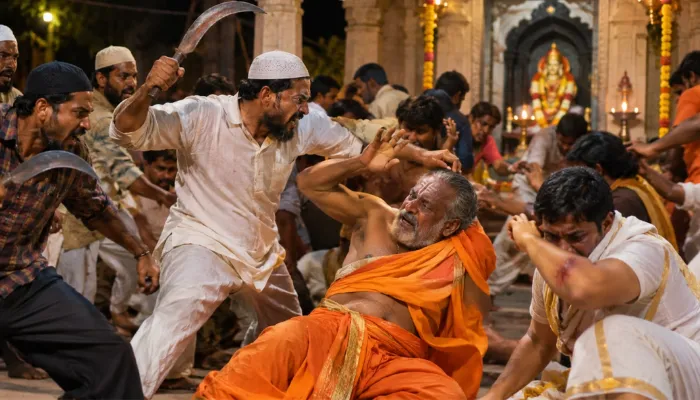
Hindu priests and devotees assaulted by Muslim men while celebrating Diwali at Kanifnath Temple in Ahilya Nagar, Maharashtra
 Rahuri, Maharashtra, India
 12 November, 2023
Case Summary
In Guha village of Rahuri tehsil, Ahilya Nagar, Maharashtra, Hindu monks and devotees were assaulted by muslim men inside the Kanifnath Temple on Deepawali Amavasya. On 13 November 2023, the Hindu gathering had assembled at the temple for bhajan-kirtan as part of the Deepawali Amavasya when a group of Muslim men armed with sickles attacked the premises and those participating in the traditional bhajan-kirtan. The Muslim attackers assaulted the Hindu priest and devotees inside the temple, and objected to the religious prayers, creating chaos at the place of worship. The attack interrupted the religious gathering and left several devotees injured while worship was taking place. Raju Shaikh, Razzak Sattar, Nasir, and Ibrahim were identified as the men leading the attack. The violence resulted in injuries to at least four people. The incident was also captured on video, showing the assault on the priest and other devotees inside the temple. The attack took place amid a longstanding dispute between the Hindu and Muslim sides over the land on which the Kanifnath Temple stands. The temple site had been the subject of legal proceedings before the local court and the Collector. The Hindu side had maintained that it should be permitted to conduct regular worship at the temple and had approached the administration for permission. The Tehsildar had granted permission for the Hindu side to conduct worship at the site. Police reached the spot following the violence and initiated action against those involved. The Sub-Divisional Police Officer of the Srirampur range said police had apprehended seven suspects and registered two FIRs in connection with the incident. The first FIR named 62 persons and invoked Sections 324, 323, 153A, 296, 143, 147, 148, 504 and 506 of the Indian Penal Code along with Section 4(25) of the Arms Act. Police also registered a second FIR in connection with the incident, naming 62 persons under Sections 143, 147, 324, 504, 506 and 427 of the Indian Penal Code. The registration of cases under provisions relating to voluntarily causing hurt with dangerous weapons, rioting, unlawful assembly, disturbing a religious assembly, promoting enmity between groups on religious grounds, criminal intimidation, and intentional insult reflected the seriousness of the violence that occurred during the Hindu religious gathering.
Why it is Hate Crime ?
The primary category selected in this case is: Attack not resulting in death. The subcategory selected is: Attack against Hindu devotees. Hindu devotees are a few of the easiest targets of religiously motivated hate crimes because during the festival/procession/puja etc, for non-Hindus it is easy to profile their victims on the basis of religion. Hindu devotees come under attack on several occasions by individual non-Hindus or mobs of non-Hindus owing to their animosity against Hinduism, its symbols and tradition/practices. There are several instances of Hindu devotees being attacked while they worship in temples or temporary religious structures, during religious processions, doing bhajan/kirtan/puja in their own homes, in the residential society etc. These attacks are perpetrated by non-Hindus primarily because of their animosity towards Hindus and their faith. In some cases, the trigger for the violence may be non-religious, however, there are two elements that make these hate crimes. First, the Hindus who come under attack are attacked violently while indulging in religious activity. Whether they are in a place of worship or not is immaterial to the crime. When individuals are attacked while indulging in religious practices, the attack in itself is a hindrance to their freedom to practice religion and therefore constitutes a hate crime. Secondly, religious supremacist doctrines and ideologies deem religious practices of Hindus to be offensive ab initio since they are considered “sinful” by these ideologies, worthy to be annihilated by force or coercion. Driven by these religious supremacist ideologies and doctrines, the attacks against Hindu devotees stem from intrinsic animosity towards Hinduism. In some cases, the trigger for the violence may be non-religious, however, it develops into a religiously motivated crime during the course of the violence. Since these attacks stem from animosity towards Hindus and Hinduism, they are considered religiously motivated hate crimes under this category. The religious motivation behind the attack is reflected in the deliberate targeting of Hindu devotees while they were engaged in worship inside the Kanifnath Temple. The attackers objected to the bhajan-kirtan and assaulted the priest and devotees, directly interfering with a Hindu religious gathering. Bhajan-kirtan is an important form of Hindu devotional worship, through which devotees sing hymns in praise of deities and express their faith. Targeting people for participating in these prayers demonstrates hostility towards their religious practices and their right to worship. The timing of the attack makes it particularly significant. The devotees had gathered on Deepawali Amavasya, the day of Diwali, one of the most sacred occasions in the Hindu calendar. Diwali is marked by prayers, worship and devotional celebrations, and for many Hindus, the day holds deep religious significance. Attacking devotees during a Hindu religious observance, objecting to their prayers and disrupting their gathering inside a temple added a clear religious dimension to the violence. It also deprived the devotees of the opportunity to observe the festival peacefully. The longstanding dispute over the land on which the temple stands does not explain away the attack's religious nature. The Hindu side approached the authorities for permission to conduct worship, and the Tehsildar granted it. The violence was directed at people exercising that right and participating in religious activities. The use of sickles and the assault on the priest and devotees inside the temple turned the place of worship into a site of intimidation and violence. Such attacks create fear among the Hindu community and undermine its ability to maintain and use its religious spaces. The central issue here is not merely a dispute over temple land. It is the assault on Hindu devotees for engaging in religious worship, on one of the most important days in their religious calendar, inside a Hindu temple. The objection to bhajan-kirtan and the violence against those participating in it reflect hostility towards Hindu religious expression. The incident therefore constitutes an attack on Hindu religious practices and the right of Hindus to worship without fear or intimidation.


Case Status
Complaint registered


Perpetrators Details
Perpetrators
Muslim Extremists
Perpetrators Range
Unknown
Perpetrators Gender
male
 Sources



