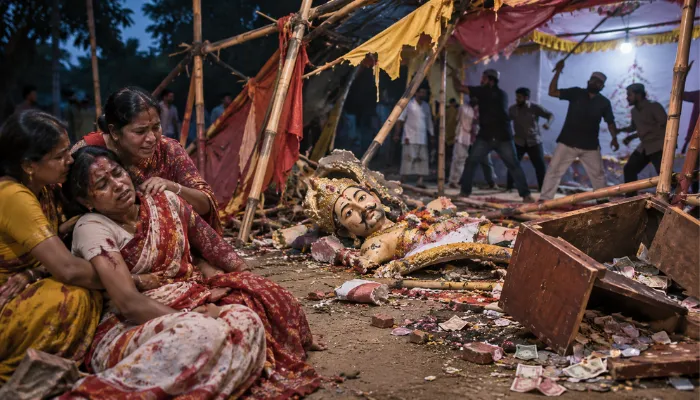
Kali Puja mandap in Noakhali attacked; three women injured, idol damaged and donation box looted
 Noakhali District, Bangladesh
 10 November, 2023
Case Summary
On 11 November 2023 in Karimpur, Noakhali, Bangladesh, a temporary Hindu puja mandap at the 26-year-old Joy Shiva Rabi Das Sangha Kali Mandir was attacked by a group led by resident Sheikh Selim. The temple, also known as Karimpur Kali Mandir, regularly hosts Kali Puja, Saraswati Puja and Vishwakarma Puja. The Hindu cobbler community residing near the Karimpur Petrol Pump area, locally known as Muchipara, had lived on the government khas land and performed religious rituals there for a long time. Before the attack, Sheikh Selim, aged around 50, had repeatedly created disputes whenever religious celebrations were organised at the mandap. He had been asserting ownership over the temple land and threatened residents against setting up the mandap for Kali Puja. On Saturday evening, when no men were present at the puja mandap, a group led by Selim attacked the premises. Ganesh Rabi Das, president of the Karimpur Kali Mandir, said the attackers numbered about 30–35, while The Daily Star put the group at around 20–25. The attack took place between approximately 6:00 PM and 8:00 PM. Three Hindu women identified as Alo Rani, Lakshmi Rani Das and Lakshmi Rani were injured in the assault. The attackers damaged the religious installations, broke an idol, vandalised an unfinished pandal and looted the donation box and materials used for the idols. The temple committee's account identified the broken idol as that of Bhagwan Vishwakarma, while The Daily Star described the idol of Goddess Kali as desecrated. The attackers also damaged a pandal pillar. Following the attack, local members of the Hindu community blocked the Karimpur–Ganipur road in Ward No. 5 of Chaumuhani Municipality and staged a protest for approximately half an hour. Police and Rapid Action Battalion (RAB) personnel arrived and brought the situation under control. Begumganj Upazila Nirbahi Officer Yasir Arafat also visited the site with police and RAB personnel and directed the police to arrest those responsible. On Saturday night, mandap attendant Alo Rabi Das filed a case at Begumganj Model Police Station. The case listed Sheikh Selim and two other persons as named accused, along with 20 unidentified persons. The case was registered under charges concerning religious desecration, attacking the puja mandap and insulting religion. Begumganj Police Station Officer-in-Charge Md. Anwarul Islam confirmed the case registration, while Officer-in-Charge (Investigation) Faridul Alam said the situation had returned to normal. Police were attempting to arrest the accused, and Selim remained on the run after the incident. The police described the matter as a dispute between two parties over ownership of government khas land. Officer-in-Charge Anwarul Islam said two people approached the site during the pandal's construction and claimed ownership of the land, disturbing one of its pillars. Additional Superintendent of Police Nazmul Hasan Rajib stated that the Hindu community had not obtained permission to organise the puja mandap on the disputed government land, and that the matter would be investigated before legal action was taken. The persecution of Hindus in Bangladesh has deep historical roots, with the community facing repeated episodes of communal violence, intimidation, attacks on religious institutions, land grabbing and displacement. However, the situation has become particularly alarming following the ouster of Sheikh Hasina in August 2024, when a fresh wave of attacks targeted Hindu homes, businesses, individuals and places of worship across the country. Temples have been vandalised, deities desecrated, and Hindu families subjected to violence and intimidation, reinforcing the insecurity of an already vulnerable minority. These incidents are not isolated from the wider history of anti-Hindu persecution in Bangladesh. They reflect a continuing pattern in which Hindus are targeted on account of their religious identity, while their places of worship and cultural institutions remain vulnerable to hostility and destruction.
Why it is Hate Crime ?
The primary category selected for this case is: Attack on Hindu religious representations. The subcategory selected is: Desecration of Hindu religious symbols. Icons and symbols or a religious representation of a spiritual ideal are widely revered in Hinduism. Iconography is of vital significance in the Hindu milieu. It helps connect people’s spiritual beliefs with the real world. Iconography within the Hindu faith takes several shapes and forms. Murtis are of most significance to Hindus, to which daily rituals, prayers and offerings are done. Besides the murtis, there are several other symbols which have deep significance in the Hindu faith – the Om and Swastika for example. Since these Hindu religious symbols hold paramount importance in Hinduism, any desecration of symbols, icons, murtis, religious representations and manifestations, is driven by animosity towards the faith itself which manifests itself through these murtis, icons and symbols. Therefore, any desecration of these Hindu religious symbols and representations is considered religiously motivated hate crimes under this category. The next subcategory selected is: Defiling religious customs. Sanatan Dharma is not a religion of one book, which is to say that while it has religious scriptures that form the central tenets of the faith, there are several traditions followed through thousands of years, mostly passed from generation to generation orally. There are several such customs and traditions that are followed by various Hindus and Hindu sects. Defiling of these traditions and customs is a breach of an individual or group’s religious practices. Such practices can range from dietary restrictions like not eating non-vegetarian food for a certain period of the year, not eating non-vegetarian food at all, not eating beef since the cow is considered holy in Hinduism, the sanctity of religious customs followed in the house (like many ISCKON devotees), etc. Any malicious action leading to the breach of such traditions or defilement of these traditions owing to animosity towards the faith or for the sake of activism stems not only from the lack of faith in the religion itself but also from disregard for the faith of the devotees who follow the customs/traditions and implicit bias against the faith, the tradition itself. Since these specific traditions are central to the faith of the devotees of that specific sect of Hindus, any non-compliance with these traditional rules would be considered a religiously motivated hate crime. The next primary category selected for this case is: Attack not resulting in death. The subcategory selected is: Attack against Hindu devotees. Hindu devotees are a few of the easiest targets of religiously motivated hate crimes because during the festival/procession/puja etc, for non-Hindus it is easy to profile their victims on the basis of religion. Hindu devotees come under attack on several occasions by individual non-Hindus or mobs of non-Hindus owing to their animosity against Hinduism, its symbols and tradition/practices. There are several instances of Hindu devotees being attacked while they worship in temples or temporary religious structures, during religious processions, doing bhajan/kirtan/puja in their own homes, in the residential society etc. These attacks are perpetrated by non-Hindus primarily because of their animosity towards Hindus and their faith. In some cases, the trigger for the violence may be non-religious, however, there are two elements that make these hate crimes. First, the Hindus who come under attack are attacked violently while indulging in religious activity. Whether they are in a place of worship or not is immaterial to the crime. When individuals are attacked while indulging in religious practices, the attack in itself is a hindrance to their freedom to practice religion and therefore constitutes a hate crime. Secondly, religious supremacist doctrines and ideologies deem religious practices of Hindus to be offensive ab initio since they are considered “sinful” by these ideologies, worthy to be annihilated by force or coercion. Driven by these religious supremacist ideologies and doctrines, the attacks against Hindu devotees stem from intrinsic animosity towards Hinduism. In some cases, the trigger for the violence may be non-religious, however, it develops into a religiously motivated crime during the course of the violence. Since these attacks stem from animosity towards Hindus and Hinduism, they are considered religiously motivated hate crimes under this category. The religious motivation behind this attack is reflected in the repeated hostility towards Hindu religious celebrations and the targeting of a place where the local Hindu community gathered to practise its faith. Sheikh Selim had reportedly objected whenever religious festivities were organised at the mandap and had threatened residents against setting it up for Kali Puja. This pattern of interference goes beyond a disagreement over land. It demonstrates hostility towards the community's religious activities and its right to maintain a space for worship. The desecration of Hindu religious representations makes the nature of the targeting particularly significant. An idol is not merely an object placed at a temporary structure. It is an object of devotion and an integral part of Hindu worship. Damaging an idol, vandalising the puja mandap and destroying the arrangements made for religious ceremonies strikes at the faith and religious sentiments of the devotees. The targeting of the mandap also affects the wider Hindu community, for whom it serves as a shared space to observe festivals and perform religious rituals. The fact that the Hindu cobbler community had been practising its religious traditions at this location for years further highlights the significance of the attack. Their ability to organise worship and celebrate Hindu festivals was met with repeated objections, threats and ultimately violence. The assault on women devotees and the destruction of religious installations created an atmosphere of fear around the community's religious life. A dispute over land cannot be separated from the pattern of hostility directed at the mandap whenever Hindus attempted to organise religious celebrations there. This incident also needs to be viewed against the longer history of persecution faced by Hindus in Bangladesh. The community has repeatedly experienced communal violence, intimidation, attacks on temples, desecration of deities, land grabbing and displacement. The ouster of Sheikh Hasina in August 2024 was followed by a renewed wave of attacks on Hindu individuals, homes, businesses and places of worship, further deepening the insecurity of this minority. The attack on the Karimpur Kali Mandir reflects the wider vulnerability of Hindu religious spaces and the hostility that communities can face simply for seeking to preserve and practise their faith. The targeting of the puja mandap, repeated objections to Hindu religious celebrations and desecration of Hindu religious representations make this an instance of hostility directed at the religious identity and practices of the Hindu community. The incident is therefore being included in the Hinduphobia Tracker. Disclaimer: The perpetrator count remains at 23, as the FIR named three known individuals and 20 unidentified individuals.
Victim Details
Total Victim
3
Deceased
0
Gender
- Male 0
- Female 3
- Third Gender 0
- Unknown 0
Caste
- SC/ST 0
- OBC 0
- General 0
- Unknown 3
Age Group
- Minor 0
- Adult 3
- Senior Citizen 0
- Unknown 0


Case Status
Arrested


Perpetrators Details
Perpetrators
Muslim Extremists
Perpetrators Range
From 10 to 100
Perpetrators Gender
male
 Sources



