Kali Puja idol immersion procession targeted, Hindu devotees attacked with sticks and rods in Darbhanga, Bihar
 Darbhanga, Bihar, India
 14 November, 2026
Case Summary
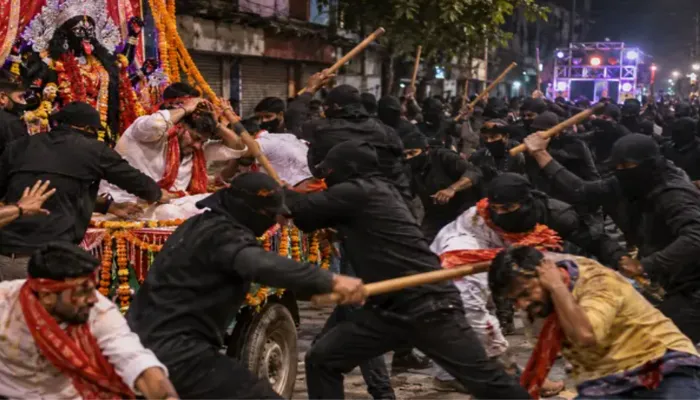
In Kaligaon, Darbhanga, Bihar, a Kali Puja idol immersion procession was attacked by a group of armed, unidentified miscreants. The incident took place on 15 November 2026, Sunday night, under the Singhwada police station's jurisdiction, when the immersion procession was passing through Dada Chowk. Unidentified miscreants from the same village attacked the procession with sticks and rods, triggering a violent clash and causing chaos and a stampede among the devotees. Devotees and villagers present at the nearby Chhath Ghat at Rambabu Talab were also frightened as the violence unfolded. Four injured persons, identified as Pratik Jha, Gaurav Jha, Mayank Jha and Pawan Ram, were admitted to Singhwada Community Health Centre (CHC) for treatment. Around six other people were also injured and received treatment locally. The attack disrupted the Kali Puja idol immersion procession and caused panic among Hindu devotees participating in the religious ceremony. The incident was particularly concerning as the procession had faced a similar attack the previous year. One side stated that the earlier incident had been resolved through a community council, yet the Kali Puja immersion procession was targeted again during the latest incident.
Why it is Hate Crime ?
This case is being added to the tracker under the primary category: Attack not resulting in death. The subcategory selected is: Attack on religious procession. The outward celebration and display of religious symbols in an intrinsic part of Hinduism. Religious processions on various festivals are age-old traditions and a way to manifest faith and form a part of the religious practices of Hindus. On several occasions, such religious processions come under attack by non-Hindu mobs, in a manifestation of their animosity towards Hinduism and their practices. The reasons cited for such violent attacks are many and range from crossing a non-Hindu resident-dominated area to playing loud music, crossing from an area where there is a religious structure of another faith etc. The violent attacks are triggered by the outward display of religiosity by Hindus. The attacks are mainly a manifestation of religious supremacist doctrine which believes that idolatry, essentially the Hindu faith, is one that deserves to be annihilated since the very tenets of Hinduism, its practices and traditions are considered a sin in those doctrines. Since these attacks emanate from intrinsic and doctrinal animosity towards Hindus and Hinduism, it is considered a religiously motivated hate crime under this category. The other subcategory selected is: Attack against Hindu devotees. Hindu devotees are a few of the easiest targets of religiously motivated hate crimes because during the festival/procession/puja etc, for non-Hindus it is easy to profile their victims on the basis of religion. Hindu devotees come under attack on several occasions by individual non-Hindus or mobs of non-Hindus owing to their animosity against Hinduism, its symbols and tradition/practices. There are several instances of Hindu devotees being attacked while they worship in temples or temporary religious structures, during religious processions, doing bhajan/kirtan/puja in their own homes, in the residential society etc. These attacks are perpetrated by non-Hindus primarily because of their animosity towards Hindus and their faith. In some cases, the trigger for the violence may be non-religious, however, there are two elements that make these hate crimes. First, the Hindus who come under attack are attacked violently while indulging in religious activity. Whether they are in a place of worship or not is immaterial to the crime. When individuals are attacked while indulging in religious practices, the attack in itself is a hindrance to their freedom to practice religion and therefore constitutes a hate crime. Secondly, religious supremacist doctrines and ideologies deem religious practices of Hindus to be offensive ab initio since they are considered “sinful” by these ideologies, worthy to be annihilated by force or coercion. Driven by these religious supremacist ideologies and doctrines, the attacks against Hindu devotees stem from intrinsic animosity towards Hinduism. In some cases, the trigger for the violence may be non-religious, however, it develops into a religiously motivated crime during the course of the violence. Since these attacks stem from animosity towards Hindus and Hinduism, they are considered religiously motivated hate crimes under this category. This incident is a clear example of a religiously driven hate crime, as the perpetrators, armed with sticks and rods, attacked a Kali Puja idol immersion procession and assaulted Hindu devotees participating in the sacred religious celebration. Kali Puja holds immense religious significance for Hindus, particularly across eastern and northeastern India, including Bihar, where the festival is widely observed with devotional fervour. Dedicated to Goddess Kali, a fierce and powerful manifestation of Adi Shakti, the festival honours the Goddess as the destroyer of evil, vanquisher of demonic forces and protector of her devotees. Worshippers offer prayers, perform rituals, organise religious gatherings and participate in celebrations in reverence to the Goddess, seeking her blessings, protection and the triumph of good over evil. The Kali idol immersion procession forms an integral part of these festivities, marking the culmination of the Puja celebrations as devotees carry the idol of Goddess Kali through public streets before immersing it in accordance with religious traditions. Therefore, the deliberate targeting of a Kali Puja immersion procession demonstrated blatant hostility towards Hindu religious expression and a profound disregard for Hindu religious sentiments. Attacking devotees carrying the idol of Goddess Kali for immersion, while they were participating in a sacred religious observance, reflected contempt for the sanctity of the festival, the revered deity and the faith of the Hindu community. The perpetrators showed complete disregard for the religious significance of the procession, violently interfering with devotees' right to celebrate and practise their faith without fear or intimidation. Such an assault on a sacred Hindu procession was not merely an act of violence or disruption of public order; it was an affront to Hindu religious sensibilities, an act of intimidation against devotees exercising their faith, and a manifestation of hostility towards Hindu religious traditions and public worship. The fact that the Kali Puja immersion procession had faced a similar attack the previous year, and that the incident recurred despite the earlier dispute having been resolved through discussions and a community council, raises serious concerns about repeated hostility towards the Hindu religious procession. The recurrence of violence against the same religious celebration, even after efforts to settle the earlier matter, points to a disturbing pattern of targeting and intimidation rather than an isolated altercation. Repeatedly disrupting a Hindu procession carrying the idol of Goddess Kali reflects disregard for the sanctity of the religious observance and the sentiments of devotees, while subjecting the Hindu community to renewed fear and insecurity during its religious celebrations. Such repetition reinforces the perception of persistent animosity towards the procession and the Hindu religious expression it represents. At the time of documentation, the perpetrators’ identities remained unknown. Nevertheless, the nature of the attack, involving the targeting of a Hindu religious procession and the assault on devotees participating in a sacred observance, demonstrated hostility towards Hindu religious expression and the Hindu community. Accordingly, the incident is included in the Hinduphobia Tracker’s hate crime database. Disclaimer: As per media reports, four people were injured, in addition to around six others who also sustained injuries. Accordingly, the total victim count has been recorded as ten.
Victim Details
Total Victim
10
Deceased
0
Gender
- Male 4
- Female 0
- Third Gender 0
- Unknown 6
Caste
- SC/ST 0
- OBC 0
- General 0
- Unknown 10
Age Group
- Minor 0
- Adult 0
- Senior Citizen 0
- Unknown 10


Case Status
Unknown


Perpetrators Details
Perpetrators
Unknown
Perpetrators Range
Unknown
Perpetrators Gender
unknown
 Sources



