Hindu family attacked by Muslim men over children bursting Diwali crackers outside their home near a mosque
 Krishna, Andhra Pradesh, India
 10 November, 2026
Case Summary
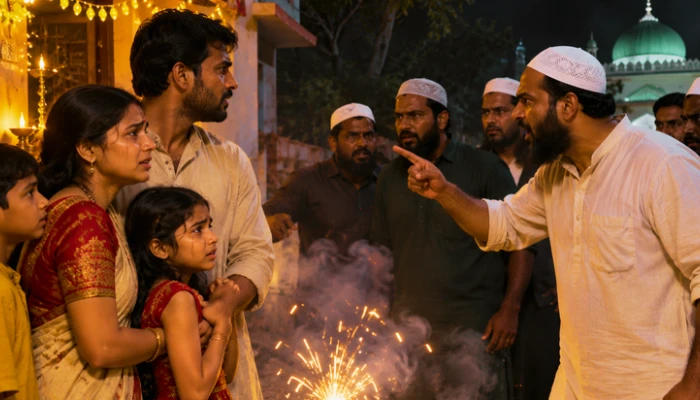
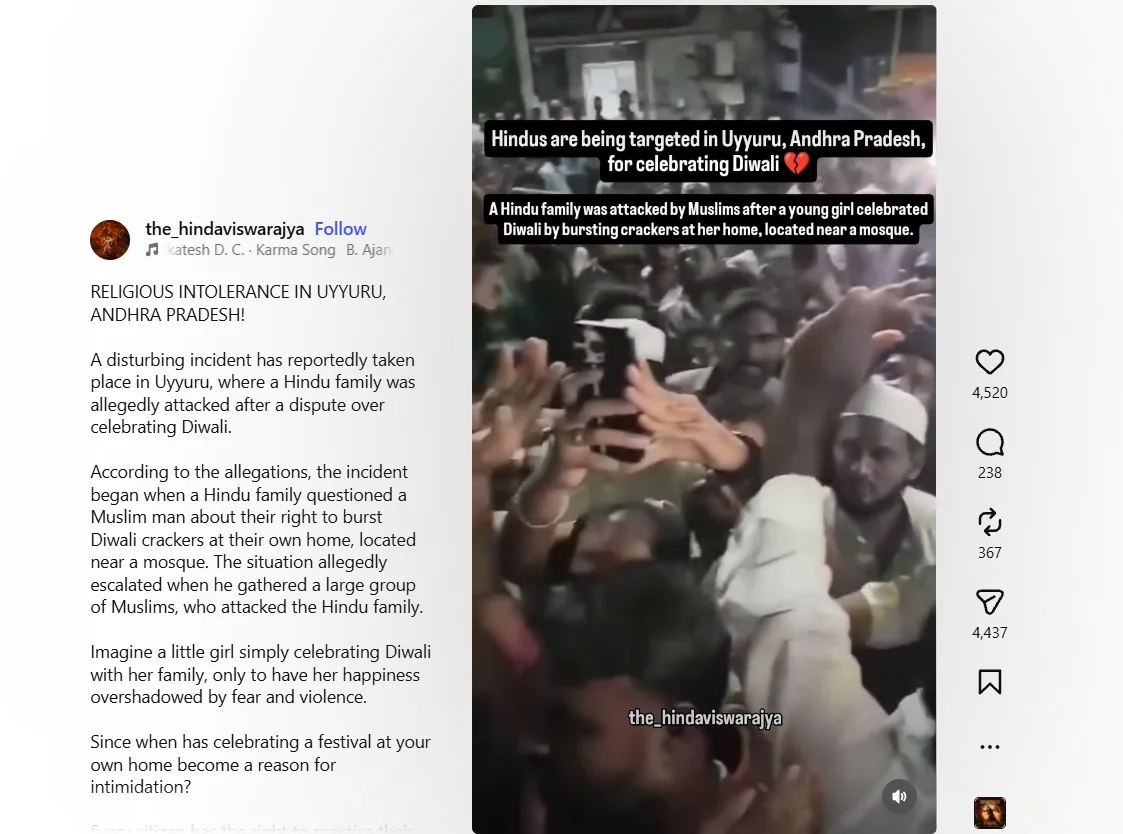
In Uyyuru town, Krishna district, Andhra Pradesh, Hindu children of a family were harassed, questioned and threatened by a local Muslim man for celebrating Diwali by bursting firecrackers outside their home, which was located near a mosque. Following this, a large group of Muslim men launched a physical attack on the Hindu children's family over their Diwali celebrations. The incident took place on 11 November 2026, when a minor Hindu girl and other children belonging to her family were bursting firecrackers outside their home as part of Diwali celebrations. A Muslim man from the locality objected to the children bursting crackers, citing the proximity of their home to a mosque, and confronted them, questioning their celebrations. He harassed and threatened the children over their observance of Diwali, leading to a confrontation with the minor girl's family. Following the initial confrontation, a large group of Muslim men gathered and brutally attacked the Hindu family over the dispute arising from the Diwali celebrations. A video of the incident subsequently went viral on social media, showing a large group of Muslim men mobilised outside the Hindu girl's home. At the time of writing, no publicly available information could be found confirming whether a police complaint had been registered or any action had been taken against the perpetrators in connection with the attack.
Case Images
Why it is Hate Crime ?
This case has been added to the tracker under the primary category of: Attack not resulting in death. Within it, the selected subcategory is: Attacked for Hindu identity. In several cases, Hindus are attacked merely for their Hindu identity without any perceived provocation. A classic example of this category of religiously motivated hate crime is a murder in 2016. 7 ISIS terrorists were convicted for shooting a school principal in Kanpur because they got ‘triggered’ seeing the Kalava on his wrist and tilak that he had put. In this case, the Hindu victim had offered no provocation except for his Hindu religious identity. The motivation for the murder was purely religious, driven by religious supremacy. Such cases where Hindus are targeted merely for their religious identity would be documented as a hate crime under this category. The other sub-category selected in the case is: Attacked for crossing a 'Muslim area' One of the reasons that Hindus get attacked unprovoked specifically by Islamists is for crossing ‘Muslim areas’. Essentially, Muslim mobs often attack Hindus crossing or present in certain areas which have a majority Muslim population. It has often been cited as one of the reasons to blame Hindus for attacks against themselves, signalling that Hindus displaying religious symbols, taking our religious processions, or crossing any area which is dominated by Muslim residents is a provocation in and of itself. These areas are mostly ghettoized areas where mobs mobilize quickly to attack Hindus for a variety of reasons,s like playing music during a religious procession, crossing a mosque, wearing a tilak or any other religious symbol in a Muslim-dominated area, praying at a local temple in that area, ea etc. There have been cases where the few local Hindus of that area have been attacked on their way to the Temple for prayers as well, simply because the area is considered a Muslim-dominated area. Several times, it is entirely possible that the immediate trigger for the violence against Hindus was non-religious in nature; re, however, the violence became religiously motivated in nature because the area was Muslim-dominated and the residents, on the whole, harboured animosity towards Hindus, as evidenced by the actions of the mob, the slogans, and the nature of the attack. Such crimes are motivated by the religious identity of the victims and are therefore classified as hate crimes under this category. This incident is a clear example of religiously motivated hostility, as Hindu children were threatened, intimidated and harassed by a Muslim man for celebrating Diwali and bursting firecrackers outside their own home, which was located near a mosque. The subsequent attack on the minor Hindu girl's family by a large group of Muslim men demonstrates the escalation from intimidation over Hindu religious observance to physical violence against the family. The targeting of the children for celebrating their religious festival, followed by a collective attack on their family, reflects religious hostility directed at Hindus for practising their faith. Diwali is one of the most significant festivals in Hinduism, celebrating the triumph of light over darkness, good over evil, and the return of Bhagwan Ram to Ayodhya following his exile and victory over Ravana. Lighting lamps, decorating homes and bursting firecrackers are traditional ways in which Hindus celebrate the festival, expressing joy, devotion and the festive spirit. In Hindu traditions, firecrackers are also associated with beliefs about guiding departed ancestors back to Pitrlok (the realm of the ancestors, where the departed souls of one's forefathers reside, according to Hindu beliefs). The fact that Hindu children were threatened and intimidated simply for participating in these customary Diwali celebrations, and that their family was subsequently attacked over the same, underscores the deep-seated religious hostility behind the incident. When the celebration of a Hindu festival and the expression of religious joy by Hindu children become grounds for intimidation, threats and violence, it demonstrates hostility towards Hindu religious practices and the faith itself. The perpetrators' reaction to an ordinary act of Hindu celebration showcases how Hindu religious expression was treated as something to be suppressed rather than tolerated, making the incident an expression of anti-Hindu hostility and religiously motivated hate. An important factor in this incident is that the perpetrators objected to the Hindu children's celebrations specifically because their home was located near a mosque. The children were not bursting crackers inside the mosque or on its premises, but outside their own home. The accused nevertheless used the mosque's proximity to intimidate the children and subsequently attack their family, demonstrating an attempt to impose religious restrictions on Hindu celebrations beyond the boundaries of their own place of worship. This showcases a sense of religious entitlement and territorial domination, wherein Hindu families are subjected to intimidation for practising their faith in their own residential surroundings simply because a mosque is located nearby. Such conduct demonstrates religious exclusion and hostility towards Hindu religious expression. The incident occurred near a mosque, and it is crucial to note that Muslims often consider areas near mosques, dargahs, or where their community is in the majority as "Muslim areas." This reveals a disturbing sense of Islamic supremacy held by the attackers, who viewed the area near the mosque as an exclusive zone where non-Muslims, particularly Hindus, were unwelcome. This sense of entitlement and superiority reflects deep-seated prejudice and an attempt to assert religious dominance over public spaces. The targeting and harassment of Hindu children reflects an Islamic supremacist mindset in which Muslims in the area viewed Hindus as inferior and believed they had the right to dictate how Hindus celebrated their festivals and moved freely within what they considered ‘their area.’ This displays religious exclusion, territorial dominance and deep-seated anti-Hindu hostility, making the incident a clear example of religiously motivated hate. Furthermore, the escalation of the incident into a brutal physical assault on the minor girl's entire family by a large group of Muslim men cannot be viewed in isolation from the initial confrontation over the children's Diwali celebrations. The attack followed the harassment and threats directed at the children for bursting firecrackers, turning hostility towards Hindu religious observance into collective violence against their family. The mobilisation of a large group of Muslim men and the assault on the family demonstrate the severity of the perpetrators' religious animosity, with the entire family being targeted over the children's celebration of Diwali. This showcases communal hostility directed at Hindus for practising and celebrating their faith. Overall, the incident demonstrates deep-rooted anti-Hindu hostility, with Hindu children being threatened, harassed and intimidated for celebrating Diwali, followed by a brutal attack on their family. The perpetrators' actions showcase religious intolerance and hostility towards Hindu celebrations, with violence being unleashed against the family over their observance of a Hindu festival. Therefore, this case is being added to the Hinduphobia Tracker's hate crime database as an incident of religiously motivated hate. Disclaimer: Although the entire Hindu family was targeted in the incident, including multiple Hindu children, the total number of victims was not specified in the available reports. Only one minor Hindu girl was specifically identified. Therefore, for documentation purposes, the victim count has been recorded as one. This represents a conservative estimate based solely on the explicitly identified victim and does not reflect the total number of individuals affected. Similarly, although a large group of Muslim men subsequently attacked the Hindu family, the total number of perpetrators involved was not specified in the available reports. Only one Muslim man was identified in the initial confrontation with the Hindu children. Therefore, a perpetrator count of one has been recorded as a conservative estimate for documentation purposes only and does not represent the actual number of attackers involved in the subsequent assault.
Victim Details
Total Victim
1
Deceased
0
Gender
- Male 0
- Female 1
- Third Gender 0
- Unknown 0
Caste
- SC/ST 0
- OBC 0
- General 0
- Unknown 1
Age Group
- Minor 1
- Adult 0
- Senior Citizen 0
- Unknown 0


Case Status
Unknown


Perpetrators Details
Perpetrators
Muslim Extremists
Perpetrators Range
One Person
Perpetrators Gender
male
 Sources



