Sacred Hindu festival denigrated: Leftist media repeatedly reduces Diwali to narratives of poverty, humiliation and disgrace
 India
 23 October, 2017
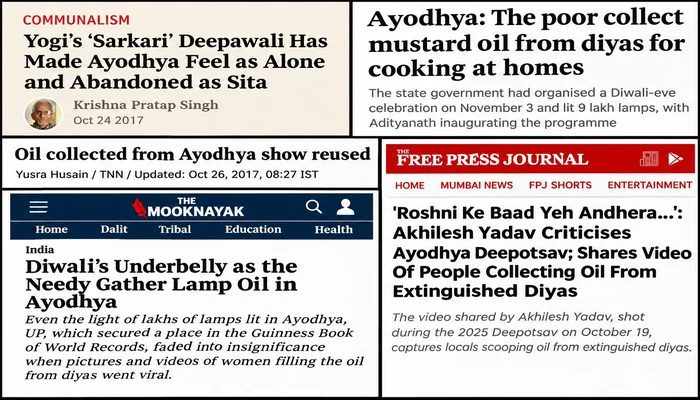
Case Summary
Leftist media repeatedly portrayed the sacred Hindu festival of Diwali through narratives of poverty, deprivation and humiliation, using selective imagery and politically charged headlines that denigrated its religious and cultural significance. The recurring emphasis on poor people collecting residual oil from diyas reduced Ayodhya's Deepotsav to a narrative of misery and disgrace. On 24 October 2017, The Wire published an article by Krishna Pratap Singh titled 'Yogi's “Sarkari” Deepawali Has Made Ayodhya Feel as Alone and Abandoned as Sita', framing the government-organised celebration through the imagery of Sita's abandonment. On 7 November 2021, The Telegraph published Piyush Srivastava's report, 'Ayodhya: The Poor Collect Mustard Oil from Diyas for Cooking at Homes', highlighting footage of women and children collecting residual mustard oil from diyas for household use. The report juxtaposed the Uttar Pradesh Government's Diwali-eve celebrations on 3 November 2021, during which nine lakh lamps were illuminated under Chief Minister Yogi Adityanath, with images of children gathering leftover oil from extinguished lamps. The Mooknayak subsequently published 'Diwali's Underbelly as the Needy Gather Lamp Oil in Ayodhya', juxtaposing the lighting of lakhs of diyas and the Guinness World Records recognition with images of women collecting residual oil from the lamps. On 19 October 2025, during Ayodhya's Deepotsav celebrations, locals were filmed collecting oil from extinguished diyas. The Free Press Journal subsequently published ''Roshni Ke Baad Yeh Andhera...': Akhilesh Yadav Criticises Ayodhya Deepotsav; Shares Video of People Collecting Oil From Extinguished Diyas', focusing on Akhilesh Yadav's criticism of the celebrations and the video he shared.
Why it is Hate Crime ?
This case is being added to the tracker under the primary category: Hate Speech against Hindus. The subcategory selected is: Anti-Hindu subversion and prejudice. Hate speech is defined as any speech, gesture, conduct, writing, or display that is prejudicial against a specific individual and/or group of people, which is leading to or may lead to violence, prejudicial action or hate against that individual and/or group. Media plays a specific and overarching reach in perpetuating prejudicial attitudes towards a community owing to unfair, untrue coverage and/or misrepresentation/misinterpretation, selective coverage and/or omission of facts of/pertaining to issues affecting a specific religious group. This type of bias can dehumanise the victim group, making it easier for others to justify harmful actions against them, which aligns with the objectives of hate speech laws aimed at preventing such harm. It is often observed that the media takes a prejudicial stand against the Hindu community driven by their need to shield the aggressor community which happens to be a numeric minority, however, is the one perpetrating violence against Hindus. For example, the media is often quick to contextualise religiously motivated crimes against Hindus, omit or misrepresent facts that point towards religiously motivated hate crimes, justify and/or downplay religiously motivated hate crimes or simply present fake news to stereotype Hindus. Such media bias leads to the denial of persecution and is often used to dehumanise Hindus, leading to justification for violence against them. For example, the media covered several fake allegations of Hindus targeting Muslims and forcing them to chant Jai Shree Ram. Most of these cases were proved false and fabricated after police investigation. These fake news reports were subsequently never retracted or clarified. Such fake news led to the justification of violence and dehumanisation of Hindus based on the argument that since Hindus targeted Muslims and forced them to chant Jai Shree Ram, the dehumanisation of Hindus and violence against them was par for the course and merely a retaliation. Such media bias leads to prejudicial portrayal of Hindus and offers a justification for violence against them and therefore, is considered hate speech under this category. This case constituted a hate crime because the media's conduct was directed at Hindus and their religious observances and repeatedly portrayed their religious identity, beliefs, cultural practices and collective celebrations through narratives of poverty, humiliation and disgrace, subjecting the community to negative stereotyping and contempt. Diwali is one of Hinduism's most revered festivals, celebrated as a symbol of victory over darkness and good over evil. The festival holds immense religious, spiritual, and cultural significance for Hindus worldwide, with traditions commemorating the return of Lord Rama to Ayodhya, the worship of Goddess Lakshmi, and other sacred occasions. Repeatedly portraying Diwali and Ayodhya's Deepotsav through narratives of poverty, deprivation, humiliation and disgrace, while associating its sacred rituals and celebrations with images of economic desperation, demonstrated a pattern of disparaging representation of a revered Hindu religious observance and the Hindu community. The repeated use of politically charged headlines, selective imagery and negative comparisons reduced the significance of Hindu religious traditions to narratives of misery and social backwardness. The invocation of Mata Sita's abandonment to characterise Ayodhya and the portrayal of traditional diyas primarily through images of poverty further reinforced this negative framing. This went beyond ordinary criticism of government expenditure or public administration, as the coverage repeatedly placed Hindu religious symbols, traditions and collective celebrations within a disparaging narrative. Such representation denigrated Hindu religious and cultural identity, diminished the dignity associated with its sacred observances and reinforced negative stereotypes about the Hindu community. It reflected a pattern of anti-Hindu religious denigration through selective and prejudicial media framing. The Ramayana is one of the most sacred foundations of Hindu religious belief, devotion, and civilisational identity, with Lord Rama and Mata Sita revered as divine figures embodying righteousness, virtue, sacrifice, and moral strength. Their association with Ayodhya hold profound religious significance, particularly during Diwali, which commemorates Lord Rama's triumphant return to his kingdom after fourteen years of exile. Mata Sita, in particular, occupied an exalted position in Hindu religious consciousness and was revered as an embodiment of dignity, purity, courage and devotion. The Wire headline, 'Yogi's “Sarkari” Deepawali Has Made Ayodhya Feel as Alone and Abandoned as Sita', disgracefully invoked Mata Sita's abandonment to ridicule and denigrate Ayodhya's Deepawali celebrations. By exploiting the suffering of a revered Hindu goddess as a politically charged metaphor, the headline dragged a sacred episode from the Ramayana into a disparaging narrative of governmental failure, abandonment and humiliation. This invocation trivialised the religious and emotional sanctity attached to Mata Sita's story and weaponised Hindu religious imagery to cast a major Hindu celebration in a degrading light. It subjected a revered Hindu religious figure and the sacred Ramayana tradition to politically motivated disparagement, striking at the religious sentiments and cultural dignity of Hindus. Accordingly, the hate-crime dimension of this case arose from the repeated and disparaging portrayal of Hindu religious identity, sacred traditions and collective celebrations. The coverage did not merely scrutinise government expenditure or criticise political leadership, but it repeatedly reduced a revered Hindu festival to narratives of poverty, humiliation, deprivation and disgrace, while invoking sacred Hindu symbols, traditional rituals and Mata Sita's abandonment in politically charged and disparaging contexts. This framing diminished the religious and cultural significance of Diwali, subjected Hindu traditions to contemptuous representation and reinforced negative stereotypes about Hindus as a religious community. For these reasons, the case was relevant to the hate crime database. Disclaimer: The Hinduphobia Tracker documents incidents based on the date on which an event occurred or a victim's ordeal began. In this case, the media articles were published on different dates. Therefore, for documentation purposes, we used the earliest published article among the identified reports as the incident date: 24 October 2017.


Case Status
Unknown


Perpetrators Details
Perpetrators
Others
Perpetrators Range
Unknown
Perpetrators Gender
unknown
 Sources



