Hindu temple desecrated, turned into a spot for gambling and drug abuse; priest faces false complaints for opposing the desecration
 Shivpuri, Madhya Pradesh, India
 16 November, 2026
Case Summary
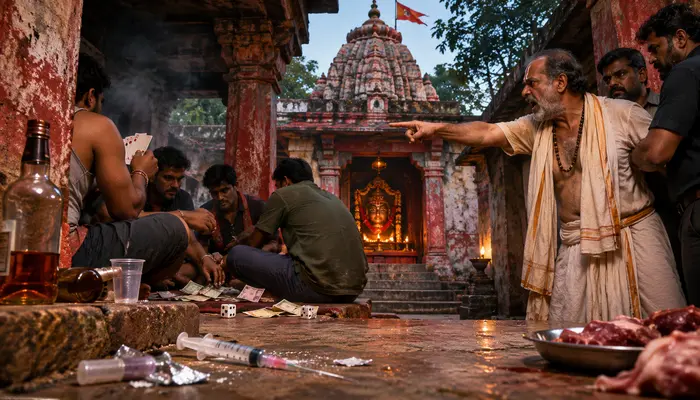
In Shivpuri, Madhya Pradesh, a 300-year-old Hindu temple named Kaliya Bhairo Baba Temple was desecrated by anti-social elements. The perpetrators turned the sacred temple premises into a site for gambling, betting and the consumption of intoxicating substances. Empty casings of intoxicant injections were also found scattered across the temple grounds. The priest who opposed these activities faced false complaints. On Tuesday, 17 November 2026, temple priest Sarnam Singh Yadav, accompanied by local Hindu residents, approached the district administration during the public grievance hearing at the Shivpuri District Headquarters. The temple is located in Old Shivpuri, near 40 Number Kothi. He submitted a written application to the Sub-Divisional Magistrate (SDM), seeking intervention to stop gambling, betting and substance abuse on the temple premises. He also demanded measures to strengthen the temple's security and protect its religious sanctity, while raising concerns about the false complaints he faced for opposing these activities. The priest also spoke to the media, detailing the activities taking place on the temple premises and the difficulties he faced when he objected to them. The public grievance hearing also saw Hindu residents from other parts of Shivpuri district raise civic and law-and-order concerns.
Why it is Hate Crime ?
This case has been added to the tracker under the primary category: Attack on Hindu religious representations. The subcategory selected within this is: Breaking rules of place of worship. Sanatan Dharma is not a religion of one book, which is to say that while it has religious scriptures that form the central tenets of the faith, there are several traditions followed through thousands of years, mostly passed from generation to generation orally. One of these oral traditions or written traditions is the rules of specific temples. Certain temples have rules which are traditional rules, dependent on the worship of the presiding deities. These rules and traditions have been followed for thousands of years whether they find scriptural mention or not. Such traditions are based on the nature and rules of worship of the presiding deity of that temple. Any non-compliance of these traditions owing to animosity towards the faith or for the sake of activism stems not only from the lack of faith in the presiding deity but also disregard for the faith of the devotees of that deity/temple and implicit bias against the faith, the tradition and the deity itself. Since these specific traditions are central to the faith of the devotees of that specific temple and presiding deity, any non-compliance with these traditional rules would be considered a religiously motivated hate crime. The other sub-category selected for this case is: Defiling religious customs. Sanatan Dharma is not a religion of one book, which is to say that while it has religious scriptures that form the central tenets of the faith, there are several traditions followed through thousands of years, mostly passed from generation to generation orally. There are several such customs and traditions that are followed by various Hindus and Hindu sects. Defiling of these traditions and customs is a breach of an individual or group’s religious practices. Such practices can range from dietary restrictions like not eating non-vegetarian food for a certain period of the year, not eating non-vegetarian food at all, not eating beef since the cow is considered holy in Hinduism, the sanctity of religious customs followed in the house (like many ISCKON devotees), etc. Any malicious action leading to the breach of such traditions or defilement of these traditions owing to animosity towards the faith or for the sake of activism stems not only from the lack of faith in the religion itself but also from disregard for the faith of the devotees who follow the customs/traditions and implicit bias against the faith, the tradition itself. Since these specific traditions are central to the faith of the devotees of that specific sect of Hindus, any non-compliance with these traditional rules would be considered a religiously motivated hate crime. This incident is being recorded as a religiously driven hate crime as the perpetrators desecrated the sanctity of a 300-year-old Hindu temple by turning its premises into a site for gambling, betting and the consumption of intoxicating substances. The fact that the temple priest who opposed these activities and attempted to protect the shrine's sanctity was subjected to false complaints further demonstrates the hostility directed towards those defending their religious place of worship. Hindu temples are sacred spaces dedicated to the worship of deities, where sanctity and purity are maintained through prescribed religious customs, rituals, discipline and rules of conduct. Activities such as gambling, betting and the consumption of intoxicating substances are incompatible with the sacred character of a temple and violate the religious decorum expected within its premises. Turning a centuries-old Hindu shrine into a place for such activities demonstrates a blatant disregard for its sanctity, the religious significance it holds, and the sentiments of the Hindu community. Repeatedly subjecting the temple to such indignity amounts to a desecration of a sacred place of worship and showcases deep-seated religious hostility. The targeting of the temple priest through false complaints further reflects this animosity towards Hinduism. The priest was attempting to protect his temple, preserve its sanctity and prevent its misuse for activities that violate its religious character, yet he was subjected to complaints for standing up against the desecration. Harassing a Hindu priest for defending his own place of worship demonstrates hostility towards those upholding Hindu religious practices and protecting sacred spaces. It effectively punishes him for standing up for his faith and resisting the desecration of his temple. At the time of documentation, the exact identities of the perpetrators remained unknown. However, their actions demonstrate clear hatred for Hinduism, its places of worship and the religious sentiments of the Hindu community. Therefore, this case is being added to the Hinduphobia Tracker's hate crime database. Disclaimer: Hinduphobia Tracker records the date of an incident based on when the crime occurs rather than when it is reported by the media. In this case, the exact date on which the activities within the temple premises began could not be independently confirmed from the available sources. The complaint was submitted by the temple priest during the public grievance hearing held on 17 November 2026. Since the precise date of commencement of these activities was not specified, the date of the complaint has been used as the indicative incident date for documentation purposes only.


Case Status
Complaint filed


Perpetrators Details
Perpetrators
Unknown
Perpetrators Range
Unknown
Perpetrators Gender
unknown
 Sources



