Hindu cremation ceremony disrupted by Muslims in West Bengal; family forced to perform last rites under police protection
 Uttar Dinajpur district, West Bengal, India
 14 November, 2026
Case Summary
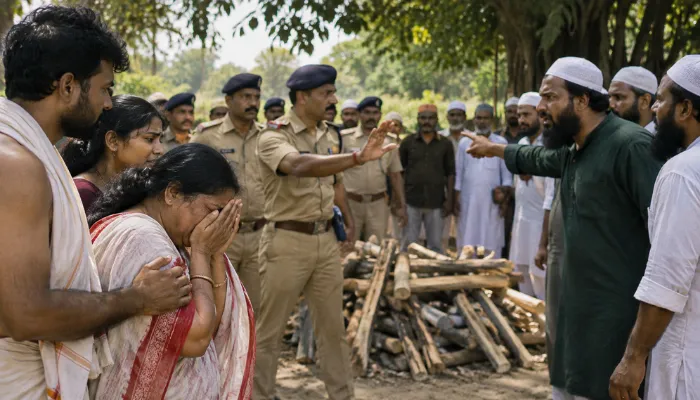
In Singragachh village, Islampur, Uttar Dinajpur, West Bengal, a Hindu family was obstructed from cremating their deceased relative at a traditional Hindu cremation ground by local Muslims. The perpetrators were attempting to encroach upon the land and convert it into an Islamic burial ground. The Hindu family was eventually forced to complete the cremation rituals under police protection. The incident took place on 15 November 2026 in Singragachh village, under Sujali Gram Panchayat and within the jurisdiction of Islampur Police Station, when the Hindu family brought the body of their deceased relative to the cremation ground. Several local Muslims obstructed the cremation, preventing the family from performing the last rites. The situation required police intervention, following which the cremation was completed under police protection. The incident caused concern among local Hindu residents, who stated that the family would not have been able to perform the last rites without police intervention. The approximately three-bigha plot had been used as a Hindu cremation ground for generations and served as the principal cremation facility for several Hindu families in the area. A dispute over the possession and use of the land had been ongoing for some time, with local Muslims attempting to encroach upon the property and convert it into an Islamic burial ground. Hindu residents, particularly elderly members of the community, emphasised the land's longstanding association with their religious and social practices and their dependence on it for performing the last rites of their deceased relatives. The attempted encroachment and proposed conversion of the cremation ground threatened to deprive several Hindu families of their established place for performing cremations in accordance with their religious customs. The obstruction of the funeral further heightened concerns over the community's continued access to the land and the possibility of further tensions surrounding its use. At the time of writing this report, the local administration had not issued an official statement regarding the dispute, and the legal status of the land and the proposed change in its use remained unverified. Local residents sought administrative intervention to investigate the obstruction, establish the legal status and permitted use of the land, and ensure that the community's access to the cremation ground was not disrupted.
Why it is Hate Crime ?
The primary category selected for this case is: Attack not resulting in death. The subcategory selected is: Attacked for Hindu identity. In several cases, Hindus are attacked merely for their Hindu identity without any perceived provocation. A classic example of this category of religiously motivated hate crime is a murder in 2016. 7 ISIS terrorists were convicted for shooting a school principal in Kanpur because they got ‘triggered’ seeing the Kalava on his wrist and tilak that he had put. In this, the Hindu victim had offered no provocation except for his Hindu religious identity. The motivation for the murder was purely religious, driven by religious supremacy. Such cases where Hindus are targeted merely for their religious identity would be documented as a hate crime under this category. This incident constitutes a religiously driven hate crime, as local Muslims disrupted a Hindu family's cremation rituals, preventing them from performing the last rites of their deceased relative in accordance with their religious beliefs. The obstruction was an attack on the family's religious identity and their right to fulfil their religious and familial obligations without intimidation. Preventing Hindus from performing the last rites of their deceased relative at a traditional cremation ground demonstrates hostility towards their faith and disregard for their right to practise their religion freely. In Hinduism, Antyeshti, or the final rites, is one of the most sacred samskaras (rites of passage) and holds profound spiritual and religious significance. Cremation is rooted in Hindu beliefs concerning the soul, the mortal body, and the cycle of life and death, with the prescribed rituals regarded as an essential duty towards the deceased and an integral part of the soul's onward journey. By obstructing a Hindu family's cremation, the Muslims interfered with a sacred religious obligation and denied them the right to perform the last rites in accordance with their faith. Such disruption goes beyond a dispute over land, as it directly interfered with the family's ability to honour their deceased relative through religious rites central to Hinduism. Preventing the family from fulfilling this religious obligation demonstrates disregard for Hindu religious beliefs and showcases hostility towards their faith and identity. If the Muslim perpetrators had a genuine dispute over the possession or use of the land, they could have pursued the matter through lawful means rather than forcibly disrupting a Hindu family's funeral. The deliberate obstruction of cremation rituals, particularly at a time when the family was mourning the loss of a relative, displays disregard for Hindu religious sentiments, customs and traditions. The fact that the family had to complete the cremation under police protection further underscores the severity of the intimidation and the hostility directed towards them while practising their faith. Furthermore, local Hindu residents stated that the Muslims were attempting to encroach upon the traditional Hindu cremation ground and convert it into an Islamic burial ground. If established to be true, such an attempt would further demonstrate religious animosity, as Hindu cremation grounds are religious spaces intrinsically associated with the Hindu community's funeral rites, religious obligations and traditions. Deliberately attempting to take over a Hindu cremation ground and repurpose it as an Islamic burial site would demonstrate disregard for its religious significance and an attempt to displace a space integral to the community's ability to perform its final rites. The disruption of the Hindu family's cremation, coupled with the attempt to encroach upon and change the religious purpose of the cremation ground, showcases hostility towards Hindu religious practices, sacred spaces and the community's religious identity. Since the incident meets the parameters of a hate crime, it is being added to the hate crime database of the Hinduphobia Tracker.


Case Status
Unknown


Perpetrators Details
Perpetrators
Muslim Extremists
Perpetrators Range
Unknown
Perpetrators Gender
unknown
 Sources



