Hindu temple desecrated: Couple vandalises premises, spits and urinates inside, then invokes alcohol intoxication as an excuse
 Jhansi, Uttar Pradesh, India
 15 November, 2026
Case Summary
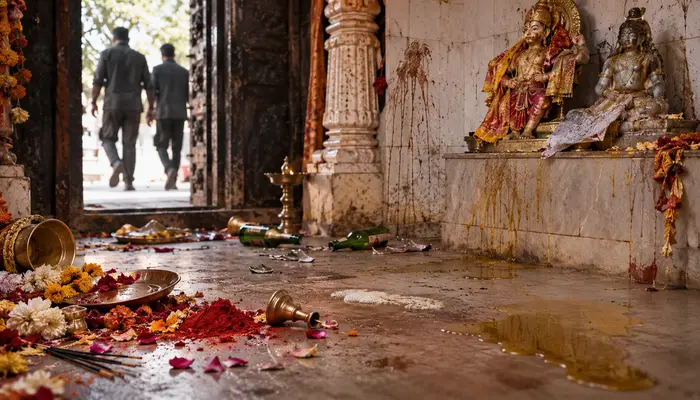
In Ranipur, Jhansi, Uttar Pradesh, a Hindu temple belonging to the Valmiki community was vandalised, and its premises were desecrated when a couple claiming to be under the influence of alcohol spat and urinated inside the temple. The incident took place on the evening of 16 November 2026, when a husband and wife from the town entered the temple in an intoxicated state and vandalised its premises. The temple was located in Ladganj locality, where members of the Valmiki community and residents of surrounding areas regularly visited to offer prayers. The couple used alcohol intoxication as an excuse for their conduct. When members of the Valmiki community arrived at the temple to offer prayers, they discovered the damage and expressed strong outrage over the desecration. They promptly alerted the police, following which Sub-Inspector Satish Chandra reached the spot along with a police team. The community subsequently submitted a written complaint to the police, demanding stringent action against the couple. The complaint also raised concerns about the accused husband's involvement in the illegal sale of liquor in the locality. Sub-Inspector Satish Chandra confirmed that the matter was under investigation and assured that appropriate action would be taken against those responsible.
Why it is Hate Crime ?
The primary category selected in this case is: Attack on Hindu religious representations. Within this, the first subcategory selected is: Attack on Temples. In Hinduism, a temple is the abode of the Deity. The Deity in the Temple is consecrated, thereby, making it a real, breathing entity. Hindus believe that not just the Deity but the temple premises itself are sacred to Hindus since Hindus hold the faith that the entire Temple space is an amalgamation of the divine energy of the deity. Given the central significance of Temples in Hindu Dharma, any attack against a Hindu Temple or its peripheral premises is an attack on the faith itself and is born out of animosity towards the faith, of which, the Temple is a central tenet. Any manner of attack against a Temple and/or its premises would therefore be considered a religiously motivated hate crime. The other subcategory selected is: Defiling religious customs. Sanatan Dharma is not a religion of one book, which is to say that while it has religious scriptures that form the central tenets of the faith, there are several traditions followed through thousands of years, mostly passed from generation to generation orally. There are several such customs and traditions that are followed by various Hindus and Hindu sects. Defiling these traditions and customs is a breach of an individual or group’s religious practices. Such practices can range from dietary restrictions like not eating non-vegetarian food for a certain period of the year, not eating non-vegetarian food at all, not eating beef since the cow is considered holy in Hinduism, the sanctity of religious customs followed in the house (like many ISKCON devotees), etc. Any malicious action leading to the breach of such traditions or defilement of these traditions owing to animosity towards the faith or for the sake of activism stems not only from the lack of faith in the religion itself but also from disregard for the faith of the devotees who follow the customs/traditions and implicit bias against the faith and the tradition itself. Since these specific traditions are central to the faith of the devotees of that specific sect of Hindus, any non-compliance with these traditional rules would be considered a religiously motivated hate crime. This case was a clear example of a religiously motivated hate crime, as the perpetrators deliberately entered a Hindu temple, vandalised its premises, spat and urinated inside, directly violating the sanctity of a place of worship sacred to Hindus. The act of spitting and urinating inside a Hindu temple was a deeply offensive form of religious desecration that showed complete disregard for the sanctity of a Hindu place of worship. A temple holds immense spiritual and emotional significance for Hindus, as it is a space where devotees offer prayers, worship their deities and seek divine blessings. By spitting and urinating inside the temple, the perpetrators had subjected a sacred place to degrading and deeply disrespectful acts. This went far beyond ordinary vandalism. It was a blatant affront to the faith of every devotee who regards the temple as a place of purity, devotion and spiritual solace. Such conduct humiliated worshippers, wounded their religious sentiments and violated the sanctity of a space that holds an important place in their religious lives. The fact that the vandalism and acts of desecration occurred inside a Hindu temple further established the significance of the incident. Hindu temples hold profound religious and spiritual importance, serving as places of worship, devotion, religious learning, and the observance of sacred rituals and traditions. They provide devotees with a space to connect with the divine and participate in community religious practices. The temple premises and the sacred space within them are interconnected parts of a larger temple ecosystem, with every area dedicated to worship holding religious significance. Spitting and urinating inside such a space is therefore not merely an act of public indecency but also a violation of the sanctity of the temple itself. Defiling a Hindu place of worship through such degrading acts constitutes an attack on the religious institution, its traditions, and the faith of its devotees, demonstrating contempt for Hinduism and its sacred spaces. Some may argue that the perpetrator carried out the act under the influence of alcohol. However, intoxication does not justify the deliberate desecration of a Hindu place of worship or negate the religious dimension of the offence. The perpetrators specifically entered a Hindu temple, vandalised its premises, spat and urinated inside the sacred compound, and engaged in acts that violated the sanctity of the place of worship and the religious sentiments of Hindu devotees. If the act was solely due to intoxication, the perpetrator could have targeted any non-religious property or non-Hindu religious sites such as a mosque, church or gurudwara. The selective targeting of a Hindu temple demonstrates that the act was directed to hurt the religious sentiments of the Hindu community. This overall showcases the perpetrators' inherent hostility towards Hinduism and its adherents. Therefore, this case is being added to the hate crime database of the tracker.


Case Status
Complaint filed


Perpetrators Details
Perpetrators
Unknown
Perpetrators Range
From 2 To 5
Perpetrators Gender
both
 Sources



