Hindu girl forcibly converted on live TV after being abducted and taken to a madarsa in Sindh, Pakistan
 Sindh, Pakistan
 15 November, 2026
Case Summary
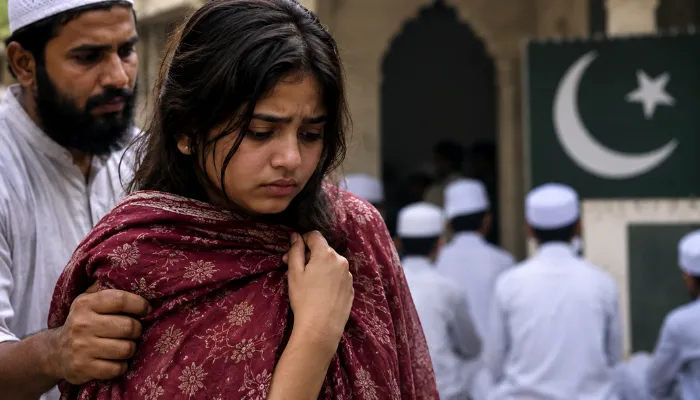
In Sindh, Pakistan, a Hindu girl was abducted from her home, taken to a madarsa, and forcibly converted to Islam on live TV. Her father was left seeking her recovery after the authorities failed to secure her release. This incident came to light after Nikhil Chandwani, a Hindu rights activist based in India, posted the case on his official Instagram handle on 16 November 2026. As per the details posted on his Instagram handle, the girl was taken from her Hindu family and brought to a madarsa, where she was subjected to religious conversion. The incident was captured on television, showing the girl being presented after her conversion. Her father maintained that the local police knew where his daughter was but did not intervene to rescue her. The girl was subsequently rescued from the same village in Sindh and brought to safety in India along with her family. Following their rescue, assistance was provided to help the family rebuild their lives.
Why it is Hate Crime ?
The primary category selected in this case is: Predatory Proselytisation. The subcategory selected is: Harassment, threats, coercion for conversion. Harassment covers a wide range of behaviours of an offensive nature. It is commonly understood as behaviour that demeans, humiliates, and intimidates a person, including threats and coercion. Harassment and threats, in this case, find their root on discriminatory grounds which has the effect of nullifying a person’s rights or infringing upon his freedom to exercise his right specifically owing to the victim’s religious identity. Verbal and physical threats and psychological or physical harassment are often used against Hindu victims because they choose to practice their professed religion. Religious harassment also includes forced and involuntary conversions by harassment, threats or coercion. Coercion includes intimidatory tactics like force-feeding a Hindu victim beef to convert to another religion, forceful circumcision etc. In several cases documented, non-Hindu perpetrators or those who harbour specific animosity towards Hinduism, harass victims simply based on their religious identity. Such cases often also include harassment to ensure the Hindu victim abandons his/her professed religion and adopts the religion of the perpetrator. Such cases where Hindu victims are harassed to convert to the perpetrator’s religion are rooted in animosity towards the victim’s religious identity and are therefore documented as religiously motivated hate crimes. Such cases where Hindu victims are harassed to convert to the perpetrator’s religion are rooted in animosity towards the victim’s religious identity and are therefore documented as religiously motivated hate crimes. This case was a clear example of a religiously motivated hate crime because a Hindu woman was abducted, threatened and pressured to abandon her Hindu faith and convert to Islam. Such incidents were not isolated occurrences but formed part of a persistent and deeply troubling pattern in Pakistan, where Hindu minorities, particularly girls, were systematically targeted for abduction, forced religious conversion, and marriage to Muslim men. This ongoing trend revealed the entrenched discrimination and violence faced by Hindu communities, who had endured harassment, marginalisation, and abuse since the country’s inception. In this specific case, it is important to also explain the dynamics of religious conversions in Pakistan. It is true that there are several religious conversions across the world which are completely voluntary and done out of the individual's own free will, driven by a change in faith. However, religious conversions in Pakistan have an especially predatory nature. Pakistan, being an Islamic nation, harbours specific animosity towards non-Muslims, especially Hindus. Human Rights reports have detailed how minor Hindu girls are abducted by Muslim men and forcefully converted to Islam, then married off to their abductors. Hindus are widely persecuted on the basis of their religion. There are instances where minors, who were forced to convert after being kidnapped, were handed over to their abductors even by the courts of Pakistan. Temples are desecrated and razed to the ground, religious symbols destroyed and Hindus killed merely for displaying their faith. Under such circumstances, the version that 50 Hindus converted to Islam out of their own free will is a version that is most likely coloured by religious bigotry and coercion. Further, there is a strong possibility that even if the Hindus say they converted out of their own free will, it is to escape the persecution if they don't convert to Islam in Pakistan. For that reason, this case is being added to the hate crime tracker. Such acts are carried out by Muslim perpetrators due to indoctrination by the Islamic theology, which advocates that all non-Muslims (referred to as kafirs) are inferior and subject to subjugation unless they convert to Islam or live under Islamic rule (dhimmitude). These ideas are not mere abstractions; they manifest in actions where non-Muslims, especially Hindus in India, are seen as targets for religious domination, coercion, or humiliation. This theological framework fosters an "us versus them" mindset, in which any assertion of Hindu identity or religious freedom is seen not only as undesirable but as a threat to Islamic supremacy. As a result, perpetrators who are shaped by such teachings feel justified, even morally obligated, to harass, suppress, or violently attack Hindus, particularly when Hindus assert their religious rights or resist conversion. Such acts, therefore, are not isolated but driven by a broader ideological hostility towards Hindus as non-believers and reflect an attempt to impose religious dominance. The fundamental motivation behind the crime appeared to be the imposition of a different religious identity on a Hindu victim. The targeting of her Hindu identity reflected hostility towards her continued adherence to Hinduism and an attempt to bring her within an Islamic religious framework. The coercive nature of the religious change suggested that her freedom to retain her ancestral faith was treated as something that could be overridden. The incident therefore reflected an attempt at religious domination through the erasure of Hindu identity. Provided grounds for treating the incident as an attack on Hindu religious identity and religious practice. Therefore, this case has been added to the hate crime database.
Victim Details
Total Victim
1
Deceased
0
Gender
- Male 0
- Female 1
- Third Gender 0
- Unknown 0
Caste
- SC/ST 0
- OBC 0
- General 0
- Unknown 1
Age Group
- Minor 1
- Adult 0
- Senior Citizen 0
- Unknown 0


Case Status
Complaint not filed


Perpetrators Details
Perpetrators
Muslim Extremists
Perpetrators Range
Unknown
Perpetrators Gender
male
 Sources



