Dalit Hindu family harassed for refusing to convert to Christianity; photos of Hindu deities vandalised and family threatened with death in Mumbai
 Mumbai, Maharashtra, India
 31 October, 2026
Case Summary
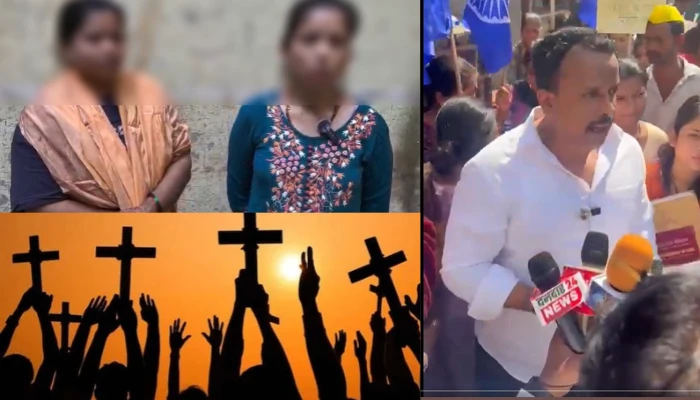
In Chandivali, Mumbai, a Dalit Hindu family was harassed and pressured to convert to Christianity by their neighbours, who also vandalised photographs of Hindu deities displayed outside their home, including an image of Panchamukhi Hanuman. The family was also subjected to threats and intimidation for refusing to abandon their Hindu faith. The incident came to light after the Sakal Hindu Samaj shared a video on its X account, @Sakalhindu_, featuring the testimonies of two women, Sonali Nanoba Kamble and Rupali Suryakant Ambiigar, on 13 November 2026. In the video, the first victim, Sonali Kamble, stated that the incident took place on 1 November 2026, when some of her Christian neighbours objected to the photographs of Hindu deities displayed on her doorway. The victim stated, “They took those photos down, threw them at their feet, and broke them. Among them was a photo of Lord Hanuman, a Panchamukhi Hanuman photo”. When Sonali's sister intervened to protect the photographs, the accused assaulted her as well. Sonali further stated that her sister's husband was also harassed over the matter and that her younger sister's husband, Suryakant Prabhu Ambiigar, was falsely implicated in the vandalism case. Sonali further stated that the neighbours had been harassing her for four months and pressuring her to convert to Christianity. She said that she had refused to change her religion and believed that her refusal was the reason behind their attempts to destroy the images of her deities. She also described how the neighbours repeatedly wiped away the rangoli drawn at her doorstep, extinguished the diyas and prevented her from lighting incense sticks. These acts had subjected her to prolonged mental harassment. Sonali further recounted that a photograph of Panchamukhi Hanuman had also been damaged on an earlier occasion. At that time, her family asked her not to confront the neighbours, and she refrained, assuming the photograph might have fallen because of the wind. However, during the latest incident, the photograph was broken in front of her. She expressed deep anguish over the desecration of her deity's image and appealed to members of the Hindu community to support her. In the same video, Rupali Suryakant Ambiigar, Sonali's younger sister, said false accusations had been levelled against her husband, Suryakant Prabhu Ambiigar, and demanded police action. She also announced that a protest march would be organised on Sunday, 15 November 2026, and appealed to members of the Hindu community and the wider community to participate in support of the affected family. To demand justice for the family, the Sakal Hindu Samaj organised a protest march on 15 November 2026. The organisation stated that despite the family being harassed, threatened with death,th and subjected to the vandalism of Hindu religious images inside their home, the police administration had taken no action.
Why it is Hate Crime ?
The first primary category selected in this case is: Predatory Proselytisation. The subcategory selected is: Harassment, threats, coercion for conversion. Harassment covers a wide range of behaviours of an offensive nature. It is commonly understood as behaviour that demeans, humiliates, and intimidates a person, including threats and coercion. Harassment and threats, in this case, find their root in discriminatory grounds, which have the effect of nullifying a person’s rights or infringing upon his freedom to exercise his rights specifically owing to the victim’s religious identity. Verbal and physical threats and psychological or physical harassment are often used against Hindu victims because they choose to practice their professed religion. Religious harassment also includes forced and involuntary conversions through harassment, threats, or coercion. Coercion includes intimidatory tactics like force-feeding a Hindu victim beef to convert to another religion, forceful circumcision, etc. In several documented cases, non-Hindu perpetrators or those who harbour specific animosity towards Hinduism harass victims simply based on their religious identity. Such cases often also include harassment to ensure the Hindu victim abandons his/her professed religion and adopts the religion of the perpetrator. Such cases where Hindu victims are harassed to convert to the perpetrator’s religion are rooted in animosity towards the victim’s religious identity and are therefore documented as religiously motivated hate crimes. The second primary category selected is: Attack not resulting in death. The subcategory selected is: Attacked for refusal to convert. When there is pressure, threat, or coercion employed upon the Hindu victim to convert to a different religion, in several cases, the victim refuses to succumb to the pressure/threats. Once the victim refuses, the perpetrator proceeds to attack/assault the victim owing to his/her refusal to convert. In such cases, the pressure/threat/intimidation/coercion/violence itself is driven by animosity towards the victim’s Hindu faith. The violence is then another hate crime driven by the victim’s refusal to abandon his professed faith, Hinduism, and convert to the religion of a non-Hindu perpetrator. Since the victim’s faith is at the heart of the pressure to convert and the ensuing violence towards the victim, such cases are considered religiously motivated hate crimes. The other sub-category selected is: Attacked for opposing radicals or trying to save the victim. In several cases, Hindus are attacked for opposing religiously motivated crimes being committed against a fellow Hindu or simply for voicing an opinion opposing radical elements, who either have in the past or continue to persecute Hindus. In such cases, the initial attack against the victim, against which the Hindu was trying to defend the victim, would also need to be classified as a religiously motivated hate crime. Since the initial crime itself was religiously motivated and the subsequent crime of attempting to save the victim or speaking against the radical elements ends up inviting a violent attack, it would also be classified as a religiously motivated hate crime under this category. The other sub-category selected is: Attacked for Hindu identity. In several cases, Hindus are attacked merely for their Hindu identity without any perceived provocation. A classic example of this category of religiously motivated hate crime is a murder in 2016. 7 ISIS terrorists were convicted for shooting a school principal in Kanpur because they got ‘triggered’ seeing the Kalava on his wrist and tilak that he had put. In this case, the Hindu victim had offered no provocation except for his Hindu religious identity. The motivation for the murder was purely religious, driven by religious supremacy. Such cases where Hindus are targeted merely for their religious identity would be documented as a hate crime under this category. The other primary category selected in the case is: Attack on Hindu religious representations. Within it, the sub-category selected is: Desecration of Hindu religious symbol. Icons and symbols, or a religious representation of a spiritual idea,l are widely revered in Hinduism. Iconography is of vital significance in the Hindu milieu. It helps connect people’s spiritual beliefs with the real world. Iconography within the Hindu faith takes several shapes and forms. Murtis are of the greatest significance to Hindus, to which daily rituals, prayers, and offerings are done. Besides the murtis, there are several other symbols which have deep significance in the Hindu faith – the Om and Swastika, for example. Since these Hindu religious symbols hold paramount importance in Hinduism, any desecration of symbols, icons, murtis, religious representations, andmanifestations, is driven by animosity towards the faith itself, which manifests through these murtis, icons, and symbols. Therefore, any desecration of these Hindu religious symbols and representations is considered a religiously motivated hate crime under this category. This case exemplifies a series of religiously motivated hate crimes targeting a Dalit Hindu family because they refused to abandon their Hindu faith and convert to Christianity. The prolonged harassment, pressure to convert, destruction of images of Hindu deities, and threats against the family demonstrated hostility towards their Hindu religious identity and their right to practise their faith. The victim's refusal to convert was followed by escalating acts of intimidation and violence, indicating that the harassment was not merely a personal dispute but was directed at the family on account of their religious beliefs. The sustained pressure on Sonali Nanoba Kamble to convert to Christianity was the incident's central religious dimension. As she stated in her testimony, the harassment had continued for four months, during which she was repeatedly pressured to abandon Hinduism. After she refused to convert, they tried to interfere with even the simplest expressions of her faith. The neighbours wiped away the rangoli at her doorstep, extinguished the diyas, and prevented her from lighting incense sticks. These were not isolated acts of nuisance. Rangoli, lighting lamps, and offering incense are familiar expressions of Hindu religious and cultural practice. Repeatedly obstructing these observances subjected the victim to an environment in which she was made to feel that practising her faith in her own home was unacceptable. Such conduct amounted to religious harassment intended to intimidate her and pressure her into abandoning her Hindu identity. The destruction of photographs of Hindu deities, including Panchamukhi Hanuman, further demonstrated the hostility directed towards the family's religious identity. For Hindus, images of deities are not ordinary photographs but objects of reverence and devotion, often forming an integral part of worship within the home. Removing these images, throwing them on the ground and breaking them was therefore an act of deliberate disrespect towards the family's faith and, in the context of sustained pressure to convert, reflected an attempt to intimidate the family and undermine their ability to practise Hinduism without fear. The assault on Sonali's sister when she intervened to protect the photograph of Panchamukhi Hanuman also constituted an attack on a Hindu who attempted to oppose the religiously motivated harassment and protect a fellow Hindu's religious sentiments. Her intervention aimed to prevent the desecration of a Hindu deity's image. Instead of allowing the family to protect their religious symbols, those involved resorted to violence against the woman who intervened. The harassment of her husband over the same matter further demonstrated how attempts to resist the intimidation and destruction of Hindu religious symbols invited retaliation against members of the family. The threats against the family, including threats to their lives, must also be viewed in the context of the sustained pressure to convert and their refusal to abandon Hinduism. The victim's testimony described how the harassment continued over several months and affected her ability to perform ordinary religious observances at her own doorstep. The assault on her sister and the intimidation of other family members further compounded this atmosphere of fear. Such threats and coercive conduct were aimed at a family that had refused to give up its professed faith, making the violence an extension of the religious pressure exerted upon them. The incident also exposed the vulnerability of Hindu families who face intimidation for maintaining their religious identity and resisting conversion. Targeting Hindu religious practices and making it difficult for families to observe their traditions seeks to weaken their attachment to Hinduism and make continued adherence to their faith increasingly difficult. When conversion is pursued through such methods, it ceases to be a matter of personal religious choice and becomes an attempt to impose another religious identity through fear and coercion. Such coercive tactics reflect an approach to religious conversion in which the freedom of an individual to retain their existing faith is not respected. Rather than allowing conversion to arise from genuine personal conviction, intimidation, harassment, and the destruction of religious symbols are used to create pressure on individuals to abandon their faith. These predatory conversion efforts stem from inherent hostility towards the victim's professed faith since Abrahamic faiths believe that any non-adherent to the faith is subject to being dehumanised till they convert. This mindset does not merely tolerate the existence of another faith but seeks its erasure or assimilation. As a result, Hindus are often targeted not because of who they are as individuals, but because of their religious identity. The violence, deception, or humiliation inflicted in such cases is therefore not random, but part of a broader ideological hostility toward Hinduism and its symbols, practices, and adherents. Here, too, the predatory actions stemmed from doctrinal animosity towards the Hindu faith, which is why this case is being documented as a religiously motivated hate crime.
Victim Details
Total Victim
3
Deceased
0
Gender
- Male 1
- Female 2
- Third Gender 0
- Unknown 0
Caste
- SC/ST 3
- OBC 0
- General 0
- Unknown 0
Age Group
- Minor 0
- Adult 3
- Senior Citizen 0
- Unknown 0


Case Status
Complaint filed


Perpetrators Details
Perpetrators
Christian Extremists
Perpetrators Range
Unknown
Perpetrators Gender
unknown
 Sources



