Hindu family attacked by Muslim men in Delhi’s Uttam Nagar a day after Diwali over a dispute linked to mazar construction; accused had threatened to stop them from celebrating the festival
 West Delhi, Delhi, India
 15 November, 2022
Case Summary
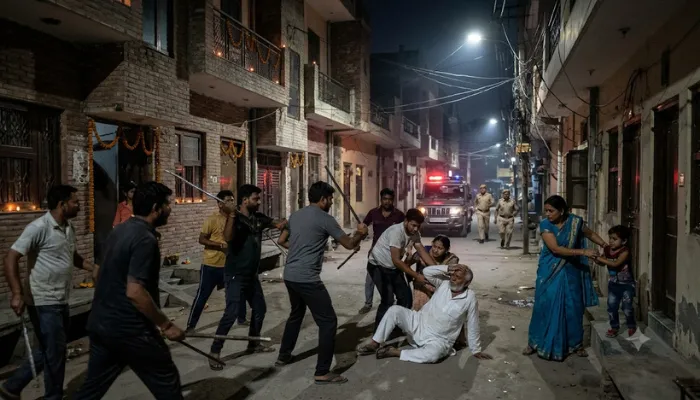
In Uttam Nagar, Delhi, a Hindu family, including elderly members and children, was brutally assaulted with sticks and other weapons by Nawab Khan, his three brothers, Yameen, Yaqoob and their associates on 9 November 2026, a day after Diwali. The attack took place following an ongoing dispute between the family and Nawab Khan, who had threatened them 15 days earlier, stating that he would not allow them to celebrate Diwali. According to residents, the dispute stemmed from the proposed construction of a mazar (Islamic shrine) on land claimed by the locality's residents. The Hindu family had opposed the construction, following which they had repeatedly faced threats and attacks. Residents also stated that the same family had faced a similar life-threatening attack three years earlier. The family called the police to inform them about Nawab entering their house to cause harm, but the police did not arrive for 2 hours. On the day of the incident, Nawab Khan conspired and arrived at the family's residence with his associates, armed with sticks, swords and knives, and launched an attack on the family. Several family members, including Jagdish, Lalit, an elderly man and a child, sustained serious injuries, with some suffering severe head injuries. The injured were subsequently admitted to a hospital for treatment. The women of the family, including the sister of the victim, were assaulted and left soaking in blood. While running away after harming the Hindu family, he warned them and said that they wouldn't be allowed to celebrate any Hindu festival in the locality. Residents identified Nawab Khan as a habitual offender with multiple criminal cases against him and stated that he was a declared absconder and had been externed from Delhi. They also identified his three brothers, Yameen and Yaqoob, as involved in the ongoing dispute. The police said the incident followed a quarrel between Madan and Nawab Khan in a park, after which Nawab Khan reached Madan's residence with several people, and a fight broke out. Police also referred to an earlier dispute between the two parties four years ago, following which intermittent altercations had continued. The police were investigating the incident. Hinduphobia Tracker earlier recorded the attack that took place in the same Uttam Nagar locality where, on 4 March 2026, during Holi celebrations, a Hindu youth named Tarun was beaten to death following a dispute over a water balloon falling on a woman. The latest assault on the Hindu family, immediately after Diwali, brought renewed tension to the area.
Why it is Hate Crime ?
This case has been added to the tracker under the primary category of: Attack not resulting in death. Within it, the selected subcategory is: Attacked for Hindu identity. In several cases, Hindus are attacked merely for their Hindu identity without any perceived provocation. A classic example of this category of religiously motivated hate crime is a murder in 2016. 7 ISIS terrorists were convicted for shooting a school principal in Kanpur because they got ‘triggered’ seeing the Kalava on his wrist and tilak that he had put. In this, the Hindu victim had offered no provocation except for his Hindu religious identity. The motivation for the murder was purely religious, driven by religious supremacy. Such cases where Hindus are targeted merely for their religious identity would be documented as a hate crime under this category. The other subcategory selected is: Attacked for opposing radicals or trying to save victim. In several cases, Hindus are attacked for opposing religiously motivated crimes being committed against a fellow Hindu or simply for voicing an opinion opposing radical elements, who either have in the past or continue to persecute Hindus. In such cases, the initial attack against the victim, against which the Hindu was trying to defend the victim, would also need to be classified as a religiously motivated hate crime. Since the initial crime itself was religiously motivated and the subsequent crime of attempting to save the victim or speaking against the radical elements ends up inviting a violent attack, it would also be classified as a religiously motivated hate crime under this category. In this incident, a Hindu family in Uttam Nagar, Delhi, was brutally assaulted by Nawab Khan, his three brothers, and their associates right after Diwali on 9 November 2026. The targeting of the family immediately following their religious celebration, paired with explicit warnings barring them from observing Diwali or any Hindu festival in the locality, demonstrates deep-seated religious hostility towards their Hindu identity and makes this a clear instance of a religiously motivated hate crime. The manner in which this violence unfolded shows that it was driven by religious animosity rather than a mere neighbourhood quarrel, despite police references to an earlier park altercation. Issuing ultimatums prior to the festival and repeating threats to stop the victims from celebrating any Hindu festival while fleeing the scene exposes the perpetrators' true intent. The victims offered no provocation, and the assault was clearly aimed at punishing them for their Hindu identity and suppressing their religious observance through fear. Diwali holds immense religious and spiritual significance in Hinduism. Also known as the festival of lights, it symbolises the victory of light over darkness, knowledge over ignorance, and good over evil, commemorating Lord Ram's return to Ayodhya after fourteen years of exile and his victory over Ravana. During Diwali, Hindu households illuminate their homes with earthen lamps, or diyas, and worship Goddess Lakshmi and Lord Ganesha as expressions of devotion and auspiciousness. Threatening a Hindu family to prevent them from celebrating Diwali and barring them from observing any Hindu festival in the area strikes directly at their fundamental right to practise and express their faith. The family's opposition to the proposed construction of a mazar, an Islamic shrine, on community land further confirms the religious motivation behind this persecution. By standing up against the imposition of an Islamic religious structure by radical elements and refusing to submit to coercion, the Hindu household became a target of sustained retaliation. In localities where radical elements attempt to assert dominance through religious encroachments, Hindus who resist are frequently subjected to targeted violence meant to break their resolve and enforce compliance. The extreme brutality of the assault against vulnerable family members, including women, an elderly man, and a child, reveals an assertion of coercive religious dominance that went far beyond a personal dispute. The fact that Nawab Khan, a habitual offender, could mobilise an armed group to invade a Hindu home while police failed to arrive for two hours reinforced an atmosphere of impunity and intimidation. Coupled with the fatal attack on a Hindu youth during Holi in the very same locality earlier in March 2026, this post-Diwali assault underscores a disturbing pattern of anti-Hindu hostility aimed at restricting Hindu festivals and subjugating Hindu residents. Overall, the targeted assault following Diwali, the explicit threats not to let the family celebrate their festival, and the sustained retaliation over opposing the mazar collectively establish the religiously motivated nature of this crime. The perpetrators' conduct reflects deep-seated intolerance towards Hindus and an effort to impose religious dominance through terror and exclusion. This case therefore fulfils the criteria of a religiously motivated hate crime. Disclaimer: The perpetrator count is four, as the total number of individuals involved in the attack has not yet been officially established.
Victim Details
Total Victim
7
Deceased
0
Gender
- Male 0
- Female 3
- Third Gender 0
- Unknown 4
Caste
- SC/ST 0
- OBC 0
- General 0
- Unknown 7
Age Group
- Minor 0
- Adult 0
- Senior Citizen 0
- Unknown 7


Case Status
Complaint filed


Perpetrators Details
Perpetrators
Muslim Extremists
Perpetrators Range
From 2 To 5
Perpetrators Gender
male
 Sources



