Anti-Hindu hatred spewed by Muslim X handle; accused branded Hindus as ‘Kafirs’, denigrated Goddess Kali and portrayed Hindu society as oppressive towards women
 India
 3 December, 2024
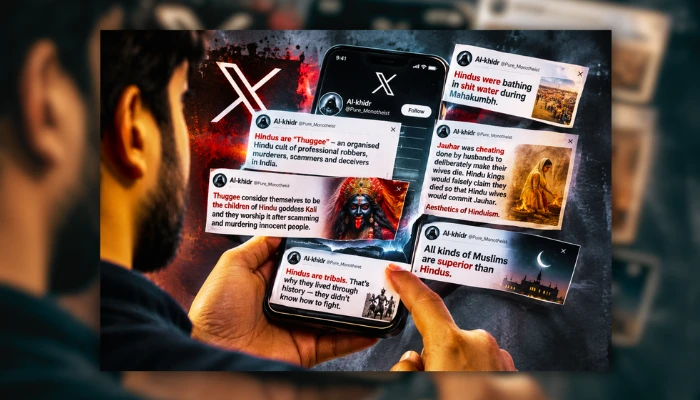
Case Summary
A Muslim social media user operating an X account under the display name “Al-Khidr” (@Pure_Monotheist) made several derogatory posts targeting the Hindu community, their faith, revered deities and religious traditions. The user also referred to Hindus as “Kafirs”, portrayed them as inferior and backward, and attempted to depict Hindu society as inherently oppressive towards Hindu women. The incident came to light when the pro-Hindu social media handle "Stop Hindu Hate Advocacy Network (SHHAN)", operating on X through the account @HinduHate, highlighted the Muslim user's account and shared screenshots of several derogatory posts targeting Hindus. Following this, the Hinduphobia Tracker team investigated the account, which had 1,240 followers at the time of documentation. The investigation revealed a pattern of repeated derogatory content targeting Hindus and their religious traditions. In one of his posts, the user described Hindus as “Thuggee”, referring to them as an organised Hindu cult of professional robbers, murderers, scammers and deceivers in India. He further claimed that Thuggees considered themselves children of Hindu Goddess Kali and worshipped her after scamming and murdering innocent people. Through this portrayal, he associated Goddess Kali with criminal activities and depicted her as a deity worshipped by criminals. In another post, the user claimed that Muslims, irrespective of their race or ethnicity, were superior to Hindus, whom he derogatorily referred to as “Kafirs”. The user also repeatedly attempted to portray Hindu society as inherently oppressive towards women. In one post, he compared the condition of Hindu women in India to that of women in pre-Islamic Arabia, describing Hindu society as a 'pagan society' where husbands enjoyed alcohol while their wives were made to work in the heat. He further claimed that the condition of women improved only after Prophet Muhammad arrived. In another post, the user mocked Hindus participating in the Mahakumbh, a sacred Hindu pilgrimage, by describing the water in which devotees bathed as “shit water”. The user also distorted the Hindu practice of Sati, claiming that Hindu husbands pretended to be dead to have their wives killed through the practice. Citing an isolated incident from the reign of Mughal emperor Akbar, he mocked the Hindu community by suggesting that Hindu men deliberately feigned their deaths to subject their wives to Sati. He further mocked Hindu religious traditions by captioning the post “Aesthetics of Hinduism”, accompanied by an image depicting a Sati incident. In yet another post, the user targeted the Hindu community by mockingly depicting Hindus as tribal people and portraying them as incapable of fighting. The user's X timeline contained hundreds of such derogatory posts targeting Hindus, their religious beliefs and practices. All the identified posts were published between December 2024 and November 2025, although they came to wider public attention recently after Stop Hindu Hate Advocacy Network (SHHAN) highlighted the account and shared screenshots of its anti-Hindu content.
Case Images
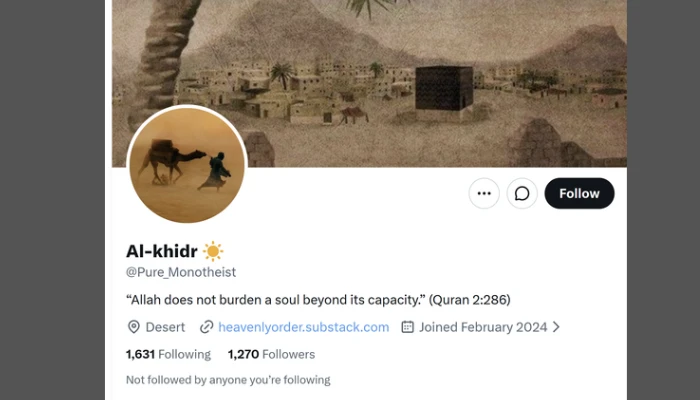
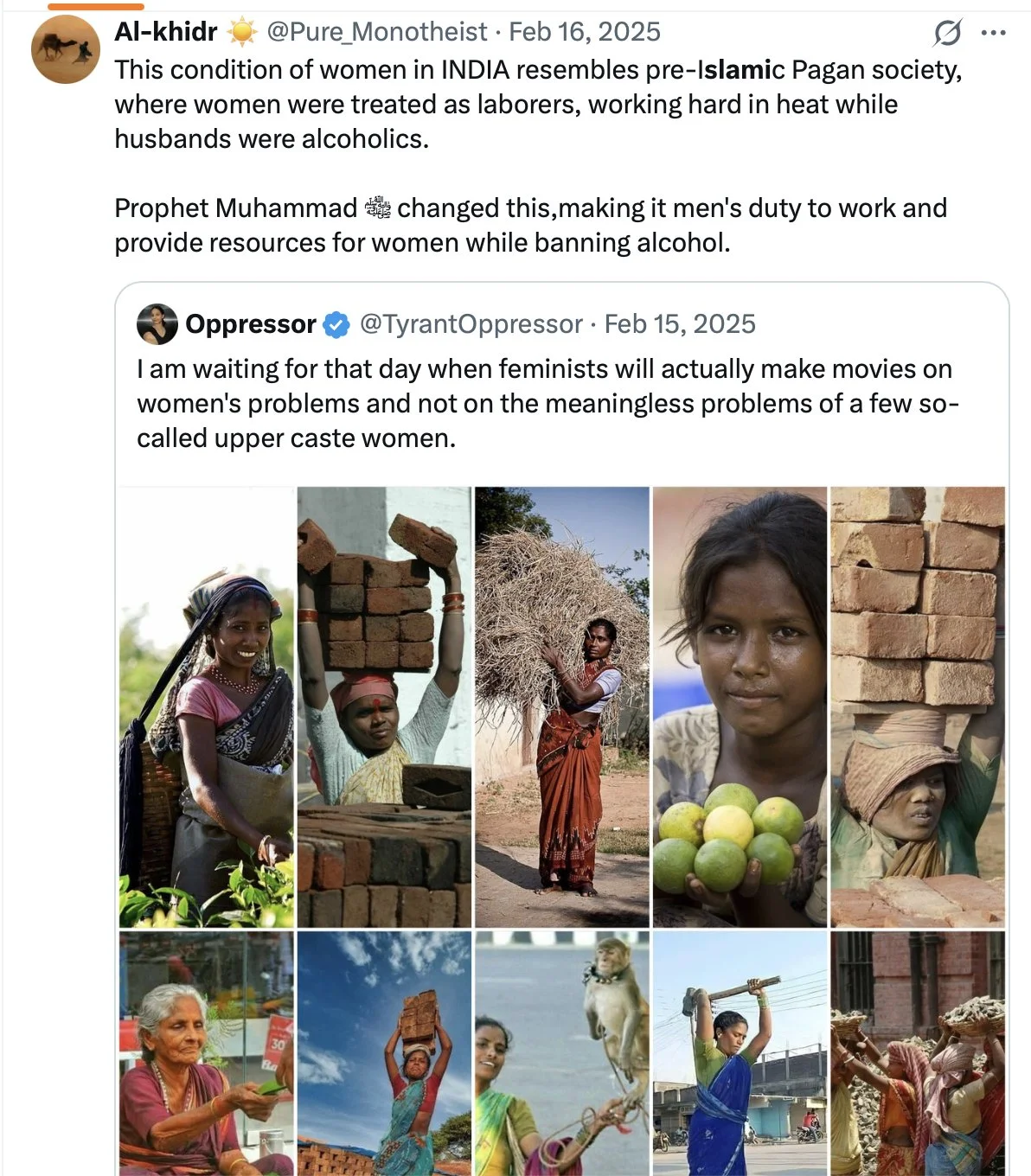
Why it is Hate Crime ?
This case has been added to the tracker under the primary category: Hate speech against Hindus. Within it, the subcategory selected is: Anti-Hindu slurs, mocking faith. Anti-Hindu slurs and the deliberate mocking of the Hindu faith owing to religious animosity involve the use of derogatory terms, stereotypes, or offensive references to religious practices, symbols, or figures. One of the common anti-Hindu slurs used against Hindus is “cow-worshipper” and “cow piss drinker”. The intention of using these terms is to demean and mock Hindus as a group and their religious beliefs, since Hindus consider the cow holy. Additionally, some symbols and the slurs attached to them have a historical context that exacerbates the insult, hate, stereotyping, dehumanization,n and oppression against Hindus. Cow worship has been used for centuries to denigrate Hindus, insult their faith,th and oppress Hindus specifically as a religious group. There has been overwhelming documentation about how cow slaughter has been used to persecute Hindus,dus with cow meat being thrown in temples and places of worship. There has also been overwhelming documentation that cow meat (beef) has been force-fed to Hindus to either forcefully convert them to Islam or denigrate their faith. Apart from cow worship, the Swastika – which holds deep religious significance for the Hindus – has also been misinterpreted and distorted and used as a slur against Hindus. Similarly, the worship of the Shivling has been used by supremacist ideologies and religions to denigrate Hindus owing to religious animosity. Such slurs and denigration stem from inherent animosity and hate towards Hindus and their faith; therefore, it is categorised as hate speech targeted at Hindus specifically owing to their religious identity. In this incident, the perpetrator repeatedly targeted Hindus, their revered deities and religious traditions through derogatory posts, denigrating Goddess Kali, branding Hindus as “Kafirs”, portraying Hindu society as misogynistic and regressive, and mocking sacred religious observances such as the Mahakumbh. This repeated targeting of different aspects of Hindu religious identity demonstrated deep-seated hostility towards Hinduism and its followers, making this an instance of religiously driven hate. In one of his posts, the perpetrator denigrated the Hindu goddess Maa Kali by associating her with criminal activities and portraying her as a deity worshipped by criminals. Goddess Kali occupies a deeply revered position in Hinduism, where she is worshipped as the supreme Divine Mother and the embodiment of Shakti, the primordial feminine cosmic power. She represents the destruction of evil, the annihilation of negative forces, protection of devotees and liberation from ignorance. She is worshipped across India and holds immense religious and cultural significance. By deliberately associating such a revered deity with professional robbers, murderers and criminals, the perpetrator reduced a sacred Hindu goddess to a figure of criminal worship. This was not merely a distortion of Hindu religious beliefs but a direct denigration of a deity deeply revered by millions of Hindus. Such deliberate association of a sacred religious figure with criminality demonstrated hostility towards Hinduism and the religious sentiments of the Hindu community and constituted an instance of religiously driven hate. In another post, the perpetrator directly targeted Hindus by derogatorily referring to them as “Kafirs” and asserting that Muslims, irrespective of their race or ethnicity, were superior to Hindus. The term “Kafir”, originating from Islamic theological terminology, refers to someone who does not believe in or accept Islam. It has also been used on several occasions as a religious slur to target, demean and vilify non-Muslims, including Hindus, on account of their religious beliefs. By using this term against Hindus and explicitly placing Muslims above them irrespective of racial or ethnic differences, the perpetrator advanced a narrative of religious supremacy that relegated the Hindu community to an inferior position solely because of its religious identity. His emphasis on Muslim identity transcending racial and ethnic boundaries also reflected the transnational religious identification associated with the concept of the Muslim Ummah, or the global Muslim community. However, he invoked this religious solidarity to establish a hierarchy in which Muslims were presented as superior and Hindus as inferior. Such explicit religious denigration and the portrayal of Hindus as a community unworthy of equal standing demonstrated deep-seated anti-Hindu animosity and clear religious hostility. The perpetrator also repeatedly attempted to portray Hindu society as inherently misogynistic and oppressive towards women. In one of his posts, he compared the condition of Hindu women in India with that of women in pre-Islamic Arabia, describing the latter as a pagan society where men enjoyed alcohol while women were made to work in the heat. He further asserted that the condition of women improved only after the arrival of Prophet Muhammad. By drawing this comparison, the perpetrator attempted to portray Hindu society as similarly regressive and oppressive towards its women. However, misogyny and discrimination against women are social problems that exist across communities and societies and cannot be attributed exclusively to one religious group. The perpetrator's selective focus on Hindu society, while presenting the arrival of Islam as the turning point for women's welfare, served to portray Hinduism as inherently backward rather than engage with the broader problem of gender discrimination. This selective denigration demonstrated that the post was directed at maligning Hindu society and its religious identity rather than addressing misogyny as a social concern. It therefore reflected an underlying hostility towards the Hindu community. In another post, the perpetrator mocked Hindus participating in the Mahakumbh by describing the water in which devotees bathed as “shit water”. The Mahakumbh is among the most significant religious gatherings in Hinduism and holds immense spiritual importance for Hindu devotees. It is associated with the sacred belief in the purifying power of holy rivers and the opportunity to attain spiritual merit through ritual bathing, prayers and religious observances. Millions of devotees, saints and pilgrims participate in this sacred gathering, making it an important expression of Hindu faith, devotion and collective religious identity. Water pollution is a serious environmental and public health concern that affects communities irrespective of their religious identity. However, instead of raising concerns about water quality or the health of devotees, the perpetrator chose to use the issue to ridicule Hindus and demean their participation in a sacred religious pilgrimage. By reducing a deeply revered religious observance to a subject of vulgar mockery, he demonstrated disregard for Hindu religious sentiments and targeted an important expression of Hindu faith. This selective ridicule reflected anti-Hindu hostility. The perpetrator also distorted the historical practice of Sati and used it to denigrate the Hindu community. In his post, he suggested that Hindu husbands deliberately pretended to be dead to have their wives subjected to Sati. Citing an isolated incident from the reign of Mughal emperor Akbar, he generalised this allegation to portray Hindu men throughout history as deliberately deceiving their wives into dying. Sati was a historical practice in which a widow died on her husband's funeral pyre. It was not a compulsory religious obligation prescribed for Hindu women, nor was it a universal practice followed by Hindu communities. It occurred in particular historical and social contexts. The practice was opposed by the Hindu community, and its reformers eventually prohibited it by law. By taking an isolated historical incident and using it to generalise the conduct of the entire Hindu community, the perpetrator distorted Hindu history and portrayed Hindu men as collectively responsible for the practice. He further captioned the post “Aesthetics of Hinduism”, accompanied by an image depicting a Sati incident. This mocking presentation reduced an entire religious tradition, with its vast philosophical, spiritual and cultural heritage, to a single historical practice. Rather than engage with the historical complexities surrounding Sati or the suffering of women, the perpetrator used the practice as a means to ridicule Hinduism and its followers. Such sweeping generalisation and deliberate mockery demonstrated an intent to malign the Hindu community and its religious identity. In another post, the perpetrator mockingly depicted Hindus as tribal people and portrayed them as incapable of fighting. By reducing an entire religious community with a diverse and extensive historical and cultural heritage to a derogatory stereotype of weakness and incapacity, he sought to demean Hindus and portray them as inferior. This further reflected the pattern of denigration evident throughout his posts, in which Hindu identity was repeatedly subjected to ridicule and disparagement. The presence of numerous derogatory posts targeting Hindus and their religious beliefs on the perpetrator's X timeline demonstrated that this was not an isolated instance of offensive expression but part of a repeated pattern of denigrating the Hindu community. From associating a revered Hindu goddess with criminality and mocking sacred pilgrimages to using religious slurs against Hindus, distorting historical practices and portraying Hindu society as inherently backward, the perpetrator repeatedly targeted different dimensions of Hindu religious and cultural identity. The consistency of this pattern demonstrated deep-seated hostility towards Hinduism and its followers. Therefore, this case is being added to the hate crime database of the tracker. Disclaimer: The Hinduphobia Tracker records incident dates based on when the offence occurred rather than when it was reported in the media. In this instance, as the derogatory social media posts were published on multiple dates, 4 December 2024, the date of the earliest identified post, has been selected as the indicative incident date for documentation purposes only.


Case Status
Unknown


Perpetrators Details
Perpetrators
Muslim Extremists
Perpetrators Range
One Person
Perpetrators Gender
unknown
 Sources



