Hindu family brutally attacked for celebrating Diwali; Muslims threatened to chop off their heads and hands if they lit diyas or burst crackers
 Etah, Uttar Pradesh, India
 9 November, 2026
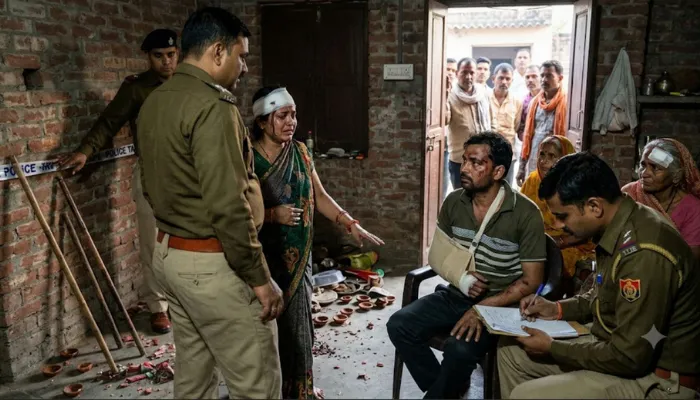
Case Summary
In Dhumri village, Etah, Uttar Pradesh, a Hindu family of six, including three women, was brutally attacked inside their home by a group of Muslim men for celebrating Diwali by lighting diyas and bursting firecrackers. The perpetrators threatened to chop off the hands of Hindu children if they continued bursting firecrackers and also threatened to slit the throat of a family member. The attackers were identified as Muhammad Raj alias Gore Khan, Naveedraj, Mohsin, Tasleem, Kashish alias Farhan, Farooq and their associates. The incident began on 10 November 2026, during Diwali celebrations, when Meenu, wife of Pradeep Rathore, was lighting earthen lamps on the roof of her house while children were bursting firecrackers. A few Muslim residents of the neighbourhood objected to the celebrations, hurled abuses and threatened to chop off the children's hands if they continued bursting firecrackers. They also threw away the diyas lit by Meenu. According to Pradeep, the perpetrators referred to the celebration of Milad (observance of the birth anniversary of Prophet Muhammad in Islam) while objecting to the children bursting firecrackers. They warned that those who continued bursting firecrackers would have their hands chopped off and would be driven away. When Meenu attempted to record the perpetrators' behaviour on her mobile phone, they threatened to slit her throat, slapped her, snatched her phone and deleted the recording. The following morning, after consulting residents of the neighbourhood, Meenu approached Jaithra Police Station and submitted a written complaint regarding the threats and obstruction to her family's Diwali celebrations. However, when she returned home after filing the complaint, a group of around 25–30 Muslim men armed with sticks and rods entered the family's house and launched a brutal assault on them. Meenu was struck on the head with a stick and a brick, while her husband, Pradeep, his mother, Usha Devi, his brother, Rajat, and other family members were also beaten. Meenu stated that the attackers assaulted her when she attempted to protect her husband. She eventually managed to escape and lock herself inside the house to save her life. Pradeep stated that he was returning from his vegetable shop when he encountered around 25–30 Muslim men armed with sticks, who attacked him. He sustained a fractured hand, while other family members also suffered head injuries and other physical injuries. During the assault, the attackers threatened the family, questioning what even the local Member of Legislative Assembly (MLA) or Prime Minister Narendra Modi could do against them. They also threatened to drive the family out of the neighbourhood and warned that they would not be allowed to live there. Six members of the family were injured in the assault: Pradeep Rathore (34), Meenu (30), Usha Devi (55), Rajat (28), Bitiya (28) and Geeta (45). The police arranged medical examinations for three of the injured. A video of the assault also surfaced on social media, showing the attackers brutally beating the Hindu family, including both women and men, with sticks and rods. Following the assault and continued threats, Meenu, Pradeep and several other women from the locality approached Circle Officer Aliganj, Rajesh Kumar Singh, demanding action against the perpetrators and security for the family. They complained that the accused continued to threaten them and were attempting to drive them out of the neighbourhood. Pradeep also stated that Gore Khan and another accused were history-sheeters who had been jailed several times. Based on Meenu's written complaint, Jaithra Police registered a First Information Report against six named perpetrators: Muhammad Raj alias Gore Khan, son of Ajit Khan alias Gillu Khan; Naveedraj, son of Gore Khan; Mohsin, son of Israr; Tasleem, son of Aslam; Kashish alias Farhan, son of Shamshul; and Farooq, son of Mushir. All six were residents of Dhumri village. The case was registered under relevant provisions of the Bharatiya Nyaya Sanhita (BNS), including charges relating to house-trespass, attempt to murder, assault and rioting. Following directions from Etah Senior Superintendent of Police Dr Ilamaran G, the police launched an operation to apprehend the accused. On 12 November 2026, Jaithra Police arrested Muhammad Raj alias Gore Khan and Naveedraj, while raids were conducted to apprehend the remaining accused. Circle Officer Rajesh Kumar Singh confirmed the arrest of the two accused and stated that police teams were searching for the others and examining the video of the assault. The police team involved in the operation included Jaithra Station House Officer Sunil Kumar Verma, Sub-Inspector Dharmesh Kumar, Constable Praveen Kumar and Reserve Constable Ujjwal.
Why it is Hate Crime ?
This case has been added to the tracker under the primary category of: Attack not resulting in death. Within it, the selected subcategory is: Attacked for Hindu identity. In several cases, Hindus are attacked merely for their Hindu identity without any perceived provocation. A classic example of this category of religiously motivated hate crime is a murder in 2016. 7 ISIS terrorists were convicted for shooting a school principal in Kanpur because they got ‘triggered’ seeing the Kalava on his wrist and tilak that he had put. In this, the Hindu victim had offered no provocation except for his Hindu religious identity. The motivation for the murder was purely religious, driven by religious supremacy. Such cases where Hindus are targeted merely for their religious identity would be documented as a hate crime under this category. The other subcategory selected is: Attacked for opposing radicals or trying to save victim. In several cases, Hindus are attacked for opposing religiously motivated crimes being committed against a fellow Hindu or simply for voicing an opinion opposing radical elements, who either have in the past or continue to persecute Hindus. In such cases, the initial attack against the victim, against which the Hindu was trying to defend the victim, would also need to be classified as a religiously motivated hate crime. Since the initial crime itself was religiously motivated and the subsequent crime of attempting to save the victim or speaking against the radical elements ends up inviting a violent attack, it would also be classified as a religiously motivated hate crime under this category. The second primary category selected is: Attack on Hindu religious representations. The subcategory selected is: Desecration of Hindu religious symbol. Icons and symbols or a religious representation of a spiritual ideal are widely revered in Hinduism. Iconography is of vital significance in the Hindu milieu. It helps connect people’s spiritual beliefs with the real world. Iconography within the Hindu faith takes several shapes and forms. Murtis are of most significance to Hindus, to which daily rituals, prayers and offerings are done. Besides the murtis, there are several other symbols which have deep significance in the Hindu faith – the Om and Swastika for example. Since these Hindu religious symbols hold paramount importance in Hinduism, any desecration of symbols, icons, murtis, religious representations and manifestations, is driven by animosity towards the faith itself which manifests itself through these murtis, icons and symbols. Therefore, any desecration of these Hindu religious symbols and representations is considered religiously motivated hate crimes under this category. The third primary category selected in this case is: Hate Speech against Hindus. The subcategory selected is: Violent Threats. Violent threats, explicit, implicit or implied, is the most dangerous form of hate speech since it goes beyond discriminatory and prejudicial language to express the intent of causing harm to an individual or a group of people based on their religious identity and faith. There could be several different kinds of threats that are issued to Hindus based on religious animosity. An explicit threat would mean the direct threat of violence towards an individual Hindu, a group of Hindus or Hindus at large. Physical violence, death threats, threats of destruction of property belonging to Hindus and threats of genocide would mean explicit threats against Hindus for their religious identity. Implicit threats may not be a direct threat but implied through the use of symbols of actions – for example – in the Nupur Sharma case, other than explicit threats, there were also implicit threats when Islamists took to the streets to burn and beat her effigies. It implies that they want to do the same to Nupur Sharma – thereby is considered an implicit threat. Violent threats can be delivered in person, through letters, phone calls, graffiti, or increasingly through social media and other online platforms. It would be important to understand that a threat – explicit or implicit, online or offline – to an individual who happens to be a Hindu does not qualify as a religiously motivated threat. Such a threat, while vile and dangerous, could be owing to non-religious reasons and/or personal animosity. To qualify as a religiously motivated threat, it would need to exhibit an indication that the individual is being targeted for religious reasons and/or owing to his/her religious identity as a Hindu. In this incident, a Hindu family was brutally attacked by a group of Muslim men for celebrating Diwali by lighting diyas and bursting firecrackers. The perpetrators threatened to chop off the hands of Hindu children if they continued bursting crackers and also threatened to slit a Hindu woman's throat. The targeting of the family for observing a Hindu religious festival, accompanied by threats of beheading and lethal violence, demonstrates deep-seated religious hostility towards their Hindu identity and makes this a clear instance of a religiously motivated hate crime. The fact that the Hindu family was targeted solely for celebrating Diwali inside its own home is particularly significant. The family was peacefully observing its religious festival, with children bursting firecrackers and Meenu lighting diyas, without causing any inconvenience to the Muslim residents. However, the Muslim perpetrators objected to these celebrations, hurled abuses and threatened the family with violence. This establishes that the hostility did not arise from any wrongdoing or provocation on the Hindu family's part but was directed at their celebration of a Hindu festival and their religious identity. The perpetrators' violent opposition to the family's peaceful religious observance therefore reflects deep-seated religious intolerance, making this a clear case of a religiously motivated hate crime rather than a mere neighbourhood dispute. Diwali holds immense religious and spiritual significance in Hinduism. Also known as the festival of lights, it symbolises the victory of light over darkness, knowledge over ignorance and good over evil. In Hindu traditions, the festival commemorates the return of Lord Ram to Ayodhya after fourteen years of exile and his victory over Ravana. The lighting of earthen lamps, or diyas, is among the most recognisable traditions associated with Diwali. These lamps symbolise the triumph of divine light over darkness and are lit in homes, temples and public spaces as expressions of devotion, auspiciousness and spiritual renewal. The festival is also associated with the worship of Goddess Lakshmi and Lord Ganesha in Hindu households. Firecrackers form a widely practised part of Diwali festivities and are associated with the expression of joy and celebration. The deliberate targeting of these religious and cultural expressions, particularly through threats and physical violence, demonstrates hostility towards the Hindu family's religious observance and its right to celebrate its faith. The threats against the Hindu children and Meenu, along with the deliberate destruction of the earthen lamps she had lit, constituted a direct attack on the family's Hindu religious identity. The diyas were an integral part of the family's Diwali observance and carried religious and symbolic significance. Their deliberate destruction amounted to the desecration of sacred Hindu symbols associated with Diwali celebrations, hurting the religious sentiments of the family and showing contempt for its faith. By throwing them away and threatening the family for lighting them, the perpetrators demonstrated hostility towards the religious practice itself. Their threats to chop off the children's hands for bursting firecrackers and to harm Meenu for lighting diyas went beyond objections to festive activities; they reflected an attempt to prevent the family from freely celebrating a Hindu festival. Targeting Hindus for observing their religious traditions in their own home exposed clear religious intolerance and an attempt to suppress their right to practise and express their faith. The threat against Meenu further exposes the severity of this religious hostility. When she attempted to record the perpetrators' actions and preserve evidence of their behaviour, they threatened to slit her throat, slapped her, snatched her mobile phone and deleted the recording. The fact that a Hindu woman was threatened with potentially lethal violence for documenting interference with her family's Diwali celebrations demonstrates an attempt to intimidate and silence her for resisting the suppression of her religious practices. Rather than allowing her to exercise her right to document the harassment, the perpetrators resorted to physical assault and a grave threat against her life. This showcases the coercive and violent nature of their religious intolerance, in which even the act of resisting interference with Hindu religious celebrations was met with threats of extreme violence. The subsequent armed attack on the family after Meenu approached the police further demonstrates the perpetrators' retaliatory conduct and intention to enforce submission through violence. The Hindu woman had exercised her lawful right to seek police intervention against those threatening her family. However, rather than respecting this right, the perpetrators retaliated by attacking the entire household. This demonstrates an attempt to punish and silence a Hindu family for resisting interference with its religious observance and refusing to submit to intimidation. The use of collective violence against the victims after they sought legal protection reflects an assertion of coercive religious dominance, whereby the family was made to face further persecution for defending its right to celebrate a Hindu festival. The scale and manner of the assault further expose the extent of this hostility. The mobilisation of 25–30 Muslim men armed with sticks and rods against a single Hindu family, leaving all six members injured, including women, went far beyond an ordinary neighbourhood confrontation. The perpetrators' threats questioning what even the local Member of the Legislative Assembly or Prime Minister Narendra Modi could do against them further reinforced the atmosphere of intimidation. Such conduct reflected an attempt to project themselves as powerful enough to act with impunity while denying the Hindu family the security and freedom to exercise its religious rights. The disproportionate use of collective violence against the family for resisting religious intimidation demonstrates an assertion of religious dominance and deep-seated intolerance towards their Hindu identity. The threats to drive the Hindu family out of the neighbourhood and prevent them from living there further reveal the exclusionary nature of the perpetrators' conduct. The family was being intimidated with the prospect of losing its place in the locality for refusing to tolerate interference with its religious celebrations. This reflects an attempt to create an environment in which Hindu residents are made to feel unwelcome and pressured into suppressing their religious practices to avoid violence. Threatening the displacement of an entire Hindu family over its celebration of Diwali demonstrates an attempt to establish religious dominance by denying the victims their security, belonging and freedom to practise their faith. Such exclusionary intimidation further showcases the communal hostility underlying the attack and the perpetrators' attempt to force the Hindu family into submission. The threats to chop off the hands of Hindu children for bursting firecrackers are particularly significant in understanding the extreme nature of the perpetrators' religious hostility. Children were threatened with mutilation merely for participating in Diwali celebrations inside their own home. The willingness to invoke such extreme physical violence against Hindu children for observing a Hindu festival demonstrates a disturbing level of religious intolerance. These threats were not ordinary expressions of displeasure but explicit threats of grave bodily harm intended to instil fear and prevent the family from celebrating Diwali. When considered alongside the threat to slit Meenu's throat, they demonstrate the perpetrators' willingness to invoke potentially lethal violence and mutilation to suppress the religious expression of an entire Hindu family. Notably, such beheading threats are not isolated incidents. Hindus have repeatedly been subjected to similar threats by Muslim perpetrators, commonly referred to as 'Sar Tan Se Juda' threats. Traditionally, such threats have been issued against Hindus over unverified allegations of blasphemy against Islam. However, this form of intimidation has also been used to target Hindus for their religious identity and practices, even in the absence of any allegation of blasphemy. The threat to slit Meenu's throat, issued merely because she was celebrating Diwali and attempting to document the perpetrators' interference with her religious celebrations, reflects this pattern of extreme religious hostility. It demonstrates the use of threats of beheading to intimidate and silence Hindus for exercising their religious rights, making this another instance of religiously motivated intimidation. “Gustakh-e-Rasool ki ek hi saza, sar tan se juda, sar tan se juda”, which translates to “There is only one punishment for disrespecting the Prophet Muhammad, beheading”, is an Islamist clarion call, that has become a staple feature of violent protests that have so far claimed the lives of at least 6 Hindus, including Kanhaiya Lal in Udaipur and Umesh Kolhe in Amravati, after Muslim fundamentalists, egged on by the dog-whistling of Alt News co-founder Mohammed Zubair against former BJP spokesperson Nupur Sharma, resorted to violence for what they perceived as ‘blasphemy’ against Prophet Muhammad. From Kanpur in India’s northern plains to the southern metropolis of Bengaluru, from Kolkata in the east to Hyderabad in the south, protests in the name of blasphemy have erupted in almost every corner of the country as Islamists took to the streets, running amok and shouting “Sar Tan Se Juda” chants over the perceived belief of blasphemy against their Prophet. Though a radical Muslim outfit in Pakistan coined this slogan, it has gained popularity among Islamists in regions beyond its geographical origins. Over the years, we have seen large crowds of Islamists chanting the “Sar Tan Se Juda” slogan, which is nothing but a direct incitement to violence against Hindus, leading to murders committed in the name of blasphemy. The radicalised outcry is not merely a statement of disapproval; it is a call for the execution of an individual through beheading, based on their religious identity. When this slogan is raised, it sends a clear and terrifying message not just to the individual targeted but also to anyone else who might share similar views or dare to express them. This tactic of intimidation aims to silence dissent and suppress freedom of expression, particularly in religious discourse. It aims to instil fear in the broader community. Islamists use this tactic to settle personal scores with non-Muslims, particularly Hindus, by levelling fabricated charges of blasphemy against them, which causes outrage and paints a target on them. The underlying hatred and animosity toward non-Muslims, especially Hindus, drive these false blasphemy accusations as a means to subjugate and victimise them. The fact that Meenu was threatened with having her throat slit despite there being no allegation of blasphemy or insult towards any Islamic figure demonstrates the extreme religious intolerance underlying the perpetrators' conduct. The threat was directed at a Hindu woman merely for celebrating her religious festival and documenting interference with her family's Diwali celebrations. This demonstrates how threats of lethal violence can also be used to intimidate Hindus for asserting their religious identity, even in the absence of any allegation of blasphemy. When considered alongside the threats against Hindu children, destruction of diyas and subsequent armed assault, the threat reflects an attempt to suppress Hindu religious expression through fear and violence. Overall, the deliberate targeting of a Hindu family for celebrating Diwali, the threats of mutilation against children, the beheading threat against Meenu, the retaliation following her police complaint and the attempt to drive the family out of its neighbourhood collectively demonstrate the religiously hostile nature of this incident. The perpetrators' conduct reflects deep-seated intolerance towards Hindu religious practices and an attempt to impose Islamic dominance through intimidation, violence and exclusion. The incident therefore fulfils several parameters of a religiously motivated hate crime and is being included in the Hinduphobia Tracker's hate crime database.
Victim Details
Total Victim
6
Deceased
0
Gender
- Male 3
- Female 3
- Third Gender 0
- Unknown 0
Caste
- SC/ST 0
- OBC 0
- General 6
- Unknown 0
Age Group
- Minor 0
- Adult 6
- Senior Citizen 0
- Unknown 0


Case Status
Case sub-judice


Perpetrators Details
Perpetrators
Muslim Extremists
Perpetrators Range
From 10 to 100
Perpetrators Gender
male
 Sources



