Hindu residents targeted for religious conversion under pretext of ‘healing’, medical treatment and training programmes in Madhyamgram, West Bengal
 Madhyamgram, West Bengal, India
 7 November, 2026
Case Summary
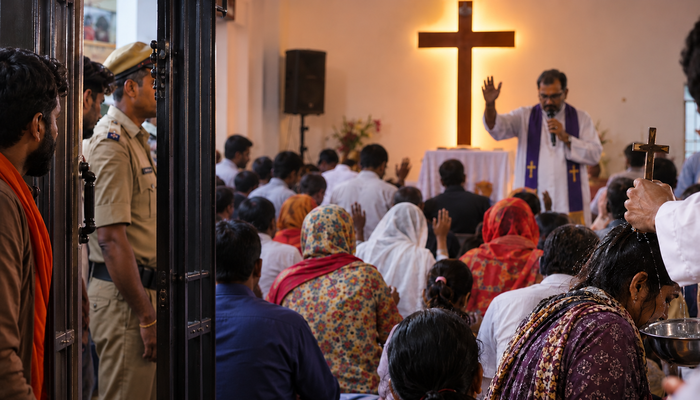
In Madhyamgram, North 24 Parganas, West Bengal, Hindu residents were targeted for forced religious conversion by Christian missionaries under the guise of ‘healing’, medical treatment and various training programmes. The incident came to light after local Hindu residents received information about religious conversion activities being conducted inside a house in Ward No. 19 under the pretext of providing healing and medical treatment. Prayers and religious ceremonies were presented as means of providing miraculous relief from illnesses and other ailments. This raised concerns that the medical and personal vulnerabilities of Hindus were being exploited to influence them towards Christianity. Following this information, local Hindus entered the premises and intervened to stop the conversion activities. As per reports, Christian missionaries had been operating in Madhyamgram for a considerable period and conducting various activities, including sewing training, computer classes and women's fellowship programmes. However, local Hindus stated that coercive religious conversion activities were being carried out under the cover of these programmes. Christian organisations, however, denied allegations of forced religious conversion, claiming that they only conducted prayers with people who voluntarily attended their meetings and that no one was being compelled to change their religion. Following the intervention by local residents, police reached the location, attempted to defuse tensions and brought the situation under control. An investigation into the activities taking place at the premises was initiated.
Why it is Hate Crime ?
This case has been added to the tracker under the primary category of: Predatory Proselytisation. Within it, the sub-category selected is: Conversion/ attempts to convert by inducement. Predatory Proselytisation is not just limited to threat, harassment, force and violence, but it also has contours of stealth. In several cases, the Hindu victim is exploited to convert, with non-Hindus taking advantage of their poverty. In such cases, the Hindu victim who is suffering financially is offered monetary benefits, including lucrative offers for jobs, health treatment, education, etc, to induce the victim into changing his/her religion. In such cases, the religious identity of the victim and the aim to disenfranchise him from his faith form the heart of the crime. Also, taking advantage of and exploiting an individual’s economic vulnerabilities is widely acknowledged as exploitation, forms of which are often penalised by law. Such cases therefore are considered religiously motivated hate crimes since the victim’s religious identity forms the very heart of the crime itself. The other subcategory selected is: Proselytisation by grooming, brainwashing, manipulation or subtle indoctrination. Religious brainwashing essentially means the often subtle and forcible indoctrination to induce someone to give up their religious beliefs to accept contrasting regimented ideas. Religious grooming or brainwashing also involves propaganda and manipulation. It involves the systematic effort, driven by religious malice and indoctrination, to persuade “non-believers’ to accept allegiance, command, or doctrine to and of a contrasting faith. Cases of such grooming or brainwashing are far more nuanced than direct threats, coercion, inducement and violence. In such cases, it is often seen that there is repeated, subtle and continual manipulation of the victim to induce disaffection towards their own faith and acceptance of the contrasting faith of the perpetrator. While subtle indoctrination is widely acknowledged as predatory, an element which is often understated in such conversions or the attempts of such conversion is the role of loyalty and trust which might develop between the perpetrator and the victim. Fiduciary relationships are often abused to affect such religious conversion. For example, an educator transmitting religious doctrine of a competing faith to a Hindu student. The Hindu student is likely to accept what the teacher is transmitting owing to existence of the fiduciary relationship. The exploitation of the fiduciary relationship to religiously indoctrinate victims would also be included in this category. Since the underlying animosity towards the victim’s faith forms the basis of predatory proselytization, such cases are considered religiously motivated hate crimes. This incident is a clear example of a religiously driven hate crime, as Hindu residents were targeted for coercive religious conversion to Christianity through inducements, manipulative healing practices and training programmes. The manner in which these activities were organised indicated an attempt to exploit the vulnerabilities of Hindu residents to influence them into abandoning their existing faith. The use of coercive means, including promises of healing and medical treatment and the organisation of various training programmes, completely undermined the victims' right to free and informed consent and violated their religious autonomy. Instead of respecting their freedom to practise and retain their Hindu faith, the perpetrators used inducements and manipulative means to influence them into embracing Christianity. This effectively treated the victims' existing religious identity as something inferior that needed to be displaced and stripped away through coercion. Such disregard for the religious identity and freedom of conscience of Hindu residents reflected deep-seated hostility towards Hinduism, making this a religiously driven offence. Furthermore, the promise of ‘healing’ and medical treatment acts as an inducement to secure religious conversion. These are not acts of goodwill or charity when they are made conditional upon or used to influence a change in religious identity. By offering relief from illnesses and medical difficulties as an incentive to embrace Christianity, the perpetrators exploited the vulnerabilities of Hindu residents and used their personal suffering as leverage to influence their religious choices. Such inducements deprive the victims of the ability to make a genuinely free and informed decision about their faith. Using medical needs as a means of persuading Hindus to abandon their religious identity demonstrates a disregard for their beliefs and reflects hostility towards their right to retain and practise Hinduism without coercion. The use of ‘healing’ as a conversion tactic also needs to be examined in the broader context of organised healing meetings, commonly known as ‘Changai Sabhas’, conducted by Christian missionaries across different parts of India. Such meetings have frequently been used to attract vulnerable individuals through promises that embracing Christianity would cure their illnesses and diseases. This practice is inherently manipulative, as it exploits people's desperation, medical vulnerabilities and lack of access to adequate treatment to influence their religious choices. Rather than embracing a faith out of genuine belief or personal conviction, individuals are influenced through promises of miraculous cures and relief from suffering. Such practices instrumentalise human suffering to facilitate religious conversion and reflect hostility towards the victims' existing religious identity. Exploiting the suffering of Hindu individuals to persuade them to abandon their faith demonstrates a disregard for their religious autonomy and treats their Hindu identity as something to be displaced through manipulation rather than respected as a matter of personal belief and freedom of conscience. These instances of targeted proselytisation activities stem from inherent hostility towards the victims' professed faith, since Abrahamic faiths believe that any non-adherent to their faith is subject to being dehumanised till they convert, making it a religiously motivated crime against Hindus. Therefore, this case is being added to the hate crime database of the Hinduphobia Tracker. Disclaimer: The Hinduphobia Tracker records incident dates based on when the crime occurred, rather than when it was reported by the media. However, in this case, media reports did not specify the exact date on which the incident took place and only mentioned the date of publication, 8 November 2026. Therefore, 8 November 2026 has been adopted as the indicative incident date for documentation purposes only.


Case Status
Unknown


Perpetrators Details
Perpetrators
Christian Extremists
Perpetrators Range
Unknown
Perpetrators Gender
unknown
 Sources



