Hindu sanitation worker targeted through false blasphemy accusation by Muslim man over minor altercation
 Hyderabad, Sindh, Pakistan
 18 August, 2019
Case Summary
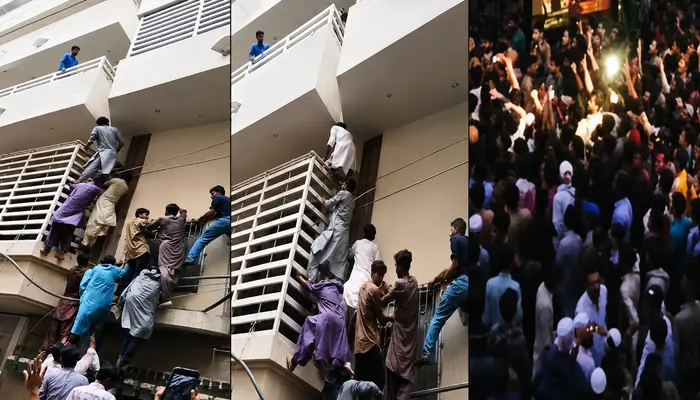
In the city of Hyderabad, Sindh province, Pakistan, a Hindu sanitation worker named Ashok Kumar was accused of burning pages of the Quran following an altercation with a Muslim shopkeeper, Bilal Abbasi. According to reports, the incident occurred on 19 August 2022, when Kumar was engaged in cleaning rubbish from the streets and burning the collected waste. During this time, he got into a brawl with a local Muslim shopkeeper, Bilal Abbasi. Following the altercation, the Hindu victim was accused of burning pages of the Quran along with the waste based on the complaint lodged by Bilal Abbasi. Following the incident, members of the extremist Islamist organisation Tehreek-e-Labbaik Pakistan (TLP) organised protests across Hyderabad, demanding the registration of a blasphemy case and Kumar's arrest. On Sunday, 21 August 2022, TLP members staged a protest outside a building housing Hindu families, where Kumar lived, and demanded that he be handed over to them. The gathering turned violent, prompting the police to use force to disperse the Muslim mob and prevent it from attacking Kumar. The Hindu families residing in the building were left frightened by the protests and the threats posed by the demonstrators. Police subsequently arrested Kumar, who was reportedly lodged at the Rabia Centre in the Saddar area of Hyderabad. A Hindu community leader from Hyderabad, who requested anonymity, criticised the police for arresting Kumar without conducting a proper investigation. Ravi Dawani also appealed to the Sindh government to ensure an impartial inquiry into the matter. Meanwhile, the incident triggered widespread tension across the city, with most markets remaining closed on Monday, 22 August 2022. At several locations, TLP protesters incited people and set fire to properties and vehicles. Senior Superintendent of Police (SSP) Amjad Sheikh stated that approximately 44 people had been arrested for their involvement in the violence, while seven police personnel, including a Station House Officer (SHO), had sustained injuries during stone-pelting incidents.
Why it is Hate Crime ?
This case has been added to the tracker under the primary category of - Attack not resulting in death. Within it, the sub-category selected here is - Attacked over 'Blasphemy'. Blasphemy essentially refers to the desecration of anything which is held sacred/holy to a group of people. However, for religious supremacist groups, the elements of ‘blasphemy’ are ever-changing, shifting and expanding – leading to infringement on the rights of other religious groups, freedom of speech and expression, threats and even physical violence. There are instances where blasphemy is also used as a dog whistle to target Hindus owing to intrinsic animosity towards Hinduism. There are several instances where stating truths as mentioned in the non-Hindu doctrine itself has led to unmitigated violence against Hindus. There have also been instances where non-Hindus have themselves created a ‘blasphemous’ situation, like placing a Quran in a temple, to use it as an excuse to attack Hindus. Essentially, Blasphemy charges are often made up and/or are used to shut down any form of criticism of non-Hindu faiths and as a tool to target Hindus. Any physical violence over Blasphemy charges against Hindus are foundationally based on animosity for Hindus and their faith owing to religious supremacist ideologies, therefore, such attacks would be documented as religious motivated hate crimes under this category. The other sub-category selected here is - Attacked for Hindu identity. In several cases, Hindus are attacked merely for their Hindu identity without any perceived provocation. A classic example of this category of religiously motivated hate crime is a murder in 2016. 7 ISIS terrorists were convicted for shooting a school principal in Kanpur because they got ‘triggered’ seeing the Kalava on his wrist and tilak that he had put. In this, the Hindu victim had offered no provocation except for his Hindu religious identity. The motivation for the murder was purely religious, driven by religious supremacy. Such cases where Hindus are targeted merely for their religious identity would be documented as a hate crime under this category. The incident constituted a case of religiously motivated targeting because a Hindu man was subjected to intimidation and mob hostility following an accusation of blasphemy by a Muslim shopkeeper. The circumstances surrounding the accusation were particularly significant. Ashok Kumar had been involved in a personal altercation with a local Muslim shopkeeper, Bilal Abbasi, over a non-religious matter. The subsequent blasphemy complaint, lodged by Abbasi following this dispute, transformed an ordinary personal disagreement into a religious controversy with life-threatening consequences for Kumar. In this case, the Hindu victim had not committed any blasphemy against Islam or mosques. However, merely because he got into an argument with a Muslim man over a completely non-religious issue, he was falsely accused of blasphemy by the Muslim shopkeeper. This demonstrated the perpetrator’s deep-seated religious animosity towards the Hindu victim, as the allegation was made with the malicious intent to mobilise members of the Muslim community against him by exploiting religious sentiments. In Muslim-majority countries such as Pakistan, accusations of blasphemy against Islam are frequently weaponised against Hindus and other religious minorities. In many such cases, it does not matter whether any blasphemy had actually taken place or whether the accused had made any remarks against Islam. A mere allegation is often enough to provoke outrage, communal mobilisation, threats, and violence against Hindus under the pretext of defending religion. This reflected hostility towards the victim because of his Hindu identity and transformed a non-religious dispute into a communal and life-threatening situation. Such allegations of blasphemy often rely on hearsay, selective interpretation, exaggeration, or completely fabricated claims, yet they remain capable of provoking immediate public outrage and vigilante reactions even before any impartial investigation takes place. Muslim extremists have historically exploited blasphemy allegations to intimidate religious minorities, particularly Hindus, silence dissent, and reinforce social control through fear and mob intimidation. Hindus remain especially vulnerable because allegations involving Islam frequently trigger communal mobilisation regardless of whether any credible evidence exists. Over the years, such accusations have repeatedly resulted in attacks on Hindu communities, destruction of Hindu homes and temples, forced displacement, social ostracism, long-term persecution, and, in several cases, even murders and beheadings carried out in the name of punishing alleged blasphemy. This broader pattern demonstrates how accusations of blasphemy are often weaponised as tools of religious persecution against Hindus because of their identity as a vulnerable religious minority. Such false accusations also create a constant atmosphere of fear, insecurity, and vulnerability within the Hindu community in Pakistan. Incidents like these send a broader message that even ordinary disagreements or personal disputes with members of the Muslim majority can rapidly escalate into life-threatening accusations carrying the risk of mob violence, social boycott, displacement, arrest, or death. The fear generated by such allegations discourages many Hindus from speaking openly, defending themselves, or seeking justice, as they remain aware that even an unverified accusation can place their lives in danger. This overall reflected the systemic insecurity, marginalisation, and communal intimidation faced by Hindus in Pakistan due to deep-rooted anti-Hindu hostility and religious prejudice. The communal dimension of the incident became evident from the response of Tehreek-e-Labbaik Pakistan (TLP), an extremist Islamist organisation, whose members mobilised crowds and organised demonstrations demanding Kumar's arrest and handover. The mobilisation was not limited to seeking an investigation into the accusation. TLP members gathered outside a building inhabited by Hindu families, creating an atmosphere of intimidation for the victim and other members of his religious community. The demand to hand Kumar over to the demonstrators was particularly serious, given the established pattern of mob violence surrounding blasphemy accusations in Pakistan. The involvement of an extremist Islamist organisation in mobilising collective hostility against a Hindu man demonstrated how an accusation involving the majority religion could be used to place a religious minority member in immediate danger. The case therefore demonstrated the intersection of religious identity, the weaponisation of blasphemy accusations and organised extremist mobilisation against a member of a vulnerable minority community. Although the initial altercation was personal and non-religious in nature, the subsequent response and false blasphemy accusation had clear and distinct communal dimension. The targeting of Kumar through an accusation involving Islam, the mobilisation of Muslim mob, and the intimidation of Hindu families demonstrated religious animosity; therefore, this case has been added to the hate crime database.
Victim Details
Total Victim
1
Deceased
0
Gender
- Male 1
- Female 0
- Third Gender 0
- Unknown 0
Caste
- SC/ST 1
- OBC 0
- General 0
- Unknown 0
Age Group
- Minor 0
- Adult 1
- Senior Citizen 0
- Unknown 0


Case Status
Unknown


Perpetrators Details
Perpetrators
Muslim Extremists
Perpetrators Range
Unknown
Perpetrators Gender
female
 Sources



