Hindu temple vandalised, perpetrator repeatedly made derogatory remarks against Hindu religious beliefs in Gorakhpur, Uttar Pradesh
 Gorakhpur, Uttar Pradesh, India
 2 June, 2026
Case Summary
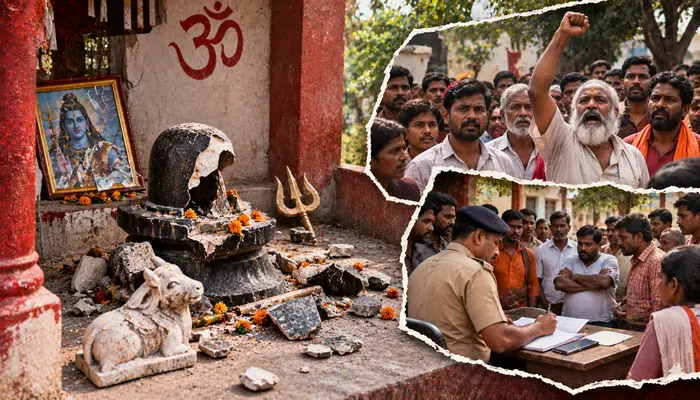
In the Bhadsar village, under the GIDA police station area of Gorakhpur district, Uttar Pradesh, on 3 June 2026, a Shiva temple was vandalised following a theft there earlier that week. According to the complaint filed by villagers, a theft had taken place at the religious site on 1 June 2026, and the Bhadsar police outpost had been informed. However, no action had been taken following the complaint. At around 7 am on 3 June 2026, a named individual arrived at the religious site accompanied by five or six associates carrying sharp weapons and began damaging it. When a person present at the site objected, the perpetrators threatened to kill him and falsely implicate him under the Scheduled Castes and Scheduled Tribes (Prevention of Atrocities) Act. As villagers gathered after hearing the commotion, the perpetrators fled the scene. Villagers also stated that the named individual had previously made remarks that hurt religious sentiments. The incident triggered anger among local residents, who gathered at the site and staged a protest demanding its restoration and strict action against those responsible. The villagers continued their protest until 10 am before approaching the GIDA police station with their demands. Following their complaint, the police registered a case against one named individual and an unidentified person and deployed additional police personnel in the village as a precautionary measure. GIDA Circle Officer Yogendra Singh stated that the police had reached the site after receiving information about the incident. The investigation identified a mentally disturbed youth as responsible for damaging the religious site. The police detained him and initiated further legal proceedings, including questioning.
Why it is Hate Crime ?
This case has been added to the tracker under the primary category of - Attack on Hindu religious representations. Within it, the sub-category selected here is - Attack on temples. In Hinduism, a temple is the abode of the Deity. The Deity in the Temple is consecrated, thereby, making it a real, breathing entity. Hindus believe that not just the Deity but the temple premises itself are sacred to Hindus since Hindus hold the faith that the entire Temple space is an amalgamation of the divine energy of the deity. Given the central significance of Temples in Hindu Dharma, any attack against a Hindu Temple or its peripheral premises is an attack on the faith itself and is born out of animosity towards the faith, of which, the Temple is a central tenet. Any manner of attack against a Temple and/or its premises would therefore be considered a religiously motivated hate crime. The other primary category is - Hate speech against Hindus. Within it, the sub-category selected here is- Anti-Hindu slurs, mocking faith. Anti-Hindu slurs and the deliberate mocking of the Hindu faith owing to religious animosity involve the usage of derogatory terms, stereotypes, or offensive references to religious practices, symbols, or figures. One of the common anti-Hindu slurs used against Hindus is “cow-worshipper” and “cow piss drinker”. The intention of using this term is to demean and mock Hindus as a group and their religious beliefs since Hindus consider the cow holy. Additionally, some symbols and the slurs attached to them have a historical context that exacerbates the insult, hate, stereotyping, dehumanisation and oppression against Hindus. Cow worship has been used for centuries to denigrate Hindus, insult their faith and oppress Hindus specifically as a religious group. There has been overwhelming documentation about how cow slaughter has been used to persecute Hindus with cow meat being thrown in temples and places of worship. There has also been overwhelming documentation where cow meat (beef) has been force-fed to Hindus to either forcefully convert them to Islam or denigrate their faith. Apart from cow worship, the Swastika – which holds deep religious significance for the Hindus – has also been misinterpreted and distorted to use as a slur against Hindus. Similarly, the worship of the Shivling has been used by supremacist ideologies and religions to denigrate Hindus owing to religious animosity. Such slurs and denigration stem out of inherent animosity and hate towards Hindus and their faith, therefore, it is categorised as hate speech targeted at Hindus specifically owing to their religious identity. The incident involved hostility directed towards a Hindu place of worship and the religious sentiments associated with it. The vandalism was not merely an instance of damage to private or public property, as it involved the deliberate desecration of a religious site. Hindu temples hold a central place in Hindu religious and cultural life, serving not merely as places of worship but as sacred spaces where devotees connect with their deities through prayer, rituals, offerings and festivals. They preserve centuries-old religious traditions, provide continuity to community practices and serve as centres of spiritual and cultural identity. Idols installed within temples are consecrated representations of Hindu deities and are treated with deep reverence by devotees. Consequently, vandalism or desecration of a Hindu temple or its sacred representations goes beyond physical damage to a structure or object; it constitutes an affront to the religious beliefs, devotional practices and sentiments of the Hindu community. The accused's history of making remarks that hurt Hindu religious sentiments constituted an important aspect of the religious hostility involved in the incident. Villagers stated that he had repeatedly made objectionable comments directed at Hindu religious beliefs, demonstrating that the hostility was not confined to the act of vandalism. Such derogatory remarks against a community's religious beliefs contribute to an atmosphere of religious intolerance by expressing contempt for its faith and undermining the dignity of its adherents. The accused's previous remarks therefore provided an important indication of his hostility towards Hinduism and its followers. When considered alongside the subsequent vandalism of a Hindu religious site, this history of anti-Hindu speech added a significant dimension to the incident, demonstrating hostility expressed through both derogatory verbal conduct and interference with a sacred religious space. The accused's response when confronted by a villager further demonstrated the hostile and intimidating nature of the incident. When a person objected to the damage being inflicted on the temple, the accused threatened to kill him and falsely implicate him under the SC/ST Act. Such threats were intended to silence opposition and intimidate anyone who attempted to defend the religious site. The intimidation of a person for objecting to the desecration of a place of worship also affected the wider community by discouraging residents from intervening against acts directed at their religious institutions. This conduct, viewed alongside the accused's previous derogatory remarks against Hindu religious sentiments, further illustrated the hostility and intimidation surrounding the incident. Additionally, in this case, the accused was identified as mentally disturbed. In several cases where perpetrators vandalise and desecrate Hindu places of worship, a usual trope to shield the perpetrator is to attribute the crime to the mental health of the accused, claiming that the crime was committed since the perpetrator was ‘mentally ill’ or ‘mentally unstable’. The police and the media, in many such cases where the crime has been committed against a Hindu places of worship, deny that the crime committed was in any way motivated by a religious bias and attribute it to the perpetrator’s mental health. Many a time the police downplay incidents of low-level communal crime because it is their jurisdiction that comes under question. The police also often say that the crime was committed since the accused was mentally unstable because they wish to ensure that owing to the crime already committed, there is no further flare-up in the area. In fact, there are many cases where this strategy has been used by the media to downplay such incidents where the crime was committed by a Muslim perpetrator, for example, the attack on the Gorakhnath temple or the incident in Telangana where two Muslim women wearing burqa tried to damage temple and church idols. The use of the "mental illness" trope to justify crimes targeting Hindu temples or idols by perpetrators raises critical questions. If perpetrators are indeed mentally unstable, why do they specifically target Hindu idols and places of worship, leaving mosques untouched? This selective focus suggests that such acts are not driven by mental health issues but by religious animosity. The repeated use of this narrative to downplay crimes against Hindus reflects a strategic effort to whitewash religious hatred, obscuring the true motivations and intentions behind the attacks.


Case Status
Unknown


Perpetrators Details
Perpetrators
Unknown
Perpetrators Range
From 5 to 10
Perpetrators Gender
male
 Sources



