Minor Hindu student subjected to religious discrimination by Muslim teacher in Bangladesh; forced to clean toilets and isolated from other Muslim classmates
 Sherpur District, Bangladesh
 12 November, 2026
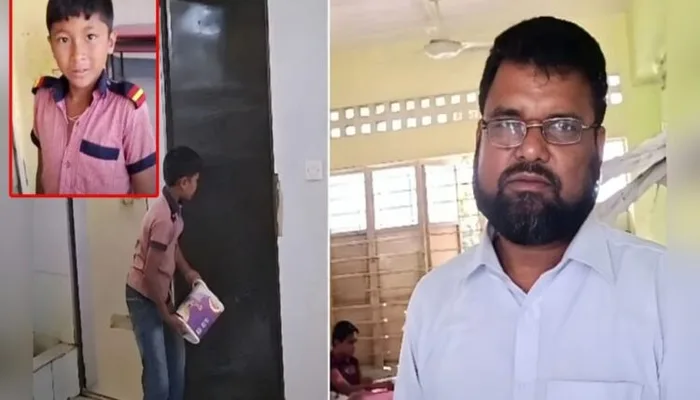
Case Summary
In Sherpur, Bangladesh, a fifth-grade Hindu student, Pranoy, was subjected to religious discrimination and humiliating treatment by Muslim assistant teacher Badsha Alamgir alias Mohammad Masud. The teacher forced the minor Hindu boy to clean the school toilets during class hours and made him sit separately from his Muslim classmates, preventing him from interacting and socialising with them. As per media reports, the incident took place on 13 November 2026 at a government primary school in Gazir Khamar Chakpara of Sherpur district. A video of the incident circulated on social media, showing the Hindu student cleaning the toilets in the school's bathroom area. The people recording the video approached the child and questioned him about why he was cleaning the toilets. The student explained that his Muslim teacher had specifically instructed him to clean the washrooms. When they subsequently confronted the teacher, he defended his actions by claiming that the student had entered the classroom at 12:10 pm, later than the scheduled time, and that this was why he had been sent out of the classroom. He denied instructing the child to clean the toilets. However, when the people questioned the Hindu student again, he reiterated that the Muslim teacher had specifically instructed him to clean the washrooms. When asked whether he had assigned the cleaning work to the child because he was a Hindu, the Muslim teacher avoided giving a direct response. Instead, he repeatedly questioned who had made the accusation, while attempting to justify his conduct. When the Hindu child subsequently returned to the classroom, the video clearly showed that he was made to sit alone on one side, physically separated from the handful of other students present in the classroom. During the confrontation, the teacher also began scolding the child, further intimidating the Hindu student. The incident sparked widespread condemnation after videos and photographs of the Hindu child circulated on social media. Members of Bangladesh's Hindu community and other social media users denounced the religious discrimination and humiliation inflicted on the child within an educational institution. They questioned how a student who should have been carrying books and notebooks could instead have been forced to clean school toilets during class hours. Many stressed that a child's dignity and right to equal treatment should take precedence over religious differences and that discrimination and humiliation of students had no place in educational institutions. This incident occurred against the broader backdrop of the historical persecution faced by Hindus in Bangladesh. While the Hindu minority has endured discrimination, targeted violence, and religious hostility over decades, such persecution has intensified in distinct spurts during periods of political and social instability. The latest major escalation began after the ouster of Sheikh Hasina’s government in August 2024, continued after the death of Sharif Osman Bin Hadi in December 2025, and resurfaced in the immediate aftermath of the 13th National Parliamentary Election in 2026. Following the ouster of Sheikh Hasina, multiple incidents involving attacks on Hindu homes, temples and religious institutions were documented, alongside intimidation, arson and mob violence targeting Hindu localities. The Hinduphobia Tracker recorded 336 incidents involving the Hindu minority during this period, reflecting the scale of the escalation and the continuing vulnerability of Hindus in Bangladesh. A further spurt of violence followed the death of Sharif Osman Bin Hadi, a Muslim political activist and student leader known for his anti-Hindu and anti-India rhetoric, in December 2025. In the aftermath, Hindu communities were subjected to retaliatory violence, with Hindu homes and properties selectively attacked and several families forced to flee. Among the victims was Dipu Chandra Das, who was lynched by a Muslim mob over false blasphemy allegations, after which his body was set ablaze. The Hinduphobia Tracker documented 51 incidents of anti-Hindu violence in the period following Hadi’s death alone, further illustrating how existing hostility towards the Hindu minority intensified during moments of communal mobilisation. During the same period, posters and written material calling for the extermination of Hindus were also displayed in public spaces. Such rhetoric, when viewed alongside incidents of arson, vandalism, assault and targeted intimidation, reflected an environment in which hostility towards Hindus was not merely episodic but repeatedly resurfaced in more intense forms during periods of unrest. The most recent escalation followed the 13th National Parliamentary Election in 2026. In the immediate aftermath of the election results, Hindu families in districts including Noakhali, Rangpur, Nilphamari, Sylhet, Thakurgaon and Dinajpur faced attacks involving arson, looting, assault and vandalism of Hindu homes and temples. In several instances, Hindu properties were selectively targeted, and families were threatened with displacement. The present incident therefore occurred within a much longer history of persecution of Hindus in Bangladesh, where hostility towards the community has persisted over time and intensified in repeated spurts. The latest cycle began after the ouster of Sheikh Hasina and continued through subsequent periods of political and communal upheaval, leaving the Hindu minority increasingly vulnerable to targeted violence, intimidation and religious hostility.
Why it is Hate Crime ?
This case is being added to the tracker under the primary category: Attack not resulting in death. The subcategory selected is: Attacked for Hindu identity. In several cases, Hindus are attacked merely for their Hindu identity without any perceived provocation. A classic example of this category of religiously motivated hate crime is a murder in 2016. 7 ISIS terrorists were convicted for shooting a school principal in Kanpur because they got ‘triggered’ seeing the Kalava on his wrist and tilak that he had put. In this, the Hindu victim had offered no provocation except for his Hindu religious identity. The motivation for the murder was purely religious, driven by religious supremacy. Such cases where Hindus are targeted merely for their religious identity would be documented as a hate crime under this category. This incident exhibited clear characteristics of a religiously driven hate crime, as a Hindu minor student was selectively targeted by a Muslim teacher, subjected to degrading treatment and segregated from his Muslim classmates. The circumstances surrounding the incident indicated hostility towards the victim on account of his Hindu identity, rather than merely an instance of routine school discipline. The first marker of religious hostility was the selective targeting of the Hindu student, who was made to clean the school toilets during class hours. The minor was subjected to degrading menial work that humiliated him and deprived him of the dignity he was entitled to as a student. No other child was subjected to such treatment, and the Hindu student alone was singled out and made to perform this humiliating task. The selective nature of this treatment demonstrated that he was being treated differently from his classmates on account of his Hindu identity. Subjecting a Hindu child to such degrading treatment within an educational institution reflected religious hostility and constituted the first marker of discriminatory targeting. The second marker was the deliberate segregation of the Hindu student from his Muslim classmates. The teacher prevented the child from interacting and socialising with the other students and made him sit separately in the classroom. The video clearly showed the Hindu boy sitting alone on one side, physically isolated from the handful of other students present. This deliberate exclusion established a religious distinction between the Hindu child and his Muslim classmates, denying him the opportunity to participate in the classroom environment on equal terms. Isolating a Hindu student from his peers while allowing the other children to sit together reflected religious discrimination and reinforced his exclusion on account of his faith. The third marker emerged from the teacher's response when confronted about the incident. The Hindu student explicitly stated that the teacher had instructed him to clean the toilets. When the teacher was questioned about whether he had assigned the task because the child was a Hindu, he avoided addressing the accusation and instead repeatedly questioned who had made it. He attempted to justify his conduct by referring to the child's late arrival in the classroom. However, when the student reiterated that the teacher had specifically instructed him to clean the washrooms, the teacher neither addressed his account nor provided a direct response to the accusation of religious discrimination. Instead, he began scolding and intimidating the minor. His decision to intimidate the child rather than address the discriminatory treatment further demonstrated the hostility directed towards the Hindu student. The incident must also be examined against the broader backdrop of the historical persecution and discrimination faced by Hindus in Bangladesh. The Hindu community has endured decades of religious hostility, targeted violence, killings, intimidation, property encroachment, forced displacement, discrimination and coercive religious conversion. The situation deteriorated further following the ousting and departure of former Prime Minister Sheikh Hasina from Bangladesh in August 2024, after which Hindu communities, their homes, businesses and religious institutions faced renewed attacks. This wider atmosphere of anti-Hindu hostility is significant because it demonstrates the vulnerability of Hindu minorities and the different ways in which hostility towards their religious identity manifests itself. Discrimination is not confined to physical attacks or violence against religious institutions; it also extends to everyday spaces, including educational institutions, where Hindu children are entitled to safety, dignity and equal treatment. Between 1 January 2023 and 16 November 2026, the Hinduphobia Tracker documented more than 703 incidents of religiously driven hate crimes against Hindus in Bangladesh. These incidents involved different forms of targeting, including physical violence, killings, attacks on Hindu religious institutions, intimidation, discrimination, forced conversion and other forms of religious hostility. The scale of these documented cases highlights that the persecution of Hindus is not confined to isolated incidents but reflects a recurring pattern of religiously motivated targeting. In this context, the humiliation and segregation of the Hindu schoolboy cannot be viewed merely as an instance of school punishment without considering the wider atmosphere of hostility towards Hindus in Bangladesh. The selective targeting of a Hindu child, his exclusion from his Muslim classmates and the degrading treatment he experienced reflect the discrimination and religious animosity faced by the Hindu community in the country. This broader pattern of anti-Hindu hostility provides important context for understanding the incident and how the victim's Hindu identity influenced his treatment. Overall, this incident met the parameters for inclusion as a religiously driven hate crime and was therefore added to the Hate Crime Database of the Hinduphobia Tracker.
Victim Details
Total Victim
1
Deceased
0
Gender
- Male 1
- Female 0
- Third Gender 0
- Unknown 0
Caste
- SC/ST 0
- OBC 0
- General 0
- Unknown 1
Age Group
- Minor 1
- Adult 0
- Senior Citizen 0
- Unknown 0


Case Status
Unknown


Perpetrators Details
Perpetrators
Muslim Extremists
Perpetrators Range
One Person
Perpetrators Gender
male
 Sources



