Statue of revered Hindu saint vandalised on Diwali night at Medak, Telangana
 Medak, Telangana, India
 7 November, 2026
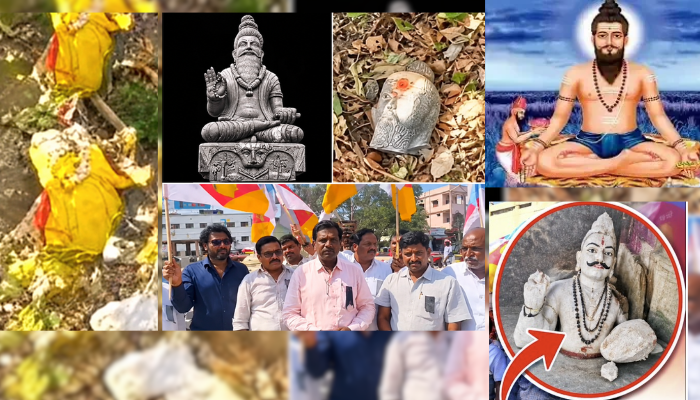
Case Summary
In Narsapur mandal, Medak district, Telangana, a 30-year-old statue of revered Hindu saint Sri Madvirat Pothuluri Veerabrahmendra Swamy was vandalised by unidentified miscreants. The vandalism occurred near the Chinnachintakunta village on the night of 8 November 2026, which coincided with Diwali. The incident triggered anger among local residents and Hindu organisations. Upon learning about the vandalism, BJP leaders and members of Hindu organisations reached the spot and staged a protest by blocking the main road, bringing traffic on the national highway to a standstill and causing a jam stretching nearly a kilometre. During the protest, BJP leaders Raghuveer Reddy and Goda Rajender condemned the desecration of the historic statue and demanded that the police immediately investigate the incident, identify those responsible and punish them severely. They also demanded the reconstruction of the temple and measures to protect it from anti-social elements. Members of the Vishwakarma community, Hindu community leaders and other Hindu organisations also participated in the protest and condemned the vandalism. Notably, Sri Madvirat Pothuluri Veerabrahmendra Swamy, popularly revered as Brahmamgaru, was a prominent Telugu Hindu saint, yogi, philosopher and prophetic figure. He is particularly revered for his Kalagnanam (also known as Kalajnanam), a collection of prophetic verses and spiritual teachings believed by devotees to foretell future events. His teachings, which also emphasised spiritual wisdom and social equality, have had a lasting influence on Telugu Hindu traditions, with his prophecies remaining deeply rooted in popular devotional belief. He is venerated by devotees across Andhra Pradesh and Telangana, with his shrines and mutts serving as important centres of worship and pilgrimage.
Why it is Hate Crime ?
This case has been added to the tracker under the primary category of Attack on Hindu religious representations. Within it, the sub-category selected is Desecration of Hindu religious symbols. Icons and symbols, or religious representations of a spiritual ideal, are widely revered in Hinduism. Iconography is of vital significance in the Hindu milieu. It helps connect people’s spiritual beliefs with the real world. Iconography within the Hindu faith takes several shapes and forms. Murtis are of the greatest significance to Hindus, to which daily rituals, prayers, and offerings are done. Besides the murtis, there are several other symbols which have deep significance in the Hindu faith – the Om and Swastika, for example. Since these Hindu religious symbols hold paramount importance in Hinduism, any desecration of symbols, icons, murtis, religious representations, ns and manifestations is driven by animosity towards the faith itself, which manifests through these murtis, icons, and symbols. Therefore, any desecration of these Hindu religious symbols and representations is considered a religiously motivated hate crime under this category. This incident is a clear example of a religiously motivated hate crime, as unidentified perpetrators vandalised the statue of a revered Hindu saint on the night of Diwali, a sacred Hindu festival. Hindu saints hold immense religious and spiritual significance within Hinduism, as they are revered for their spiritual wisdom, teachings, devotion and contributions to religious traditions. Statues of Hindu saints serve as sacred representations of these revered figures and are objects of devotion, respect and veneration for devotees. Sri Madvirat Pothuluri Veerabrahmendra Swamy, popularly known as Brahmamgaru, was a revered Hindu saint within the Telugu Hindu religious tradition. He was known for his spiritual teachings and Kalagnanam, a collection of prophetic verses believed by devotees to foretell future events. He continues to be deeply revered among Telugu Hindus, particularly in Andhra Pradesh and Telangana. Therefore, vandalising his statue amounted to the desecration of a sacred religious symbol, directly offending Hindu religious sentiments and causing outrage among the Hindu community. The act reflected disregard for the religious beliefs, faith and reverence of Hindus towards their saints and sacred representations. The deliberate targeting of a revered Hindu saint's statue, particularly on the sacred occasion of Diwali, demonstrated contempt for Hindu religious sentiments and constituted an act of religiously motivated hostility towards the Hindu community. The timing of the vandalism made the incident particularly disturbing. Diwali is one of the most sacred festivals in Hinduism, celebrated through prayers, worship, temple visits and the triumph of light over darkness. While Hindu devotees were observing the festival, the statue of a revered Hindu saint was subjected to deliberate desecration. Such an act undeniably expresses deep-seated hostility of the miscreants against Hindus and their festivals. Destruction of a sacred spiritual figure on an important religious occasion intensified the hurt and outrage among the Hindu community and undermined the sense of security surrounding their religious symbols and heritage. Although the perpetrators remained unidentified at the time of reporting, the nature of the desecration and its timing raised serious concerns about anti-Hindu hostility. The act was not merely vandalism of a physical structure but an attack on a figure deeply revered by Hindu devotees and the religious sentiments associated with him. Therefore, this case is being added to the hate crime database of the Hinduphobia Tracker.


Case Status
Unknown


Perpetrators Details
Perpetrators
Unknown
Perpetrators Range
Unknown
Perpetrators Gender
unknown
 Sources



