Hindu deity's idol damaged; Chhath Puja altar vandalised by unknown miscreants in Gorakhpur, Uttar Pradesh
 Gorakhpur, Uttar Pradesh, India
 11 November, 2026
Case Summary
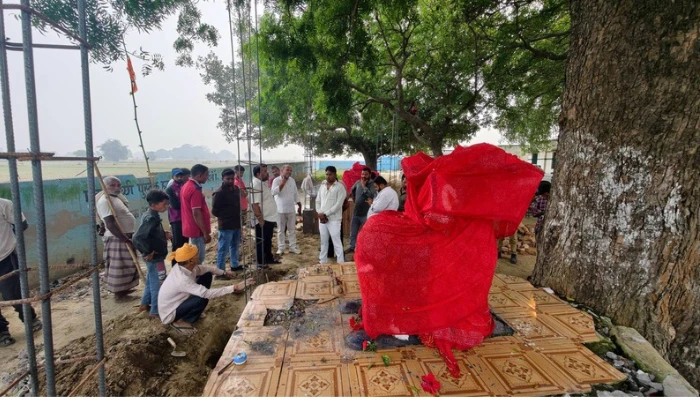
A Hindu religious site was desecrated at the Composite School premises in Amari village, Gorakhpur district, Uttar Pradesh. The miscreants damaged the idol of Goddess Kali and the temple premises. They also vandalised the altar constructed at the Chhath Puja ghat located within the same school premises. The incident came to light on Thursday morning, 12 November, 2026, when residents reached the site and found the idol of Goddess Kali and the altar at the Chhath ghat damaged. The discovery angered villagers, who demanded that the police identify those responsible and take prompt action. After the incident, the Gram Pradhan submitted a written complaint to the police, on which an FIR was registered against unidentified persons. The police began an investigation to identify the perpetrators and take legal action. Dr Sanjay Kumar Nishad, MLA from the Chauri Chaura constituency, visited the site after receiving information about the incident. He inspected the damaged idol and the temple premises and held discussions with administrative officials. He directed authorities to install a new idol of Goddess Kali as soon as possible and identify those involved in the vandalism for strict legal action. Several local representatives and party workers accompanied him during the visit, including district panchayat member Ram Preet Yadav, Mandal president Sandeep Mishra, district minister Sugriv Tiwari, Vinay Gupta, Nemdhari Paswan, Gaurav Mishra and Amit Jaiswal.
Why it is Hate Crime ?
This case has been added to the tracker under the primary category of Attack on Hindu religious representations. Within it, the sub-category selected is Desecration of Hindu religious symbols. Icons and symbols, or religious representations of a spiritual ideal, are widely revered in Hinduism. Iconography is of vital significance in the Hindu milieu. It helps connect people’s spiritual beliefs with the real world. Iconography in the Hindu faith takes several forms. Murtis are of the greatest significance to Hindus, and daily rituals, prayers, and offerings are performed before them. Besides the murtis, there are several other symbols which have deep significance in the Hindu faith – the Om and Swastika, for example. Because these Hindu religious symbols hold paramount importance in Hinduism, any desecration of symbols, icons, murtis, religious representations, and manifestations is driven by animosity toward the faith itself, which is expressed through these murtis, icons, and symbols. Therefore, any desecration of these Hindu religious symbols and representations is considered religiously motivated hate crimes under this category. The other sub-category selected here is - Violence against religious structures or centres. In Hinduism, a religious structure is also considered divine. Hindus believe that not just the Deity but the religious structure itself is sacred. In this sub-category, we would document attacks against religious structures that are not consecrated temple spaces. Such religious spaces could be temporary in nature – for example – the religious spaces erected specifically for festivals like Durga Puja, etc. This category would also document cases of attacks against religious centres. These spaces may not be ‘sacred’ per se; however, they are often where religious gurus live, religious teaching is imparted, or religious institutions are located. Any attack against religious structures is a result of animosity towards the religion itself, which manifests itself through the religious spaces; therefore, such attacks are considered religiously motivated hate crimes. Religious centres are also manifestations of the religion, its teachings, or gurus, and therefore, attacks against such centres would be considered religiously motivated hate crimes. The other sub-category selected is: Attack on temples. In Hinduism, a temple is the abode of the Deity. The Deity in the Temple is consecrated, thereby making it a real, breathing entity. Hindus believe that not only the Deity but the temple premises themselves are sacred, since they hold that the entire Temple space is an amalgamation of the deity's divine energy. Given the central significance of Temples in Hindu Dharma, any attack on a Hindu Temple or its premises is an attack on the faith itself and stems from animosity toward the faith, of which the temple is a central tenet. Any manner of attack against a Temple and/or its premises would therefore be considered a religiously motivated hate crime. This incident was included in the Hinduphobia Tracker because the vandalism targeted Hindu religious symbols and spaces of worship, reflecting hostility towards Hindu religious faith and practices. The desecration of the sacred murti of Maa Kali struck directly at Hindu devotees' religious sentiments and spiritual beliefs. In Hinduism, murtis are revered as sacred manifestations of the divine, and temples serve as important centres of worship, prayer and community life. Deliberately damaging these sacred representations amounted to an affront to the faith and religious identity of the devotees who worshipped there. The vandalism of the Chhath Puja altar carried an additional religious significance. Chhath Puja is an important Hindu festival dedicated to Surya Dev (the Sun God) and Chhathi Maiya, during which devotees observe rigorous rituals, offer arghya to the rising and setting sun and pray for the well-being of their families. The altar at a Chhath ghat is integral to these religious observances. Damaging it therefore disrupted a sacred space associated with collective worship, devotion an, and religious traditions. Such desecration showed contempt not only for Hindu places of worship but also for the religious practices through which devotees expressed their faith. Targeting both the Kali Mata shrine and the Chhath Puja altar reflected hostility toward expressions of Hindu religious life. The damage extended beyond physical structures, striking at spaces that carried deep spiritual and cultural significance for the Hindu community. Furthermore, the incident affected the wider Hindu community beyond the immediate damage to the temples. Places of worship serve as centres of religious practice and community life, and their desecration creates fear and insecurity among devotees regarding the safety of their religious institutions. It is important to mention here that, though the last update was that the miscreants were unknown, regardless, the action stemmed from hostility against Hinduism and resulted in the desecration of the sacred idol and the religious space and would therefore be considered a religiously motivated hate crime.


Case Status
Complaint filed


Perpetrators Details
Perpetrators
Unknown
Perpetrators Range
Unknown
Perpetrators Gender
unknown
 Sources



