Hindu deities and Hindu communities targeted through derogatory remarks by Muslim man in Rewa, Madhya Pradesh
 Rewa, Madhya Pradesh, India
 10 November, 2026
Case Summary
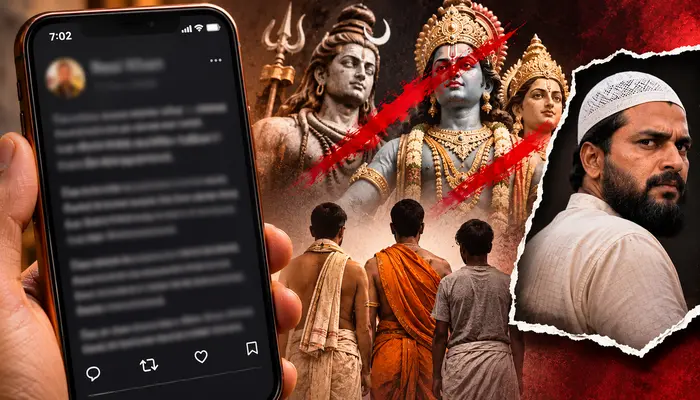
In Rewa, Madhya Pradesh, Hindu deities were denigrated and objectionable comments were made against the Brahmin, Kshatriya and Shudra communities by a Muslim man named Resi Khan on social media. According to reports, Sudhir Pandey (38), son of Udaynath Pandey and a resident of Dhekha, stated that he had been at a shop situated in front of his house at around 7 pm on 11 November 2026, when he learnt about an unidentified individual circulating objectionable material on social media. The material contained derogatory comments about Hindu deities, as well as the Brahmin and Shudra communities. Pandey stated in his complaint that the content had hurt religious and social sentiments. He subsequently approached the Civil Lines police station and lodged a formal complaint. Based on his complaint, the police registered a case against unknown persons and initiated an investigation. Although the complaint also mentioned Resi Khan in connection with the matter, the case was registered against unidentified persons. Civil Lines police station in-charge Manisha Upadhyay confirmed that an investigation and legal proceedings had been initiated. The investigation was assigned to Assistant Sub-Inspector Akhilesh Kumar Patel, who was tasked with identifying the individual responsible for circulating the objectionable material on social media.
Why it is Hate Crime ?
This case has been added to the tracker under the primary category of - Hate speech against Hindus. Within it, the sub-category selected here is - Anti-Hindu slurs, mocking faith. Anti-Hindu slurs and the deliberate mocking of the Hindu faith owing to religious animosity involve the usage of derogatory terms, stereotypes, or offensive references to religious practices, symbols, or figures. One of the common anti-Hindu slurs used against Hindus is “cow-worshipper” and “cow piss drinker”. The intention of using this term is to demean and mock Hindus as a group and their religious beliefs since Hindus consider the cow holy. Additionally, some symbols and the slurs attached to them have a historical context that exacerbates the insult, hate, stereotyping, dehumanisation and oppression against Hindus. Cow worship has been used for centuries to denigrate Hindus, insult their faith and oppress Hindus specifically as a religious group. There has been overwhelming documentation about how cow slaughter has been used to persecute Hindus with cow meat being thrown in temples and places of worship. There has also been overwhelming documentation where cow meat (beef) has been force-fed to Hindus to either forcefully convert them to Islam or denigrate their faith. Apart from cow worship, the Swastika – which holds deep religious significance for the Hindus – has also been misinterpreted and distorted to use as a slur against Hindus. Similarly, the worship of the Shivling has been used by supremacist ideologies and religions to denigrate Hindus owing to religious animosity. Such slurs and denigration stem out of inherent animosity and hate towards Hindus and their faith, therefore, it is categorised as hate speech targeted at Hindus specifically owing to their religious identity. The incident qualified for classification as a hate crime because the objectionable social media content specifically targeted Hindu religious beliefs and Hindu caste communities through derogatory remarks about Hindu deities and the Brahmin, Kshatriya and Shudra communities. Hindu deities hold a central and deeply revered place in Hindu religious life, worship and spiritual traditions. They are not merely symbolic figures but are regarded as divine manifestations and are worshipped through prayers, rituals, festivals and daily religious practices by millions of Hindus. Consequently, derogatory remarks directed at Hindu deities constituted an affront to figures central to the faith and had the potential to demean the religious beliefs and sentiments of Hindu worshippers. The targeting of Hindu deities was particularly significant because it extended the hostility beyond individual disagreements or criticism of particular practices to the denigration of sacred elements of Hinduism. Furthermore, the inclusion of the Brahmin, Kshatriya and Shudra communities in the derogatory content extended the targeting beyond Hindu religious figures to identifiable sections of Hindu society. These communities represented distinct caste groups within Hindu society, and disparaging remarks directed at them sought to demean people on the basis of their caste and religious backgrounds. Such remarks were significant because they reduced entire communities to targets of ridicule and contempt on account of their social identities, reinforcing caste-based stereotypes and hostility towards their members. Considered alongside the derogatory remarks about Hindu deities, the references to these communities demonstrated that the content extended its disparagement to both the sacred beliefs and the social composition of Hindu society. The simultaneous targeting of Hindu religious figures and multiple Hindu communities therefore gave the incident a broader anti-Hindu dimension, rather than making it a case of isolated insults directed at particular individuals. The circulation of such material on social media also gave the derogatory remarks a wider audience, extending their reach beyond a private interaction and exposing members of the targeted communities to expressions that demeaned their religious beliefs and social identities. Social media in general has devolved into a hub of anti-Hindu vitriol, inundated with derogatory memes, comments, and images that relentlessly mock and abuse Hinduism, its deities, and its revered scholars. These coordinated assaults permeate platforms daily, transforming sacred icons into punchlines and caricatures. This pervasive pattern of anti-Hindu hate speech constitutes clear instances of online Hinduphobia, inflicting profound hurt on Hindu sentiments and rendering the community a perpetual target for ridicule and abuse. Since this case meets the parameters of a religiously motivated offence, it is being added to the hate crime database of the Hinduphobia Tracker.


Case Status
Complaint registered


Perpetrators Details
Perpetrators
Muslim Extremists
Perpetrators Range
One Person
Perpetrators Gender
male
 Sources



