17-year-old Hindu girl abducted and pressured to convert by Muslim man; victim's parents abused and threatened with violence
 Budaun, Uttar Pradesh, India
 29 October, 2026
Case Summary
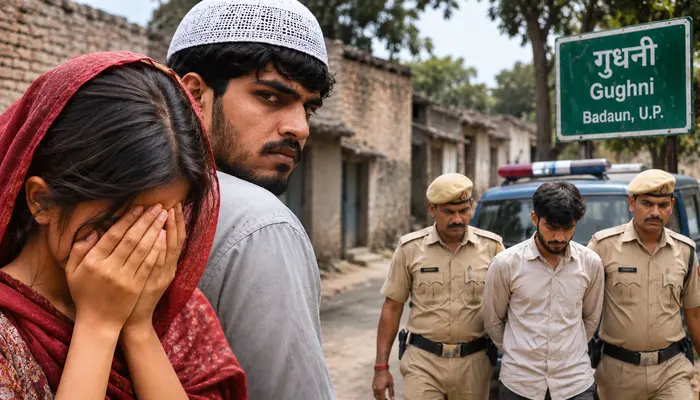
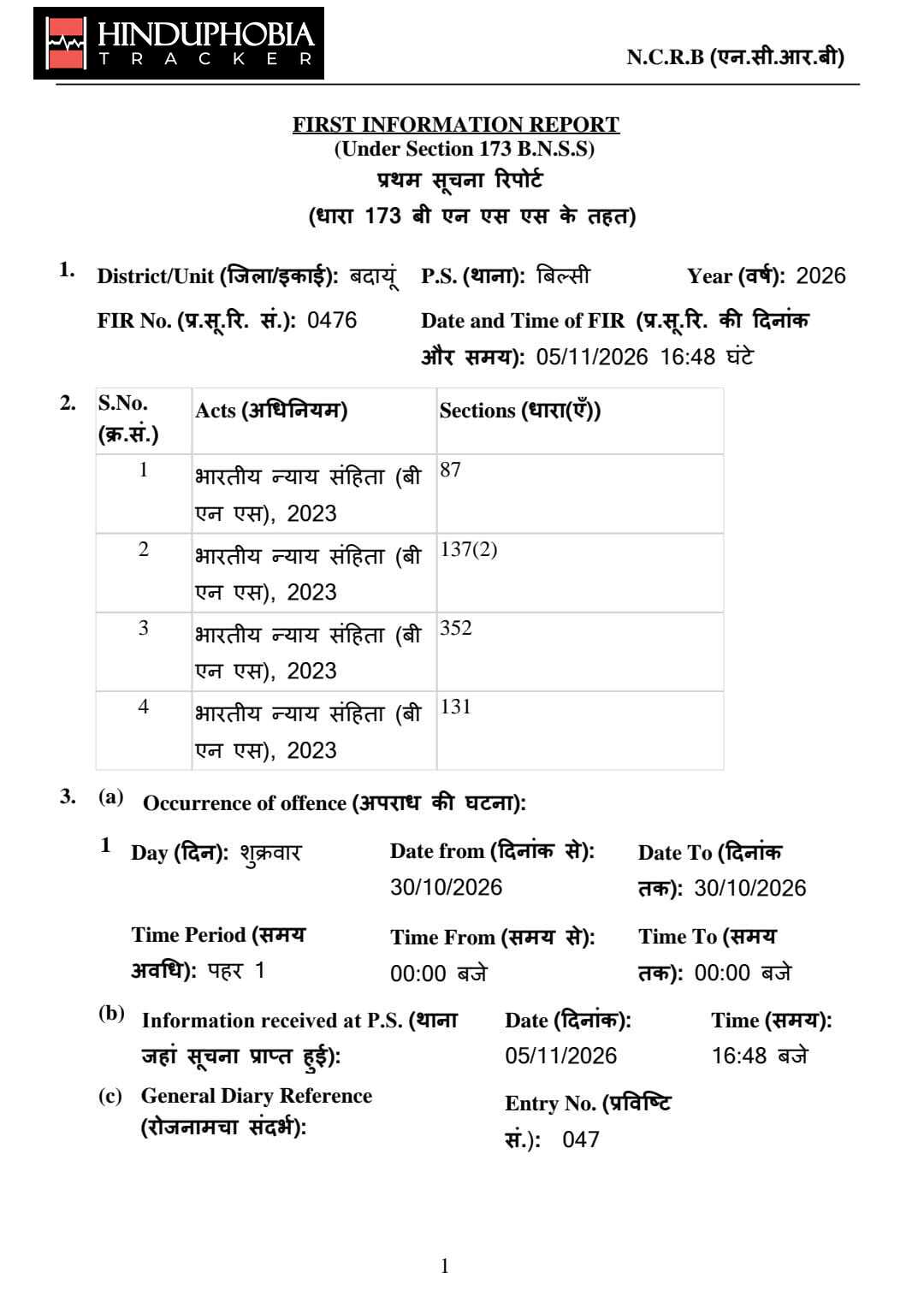
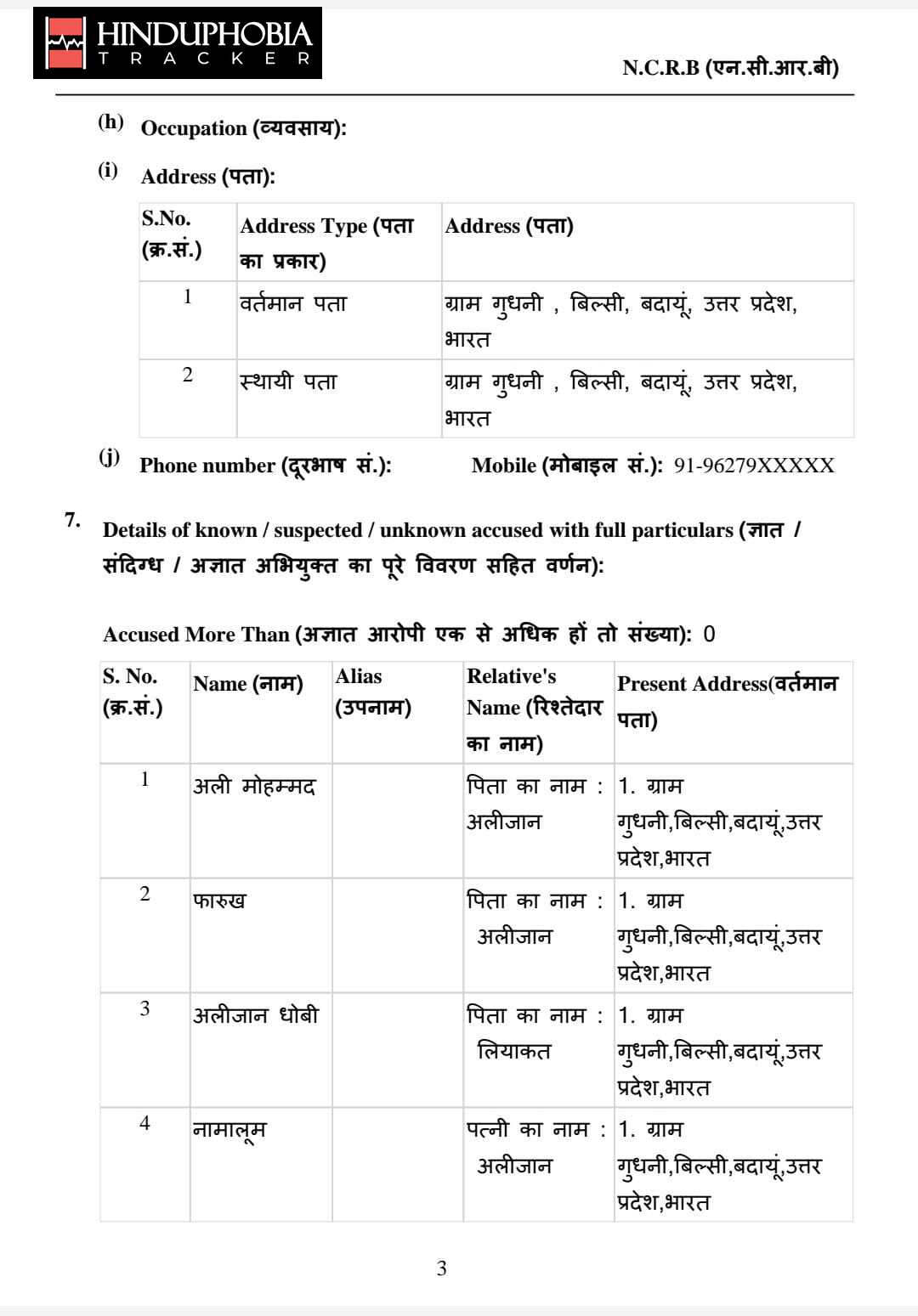
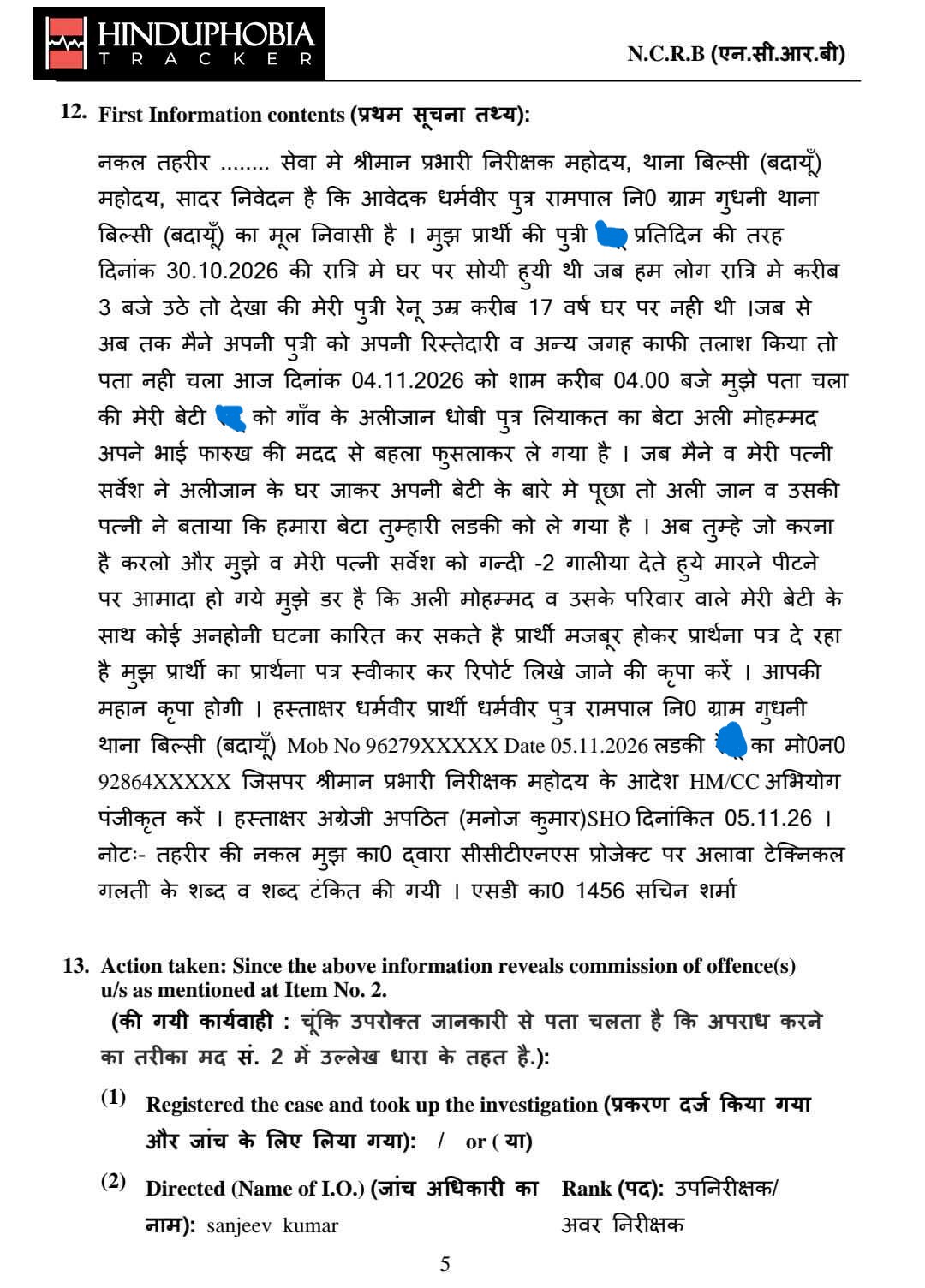
In the Gughni village of Badaun district, Uttar Pradesh, a 17-year-old Hindu girl was abducted and pressured for religious conversion by a Muslim man named Ali Mohammad. The Hinduphobia Tracker obtained the First Information Report (FIR) filed by the victim's father, Dharamveer. He stated that on the night of 30 October 2026, Renu had been sleeping at home as usual, but when her family woke up at around 3 am, they found that she was missing. Her father searched for her among relatives and at other places but could not trace her. On 4 November 2026, at around 4 pm, he learnt that a Muslim man named Ali Mohammad, son of Alijan Dhobi and a resident of the same village, had lured his daughter away with the assistance of his brother, Farukh. When Dharmveer and his wife went to Ali Mohammad's house to enquire about their daughter, Ali Mohammad's father, Alijan, and mother told them, "Our son has taken your daughter. Now do whatever you want to do." They then verbally abused Dharmveer and Sarvesh with filthy language and attempted to assault them. Furthermore, they also stated that Ali Mohammad lured her away and pressured her to convert her religion. Dharmveer expressed fear that Ali Mohammad and his family members might harm his daughter and submitted a written complaint to the Bilsi police on 5 November 2026, requesting the registration of a case. The Station House Officer, Manoj Kumar, ordered the registration of the case, following which the police registered an FIR against four people and initiated an investigation under Sub-Inspector Sanjeev Kumar. Police began searching for both Renu and Ali Mohammad following the registration of the case. On 6 November 2026, the police recovered Renu and took her into their custody, but Ali Mohammad fled and remained absconding. On 13 November 2026, acting on information received from an informer, Bilsi police arrested Ali Mohammad near the passenger shelter at Girdharpur village, along the Kachhla-Shahabad Highway. Bilsi Police Station in-charge Manoj Kumar Singh confirmed that Renu and Ali Mohammad belonged to the same village. Circle Officer Alok Sidhu also confirmed that Renu had already been recovered and taken into police custody. Following his arrest, Ali Mohammad was produced before the court on 13 November and subsequently sent to jail.
Case Images
Why it is Hate Crime ?
This case is being added to the tracker under the primary category: Predatory Proselytisation. The subcategory selected is: Proselytisation by grooming, brainwashing, manipulation or subtle indoctrination. The tertiary categories selected are: Conversion of minor and Family claims grooming. Religious brainwashing essentially means the often subtle and forcible indoctrination to induce someone to give up their religious beliefs to accept contrasting regimented ideas. Religious grooming or brainwashing also involves propaganda and manipulation. It involves the systematic effort, driven by religious malice and indoctrination, to persuade “non-believers’ to accept allegiance, command, or doctrine to and of a contrasting faith. Cases of such grooming or brainwashing are far more nuanced than direct threats, coercion, inducement and violence. In such cases, it is often seen that there is repeated, subtle and continual manipulation of the victim to induce disaffection towards their own faith and acceptance of the contrasting faith of the perpetrator. While subtle indoctrination is widely acknowledged as predatory, an element which is often understated in such conversions or the attempts of such conversion is the role of loyalty and trust which might develop between the perpetrator and the victim. Fiduciary relationships are often abused to affect such religious conversion. For example, an educator transmitting religious doctrine of a competing faith to a Hindu student. The Hindu student is likely to accept what the teacher is transmitting owing to existence of the fiduciary relationship. The exploitation of the fiduciary relationship to religiously indoctrinate victims would also be included in this category. Since the underlying animosity towards the victim’s faith forms the basis of predatory proselytization, such cases are considered religiously motivated hate crimes. The other sub-category selected here is - Harassment, threats, coercion for conversion. Harassment covers a wide range of behaviours of an offensive nature. It is commonly understood as behaviour that demeans, humiliates, and intimidates a person, including threats and coercion. Harassment and threats, in this case, find their root on discriminatory grounds which has the effect of nullifying a person’s rights or infringing upon his freedom to exercise his right specifically owing to the victim’s religious identity. Verbal and physical threats and psychological or physical harassment are often used against Hindu victims because they choose to practice their professed religion. Religious harassment also includes forced and involuntary conversions by harassment, threats or coercion. Coercion includes intimidatory tactics like force-feeding a Hindu victim beef to convert to another religion, forceful circumcision etc. In several cases documented, non-Hindu perpetrators or those who harbour specific animosity towards Hinduism, harass victims simply based on their religious identity. Such cases often also include harassment to ensure the Hindu victim abandons his/her professed religion and adopts the religion of the perpetrator. Such cases where Hindu victims are harassed to convert to the perpetrator’s religion are rooted in animosity towards the victim’s religious identity and are therefore documented as religiously motivated hate crimes. The second primary category selected is: Crimes against women in relationships or other sexual crimes. The subcategory selected is: Brainwashed and/or Groomed. The tertiary categories selected are: Conversion of minor, and Family claims grooming. In our database, we have not added incidents where women have converted to another religion of their free will and no allegations of forced/involuntary conversion have been made. However, there are certain cases of conversion where the consent itself is a result of the brainwashing or grooming of a minor by the non-Hindu perpetrator trying to victimise a woman for her Hindu religious identity. The phenomenon of grooming points to non-Hindu perpetrators identifying their Hindu victims’ vulnerabilities and exploiting them over months and sometimes years, to extract the supposed ‘consent’ in order to convert their religion. In most cases of grooming, the victims are minors or the grooming started when the victim was a minor. In other cases of grooming, the non-Hindu perpetrator brainwashes and grooms a minor victim to extract their trust and then proceeds to rape them repeatedly with the intent of converting them to their faith. It is pertinent to understand here that when the victim is a minor, the ‘consent’ to convert or enter into a romantic relationship with an adult itself is redundant – addressed by POCSO. While every case of conversion of a minor and incidents of establishing a physical relationship with a minor by an adult is a crime, for the purpose of this database, a case would be considered a hate crime only if there is a distinct religious angle to the grooming. For example, in the UK, if a Hindu minor is targeted by Pakistani grooming gangs, it would be considered a hate crime because the victims are specifically targeted owing to their non-Muslim religious identity with the perpetrators being Muslim. In other cases, if a Hindu minor is brainwashed into entering a physical relationship with the non-Hindu adult perpetrator and the family alleges grooming/brainwashing of the minor to convert her religion, it would form a part of this database. If the victim is a Hindu adult, the case would form a part of this database only if the victim herself says that she was brainwashed/groomed to convert her religion. However, if the victim is deceased (murdered or otherwise), the case would form a part of this database if her family/friends provided testimony that the victim was brainwashed/groomed to convert her religion. Since these crimes have a distinct religious angle where the victim is being targeted owing to her Hindu religious identity, these cases are considered a hate crime. The case warranted classification as a hate crime because the incident involved a Hindu minor being lured away by a Muslim man, accompanied by pressure to convert her religion. This went beyond an ordinary case of a missing minor or an interpersonal dispute, as the conduct involved an attempt to influence the victim's religious identity. It is important to note here that the victim was a minor, which means the element of consent and genuine change of conscience was missing ab initio. Minors, due to their young age and lack of maturity, are particularly vulnerable to manipulation and coercion. They may not have the ability to fully understand the implications of converting to another religion, and the Muslim perpetrator purposely targeted and exploited this vulnerability of the victim. Furthermore, any supposed consent given for such a relationship or elopement is already invalid under the POCSO Act. Since this case exemplifies the use of coercion and manipulation to achieve religious conversion, it is a blatant act of religious hate. Such acts are not merely criminal in nature; they are ideologically charged, revealing religious prejudice and a calculated intent to alter the religious identity of a minor without her volition. The religious conversion aspect was central to the hate crime assessment because it introduced an element of religious coercion into an offence. The minor Hindu girl was abducted and also pressured to abandon her Hindu faith and convert to Islam. Pressuring a Hindu individual to discard her religious faith and embrace another was a direct attack on her religious identity and dignity. It was not a matter of personal choice; it was coercion rooted in hostility towards the victim's Hindu identity. Such an attempt reflects religious animosity because the act was not simply about personal differences but about erasing the victim’s Hindu faith, making it a religiously motivated crime. In such cases, the victim is lured away or abducted by the perpetrators in an effort to isolate them from their family and immediate social circle so as to make them more susceptible to religious conversion. The intention is to break the victim down, emotionally, physically, and spiritually, so that she can be converted. This is not random violence; it is systematic, targeted, and rooted in religious animosity. The victim's parents were also subjected to verbal abuse and threats of physical violence by the accused's parents when they intervened after learning that their daughter had been taken away. The hostility directed at the Hindu family for questioning the accused's actions further demonstrated the intimidation surrounding the incident. Such retaliation against family members attempting to protect a Hindu minor from religious conversion pressure serves to discourage resistance and create fear among those seeking to safeguard their children from religious coercion. It also places families in a position where intervening to protect their religious and familial interests carries the risk of further intimidation. The targeting of the victim's parents therefore added to the broader pattern of coercion in the case and reinforced the concerns surrounding the alleged religiously motivated targeting of the Hindu girl. Such acts are carried out by Muslim perpetrators due to indoctrination by Islamic theology, which advocates that all non-Muslims (referred to as kafirs) are inferior and subject to subjugation unless they convert to Islam or live under Islamic rule (dhimmitude). These ideas are not mere abstractions; they manifest in actions where non-Muslims, especially Hindus in India, are seen as targets for religious domination, coercion, or humiliation. This theological framework fosters an "us versus them" mindset, in which any assertion of Hindu identity or religious freedom is seen not only as undesirable but as a threat to Islamic supremacy. As a result, perpetrators who are shaped by such teachings feel justified, even morally obligated, to harass, suppress, or pressure Hindus in an effort to convert to Islam. As a result, Muslim perpetrators invoke such doctrines to justify coercive attempts to convert non-Muslims, particularly Hindus, portraying conversion as a means of abandoning Kufr (a state of disbelief in Islam or disbelief in Islam) and attaining salvation. Such acts, therefore, are not isolated but driven by a broader ideological hostility towards Hindus as non-believers and reflect an attempt to impose religious dominance. Therefore, religious conversions, even of minors, are often seen as a badge of honour, totally disregarding the methods used to achieve it. Since such predatory actions stem from doctrinal animosity towards the Hindu faith and its adherents, this case is being documented as a religiously motivated hate crime.
Victim Details
Total Victim
3
Deceased
0
Gender
- Male 1
- Female 2
- Third Gender 0
- Unknown 0
Caste
- SC/ST 0
- OBC 0
- General 0
- Unknown 3
Age Group
- Minor 1
- Adult 2
- Senior Citizen 0
- Unknown 0


Case Status
Case sub-judice


Perpetrators Details
Perpetrators
Muslim Extremists
Perpetrators Range
From 2 To 5
Perpetrators Gender
both
 Sources



