Hindu temple targeted, idols of Lord Shiva, Goddess Parvati and Lord Ganesha vandalised in Lalitpur, Uttar Pradesh
 Lalitpur, Uttar Pradesh, India
 12 November, 2026
Case Summary
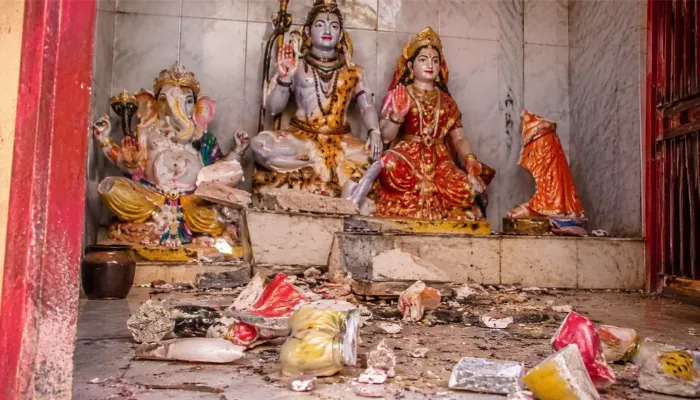
In Nimkhera Gram Panchayat, Dongrakala (Pali), Lalitpur, Uttar Pradesh, several idols of Hindu deities inside a Hanuman temple were vandalised by a miscreant. According to media reports, the incident occurred on 13 November 2026. The miscreant entered the temple and vandalised several idols of Hindu deities, including those of Lord Shiva, Goddess Parvati, Lord Ganesha and other deities, causing damage to multiple sacred representations. Upon receiving information about the incident, police personnel reached the spot and initiated an investigation. The accused was arrested outside the incident site. Following the incident, Bajrang Dal activists and local villagers gathered at the spot and demanded legal action against the individual responsible for vandalising the idols. Following the incident, some villagers claimed that the perpetrator was mentally unwell. However, others disputed these claims, asserting that he was merely pretending to be mentally unstable. At the time of writing, his medical examination to assess his mental condition was underway. The police continued their investigation into the incident, while local villagers demanded a fair inquiry and appropriate legal action against the accused in accordance with the law.
Why it is Hate Crime ?
This case is being added to the tracker under the primary category: Attack on Hindu religious representations. The subcategory selected is: Desecration of Hindu religious symbols. Icons and symbols or a religious representation of a spiritual ideal are widely revered in Hinduism. Iconography is of vital significance in the Hindu milieu. It helps connect people’s spiritual beliefs with the real world. Iconography within the Hindu faith takes several shapes and forms. Murtis are of most significance to Hindus, to which daily rituals, prayers and offerings are done. Besides the murtis, there are several other symbols which have deep significance in the Hindu faith – the Om and Swastika for example. Since these Hindu religious symbols hold paramount importance in Hinduism, any desecration of symbols, icons, murtis, religious representations and manifestations, is driven by animosity towards the faith itself which manifests itself through these murtis, icons and symbols. Therefore, any desecration of these Hindu religious symbols and representations is considered religiously motivated hate crimes under this category. The other subcategory selected is: Attack on Temples. In Hinduism, a temple is the abode of the Deity. The Deity in the Temple is consecrated, thereby, making it a real, breathing entity. Hindus believe that not just the Deity but the temple premises itself are sacred to Hindus since Hindus hold the faith that the entire Temple space is an amalgamation of the divine energy of the deity. Given the central significance of Temples in Hindu Dharma, any attack against a Hindu Temple or its peripheral premises is an attack on the faith itself and is born out of animosity towards the faith, of which, the Temple is a central tenet. Any manner of attack against a Temple and/or its premises would therefore be considered a religiously motivated hate crime. This incident constitutes a clear example of a religiously motivated hate crime, as several idols of Hindu deities were vandalised inside a Hindu temple. The deliberate destruction of sacred religious representations within a place of worship demonstrates hostility towards Hindu religious symbols and the faith they represent. A Hindu temple is a sacred space dedicated to the worship of deities, spiritual practice, religious observances and the preservation of Hindu traditions. It serves as an important centre of devotion and spiritual connection for the Hindu community, where devotees seek blessings and participate in religious rituals. Idols of Hindu deities hold profound religious significance, serving as sacred representations through which devotees worship and connect with the divine. They are consecrated objects of devotion and integral to Hindu rituals, prayers and religious practices. In Hinduism, Lord Ganesha is revered as the remover of obstacles, the deity of wisdom and the god invoked at the beginning of auspicious undertakings. Lord Shiva is worshipped as the deity associated with destruction, transformation and liberation, while Goddess Parvati is revered as the Divine Mother, embodying compassion, fertility and divine energy. Their idols are sacred representations central to worship, devotion and religious rituals, and are treated with reverence by devotees. Therefore, vandalising the idols of these revered deities inside a Hindu temple amounts to the desecration of sacred religious symbols, hurts Hindu religious sentiments and demonstrates hostility towards Hinduism and the Hindu community. Moreover, vandalism carried out within a Hindu temple also constitutes an attack on the sanctity of the place of worship itself. Hindu temples and the idols enshrined within them are inseparable components of the larger temple ecosystem, with sacred representations forming an integral part of the temple's religious and spiritual identity. Vandalising the idols of Hindu deities within a temple therefore desecrates its sanctity, undermines its sacred character and further hurts Hindu religious sentiments, making the incident an attack on both Hindu religious symbols and a sacred place of worship. Some may argue that the crime was committed because the perpetrator was mentally unstable. However, it is important to note that in several such cases, where anti-Hindu elements vandalise and desecrate Hindu places of worship, a usual trope to shield the perpetrator is to attribute the crime to the mental health of the accused, claiming that the crime was committed since the perpetrator was ‘mentally ill’ or ‘mentally unstable’. Likewise, in this case too, when the accused was identified, a few locals attributed the act to his mental illness. The use of the "mental illness" trope to justify crimes targeting Hindu temples or idols by anti-Hindu elements raises critical questions. If the perpetrator was indeed mentally unstable, why did he specifically target Hindu idols and places of worship, leaving places of worship of other faiths untouched? This selective focus suggests that such acts are not driven by mental health issues but by religious animosity. The repeated use of this narrative to downplay crimes against Hindus reflects a strategic effort to whitewash religious hatred, obscuring the true motivations and intentions behind the attacks. At the time of writing this report, even though the perpetrator's identity is unknown, the act committed demonstrates hostility towards Hinduism. Therefore, this case is being added to the hate crime database of the Hinduphobia Tracker.


Case Status
Arrested


Perpetrators Details
Perpetrators
Unknown
Perpetrators Range
One Person
Perpetrators Gender
male
 Sources



