Hinduism and Hindu deities denigrated by Muslim man who asserts Muslim dominance and boasts of converting Hindu girls
 Kheda, Gujarat, India
 9 November, 2026
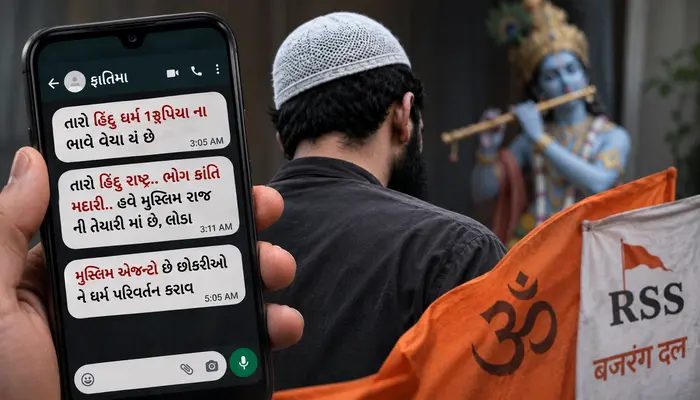
Case Summary
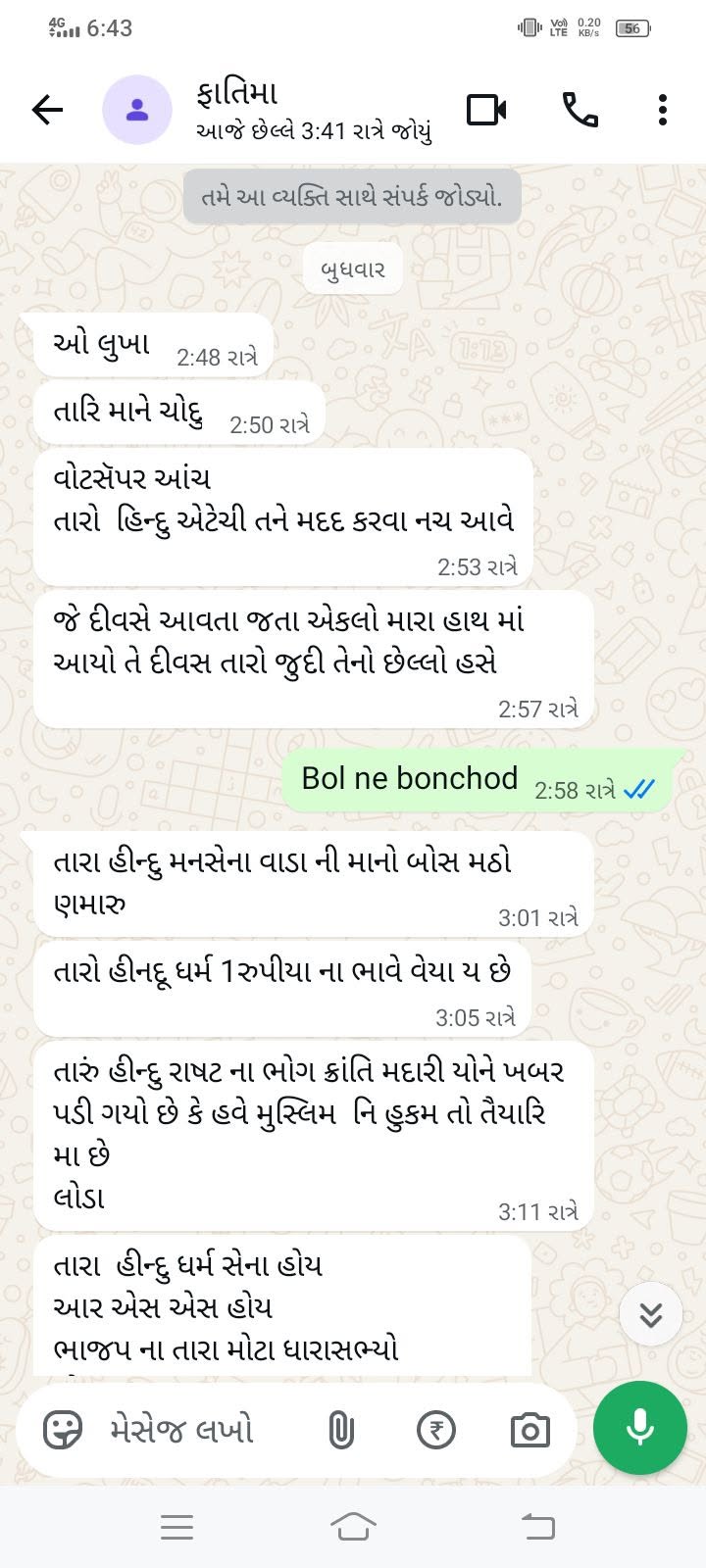
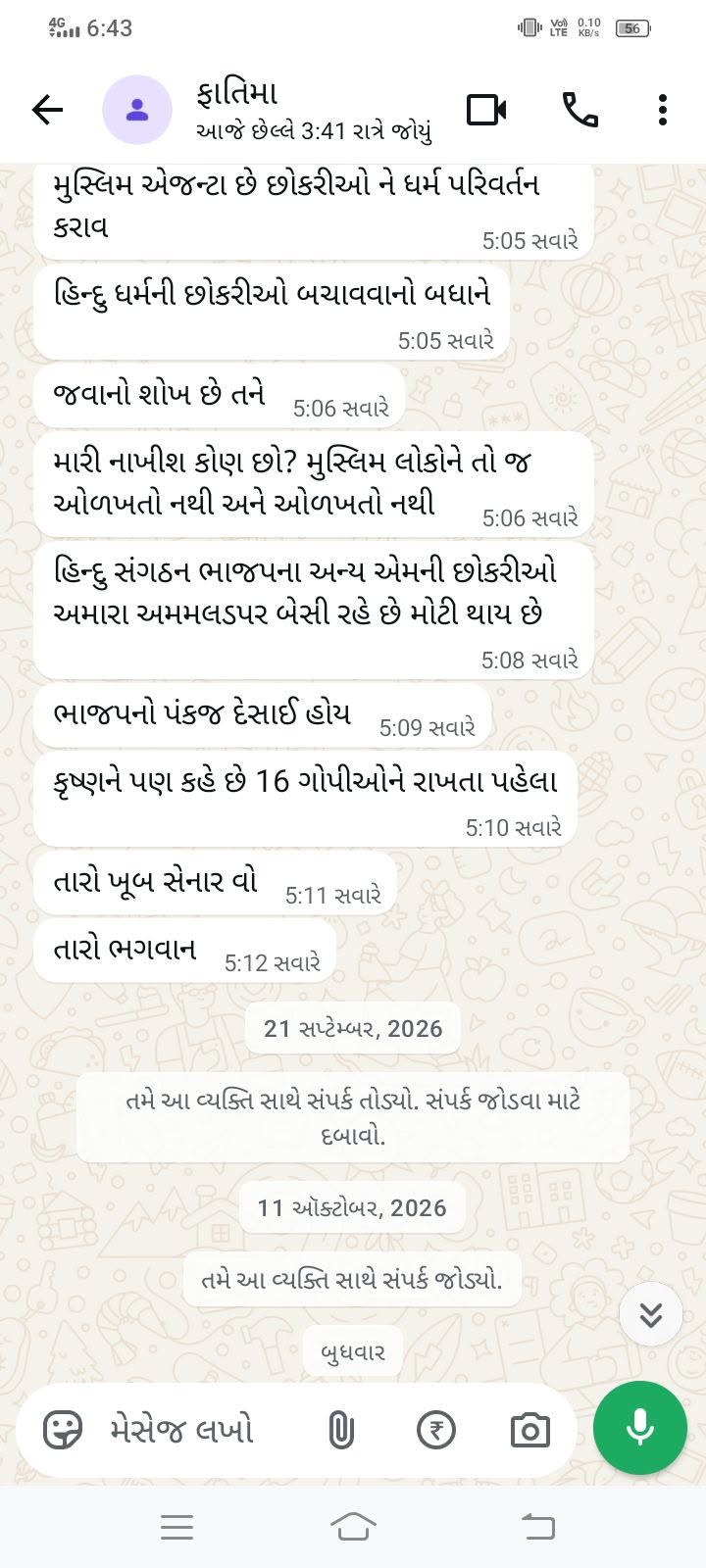
In the Vaso taluka of Kheda district, Gujarat, a Muslim man named Sameer Miyan Gulam Miyan Vohra made objectionable comments against Hinduism, Hindu gods and goddesses, and denigrated Hindu organisations such as RSS and Bajrang Dal. A written complaint was filed at Vaso Police Station against Sameer Miyan, a resident of Dantali village, for sending derogatory messages targeting Hinduism, Hindu deities, including Lord Shri Krishna, and Hindu women through WhatsApp. The accused also abused Hindu organisations, including the Rashtriya Swayamsevak Sangh (RSS) and Bajrang Dal, along with making derogatory remarks against Hindu religious beliefs and deities. He said, "Your Hindu religion is being sold for the price of one rupee." and " Your Hindu Rashtra... Bhog Kranti Madari... has found out that preparations are now underway for Muslim rule, you bastard." Furthermore, he also stated that "Muslim agents are converting (Hindu) girls" According to the complaint, the messages contained remarks that hurt the religious sentiments of Hindus. The complainant further stated that the accused had visited Davada village and threatened to kill her following an argument over the buying and selling of vehicles. Vaso Police initiated an investigation into the matter following the submission of the written complaint.
Case Images
Why it is Hate Crime ?
This case has been added to the tracker under the primary category of - Hate speech against Hindus. Within it, the sub-category selected here is - Anti-Hindu slurs, mocking faith. Anti-Hindu slurs and the deliberate mocking of the Hindu faith owing to religious animosity involve the usage of derogatory terms, stereotypes, or offensive references to religious practices, symbols, or figures. One of the common anti-Hindu slurs used against Hindus is “cow-worshipper” and “cow piss drinker”. The intention of using this term is to demean and mock Hindus as a group and their religious beliefs since Hindus consider the cow holy. Additionally, some symbols and the slurs attached to them have a historical context that exacerbates the insult, hate, stereotyping, dehumanisation and oppression against Hindus. Cow worship has been used for centuries to denigrate Hindus, insult their faith and oppress Hindus specifically as a religious group. There has been overwhelming documentation about how cow slaughter has been used to persecute Hindus with cow meat being thrown in temples and places of worship. There has also been overwhelming documentation where cow meat (beef) has been force-fed to Hindus to either forcefully convert them to Islam or denigrate their faith. Apart from cow worship, the Swastika – which holds deep religious significance for the Hindus – has also been misinterpreted and distorted to use as a slur against Hindus. Similarly, the worship of the Shivling has been used by supremacist ideologies and religions to denigrate Hindus owing to religious animosity. Such slurs and denigration stem out of inherent animosity and hate towards Hindus and their faith, therefore, it is categorised as hate speech targeted at Hindus specifically owing to their religious identity. The incident demonstrated a pattern of hostility directed at Hindus on the basis of their religious identity, with the objectionable messages going beyond an ordinary personal disagreement or an isolated exchange of insults. The remarks made by the Muslim accused specifically targeted Hindu religious beliefs, deities, religious organisations and the broader idea of a Hindu Rashtra. The targeting of Hindu deities, particularly Lord Shri Krishna, demonstrated the religious dimension of the hostility. Hindu deities occupy a central position in the faith and spiritual lives of devotees, and derogatory remarks directed at them carry an implication beyond personal abuse. Lord Shri Krishna holds a central and deeply revered position in Hinduism as an incarnation of Lord Vishnu and is worshipped by millions of Hindus across the world. His teachings, particularly those imparted in the Bhagavad Gita, form an important foundation of Hindu spiritual, philosophical and religious thought. He is revered not only as a deity but also as a divine guide whose teachings on dharma, devotion and righteous conduct have shaped Hindu religious traditions for generations. Furthermore, by extending the insults to Hindu religious institutions and organisations such as the Rashtriya Swayamsevak Sangh (RSS) and Bajrang Dal, the accused's remarks sought to disparage groups associated with the assertion, preservation and protection of Hindu religious and cultural identity. These organisations have a prominent presence in Hindu social and religious activities, and targeting them through derogatory language added another dimension to the anti-Hindu nature of the remarks. By directing hostility towards both the faith and groups associated with its preservation, the remarks reflected a broader pattern of contempt towards Hindu religious identity and its institutional expressions. The reference to Hindu Rashtra, contrasted with the statement that preparations were underway for Muslim rule, introduced an explicitly communal and religious dimension to the hostility. By invoking the prospect of Muslim rule in opposition to Hindu Rashtra, the accused asserted Muslim religious and political dominance over Hindu identity. This was particularly significant in the context of the other derogatory remarks directed at Hinduism and its sacred figures, as it reinforced a pattern of hostility in which Hindu identity was ridiculed while Muslim dominance was presented as an impending reality. Such rhetoric went beyond criticism of a political ideology or particular organisation and conveyed an antagonistic assertion of one religious community's ascendancy over another, further demonstrating the communal character of the remarks. The reference to Hinduism being sold for one rupee was particularly significant because it sought to ridicule and demean the religious identity of an entire community by portraying its faith as something cheap and without value. Such language was not merely criticism of an individual or a disagreement over religious or political views; it was expressed in a manner that disparaged Hinduism and its adherents. Furthermore, the statement concerning Muslim agents converting girls introduced another dimension of religious hostility by invoking religious conversion and portraying it in the context of a threat to Hindu women. Such actions stem from inherent hostility towards the victim's professed faith since Abrahamic faiths believe that any non-adherent to the faith is subject to being dehumanised till they convert. Such acts are rooted in a desire to dominate and erase the religious identity of the victim. These statements portray doctrinal animosity towards the Hindu faith and its adherents. The remarks made by the accused demonstrated hostility towards Hindus as a religious community through the disparagement of their faith, sacred figures, institutions and collective religious identity. The incident therefore qualified for consideration as a hate crime because the objectionable expression was specifically directed at Hindu religious identity. Disclaimer: The Hinduphobia Tracker records incidents based on when an event occurred or when the victim's ordeal began. It is important to clarify that none of the media sources covering this case has specified the exact date when the incident occurred. Therefore, for documentation purposes, we have recorded the date based on when the incident was reported in the media, 10 November 2026.


Case Status
Arrested


Perpetrators Details
Perpetrators
Muslim Extremists
Perpetrators Range
One Person
Perpetrators Gender
male
 Sources



