Hinduphobia on social media: American Christian woman vilifies Goddess Kali, describes Hindus as 'demon worshippers' and targets Hindu traditions
 United States
 9 November, 2026
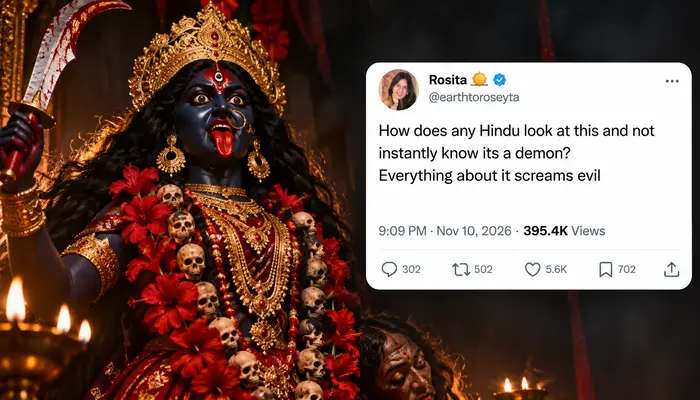
Case Summary
The revered Hindu goddess Kali was denigrated on social media by an American Christian woman. She called the goddess a "demon" and described her as "evil". The accused's social media timeline also contained numerous offensive and derogatory posts targeting Hindus, in which she referred to them as "freaks" and "demon worshippers" and disparaged Hindu traditions. According to available information, on 10 November 2026, an X (formerly Twitter) account named Rosita (@earthtoroseyta) posted a tweet featuring an image of Goddess Kali. The accused wrote, "How does any Hindu look at this and not instantly know its a demon? Everything about it screams evil". The tweet gained significant traction, garnering approximately 395.4K views and 5.6K likes. Upon inspecting the accused's social media profile, the Hinduphobia Tracker team found that she was an American Christian woman. Her timeline featured repeated posts praising Jesus Christ, promoting Christianity and urging people to turn to Jesus. This was not the first instance of the accused targeting Hindu deities or the Hindu community. In another instance, she quote-tweeted a post featuring dancers dressed as Goddess Kali and Goddess Tara performing a fierce classical dance. Responding to the performance, the accused wrote: "I am terrified. We are letting literal demon worshippers into our countries. If you think Hindus are just going to let these traditions go after thousands of years just because they want a place in the West, you are delusional." Through this post, she referred to Hindus as "demon worshippers" and characterised the worship and religious traditions associated with Goddess Kali and Goddess Tara as demonic. In yet another instance, the accused quote-tweeted a post by an X account named Cyber Green, which showed a Hindu woman performing a classical dance at a public Diwali event in Frisco, Texas. The woman was dressed in a costume depicting Goddess Meenakshi, a revered Hindu deity. Responding to the post, Rosita wrote, "DEPORT THESE FUCKING FREAKS", directing the derogatory remark at Hindus participating in the cultural event. Further inspection of the accused's X timeline revealed multiple posts containing derogatory remarks about Indians, disparagement of Hindu deities and expressions of hostility towards the Hindu community. Her posts also repeatedly promoted Christianity and praised Jesus Christ while denigrating Hindu religious beliefs and representations.
Why it is Hate Crime ?
This case is being added to the tracker under the primary category: Hate Speech against Hindus. The subcategory selected is: Anti-Hindu slurs, mocking faith. Anti-Hindu slurs and the deliberate mocking of the Hindu faith owing to religious animosity involve the usage of derogatory terms, stereotypes, or offensive references to religious practices, symbols, or figures. One of the common anti-Hindu slurs used against Hindus is “cow-worshipper” and “cow piss drinker”. The intention of using this term is to demean and mock Hindus as a group and their religious beliefs since Hindus consider the cow holy. Additionally, some symbols and the slurs attached to them have a historical context that exacerbates the insult, hate, stereotyping, dehumanisation and oppression against Hindus. Cow worship has been used for centuries to denigrate Hindus, insult their faith and oppress Hindus specifically as a religious group. There has been overwhelming documentation about how cow slaughter has been used to persecute Hindus with cow meat being thrown in temples and places of worship. There has also been overwhelming documentation where cow meat (beef) has been force-fed to Hindus to either forcefully convert them to Islam or denigrate their faith. Apart from cow worship, the Swastika – which holds deep religious significance for the Hindus – has also been misinterpreted and distorted to use as a slur against Hindus. Similarly, the worship of the Shivling has been used by supremacist ideologies and religions to denigrate Hindus owing to religious animosity. Such slurs and denigration stem out of inherent animosity and hate towards Hindus and their faith, therefore, it is categorised as hate speech targeted at Hindus specifically owing to their religious identity. The denigration of the revered Hindu Goddess Kali on social media by an American Christian woman was a clear instance of religiously motivated hostility directed towards Hinduism and its followers. Goddess Kali occupies a significant position in Hinduism and is one of the most revered manifestations of the Divine Mother. Worshipped extensively within the Hindu tradition, she is associated with the destruction of evil, the annihilation of demonic forces, the removal of ignorance and the protection of her devotees. Her fierce form, with her dark complexion, protruding tongue, garland of skulls and weapons, symbolises the destruction of negative forces, the triumph of divine power over evil and the ultimate reality beyond time and death. She is regarded as a protective and benevolent mother by her devotees and is worshipped with profound reverence by millions of Hindus across the world. Therefore, calling this sacred deity a "demon" and describing everything about her as indicative of "evil" was a derogatory characterisation of a deeply revered Hindu religious figure. Such remarks showed contempt for Hindu religious beliefs and amounted to an attack on the religious sentiments of the Hindu community. The denigration of a sacred Hindu deity in this manner reflected hostility towards Hinduism and its religious traditions, making this a clear instance of Hinduphobia. The fact that the accused deliberately published these remarks on a public social media platform further demonstrated the nature of the incident. Rather than expressing a private disagreement or discussing religious differences, she publicly denigrated a Hindu deity before a wider audience. Her repeated posts praising Jesus Christ, promoting Christianity and urging others to embrace the faith, alongside her derogatory remarks about Hinduism, reflected a pattern of religious intolerance. Her characterisation of Hindu deities and their worship as demonic, while repeatedly promoting Christianity, indicated a religiously supremacist outlook in which Hindu beliefs and practices were treated with contempt rather than mutual respect. Such conduct demonstrated deep-seated religious hostility towards Hinduism and the Hindu community. The accused's previous conduct further established that this was not an isolated incident or a one-off expression made in the heat of the moment. Her social media activity contained repeated instances of anti-Hindu remarks, including referring to Hindus as "demon worshippers", calling them "freaks" and directing derogatory remarks at Hindu deities and religious traditions. Her earlier attacks on dancers portraying Goddess Kali and Goddess Tara, as well as her demand to deport Hindus participating in a Diwali cultural event in Texas, demonstrated a recurring pattern of hostility towards Hindu religious and cultural expression. These repeated instances showed that the denigration of Goddess Kali was consistent with the accused's previous conduct and was not an isolated occurrence. This pattern of targeting Hindu religious figures, devotees and cultural practices demonstrated sustained hostility towards Hinduism and its followers. The public circulation of such derogatory remarks, particularly when they attract widespread attention and engagement, also contributes to the normalisation of anti-Hindu hostility. When Hindu deities and religious traditions are repeatedly ridiculed, and their devotees are publicly demeaned, it encourages an environment in which others may feel emboldened to engage in similar acts of religious denigration. Such hostility can contribute to the wider targeting of Hindus on account of their religious identity, exposing them to humiliation, discrimination and hostility for practising and expressing their faith. Overall, since this incident met the parameters of a religiously driven offence involving the denigration of a sacred Hindu deity and repeated expressions of hostility towards Hinduism and its followers, the case was added to the hate crime database of the Hinduphobia Tracker.


Case Status
Unknown


Perpetrators Details
Perpetrators
Christian Extremists
Perpetrators Range
One Person
Perpetrators Gender
female
 Sources



