Hindu man stabbed over his children bursting Diwali crackers; his family subjected to assault and casteist slurs by Muslim men in Maharashtra
 Aurangabad, Maharashtra, India
 7 November, 2026
Case Summary
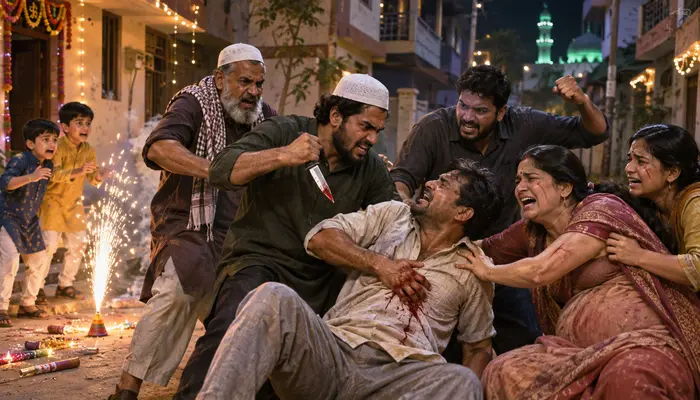
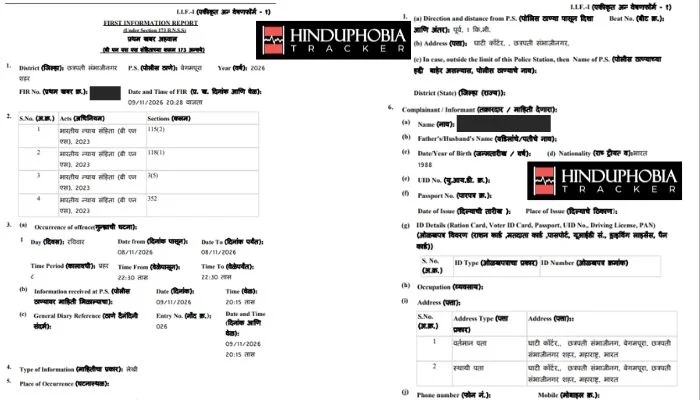
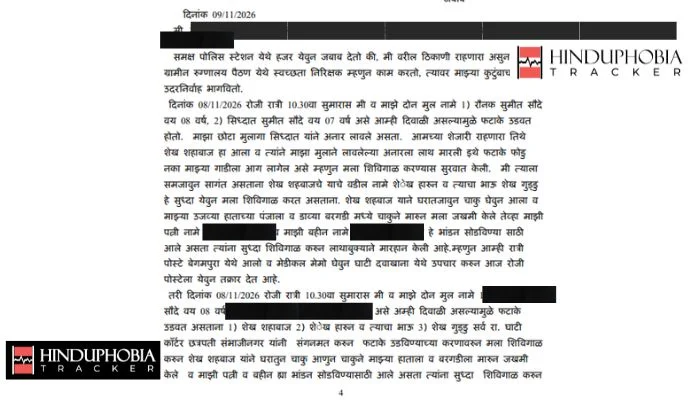
In Chhatrapati Sambhajinagar (Aurangabad), Maharashtra, a Hindu man was attacked with a knife by three Muslim men over a dispute concerning his minor sons bursting firecrackers during Diwali celebrations. The victim's pregnant wife and sister were also assaulted when they intervened to protect him. The Muslim perpetrators hurled casteist slurs at the family. The attack left the Hindu man, his wife and his sister injured, while his wife, who was two months pregnant at the time, subsequently suffered a miscarriage. The incident came to light after a First Information Report (FIR) was registered at Begumpura Police Station on 9 November 2026. The Hinduphobia Tracker team subsequently obtained a copy of the FIR and contacted the victim by telephone to gather further details. At the victim's request, his name and other identifying details have been withheld. According to the FIR, the incident occurred on 8 November 2026, at approximately 10:30 pm, in the Ghati Corner area under the jurisdiction of Begumpura Police Station. The three accused were identified as Sheikh Shahbaz, Sheikh Harun and Sheikh Guddu, all residents of the same locality. Speaking to the Hinduphobia Tracker team, the victim narrated that the incident took place on Diwali night when his two minor sons, aged 8 and 7, were bursting firecrackers in front of their own house. The accused, who lived just two buildings away, approached the children and kicked the flower-pot firecracker (anar) lit by one of them twice. He objected to the children bursting crackers, saying that his house would catch fire because of them, and began abusing the Hindu man. When the victim opposed his actions, the confrontation escalated, and Sheikh Shahbaz's father, Sheikh Harun, and brother, Sheikh Guddu, also joined him. The three men then confronted and attacked the victim. According to the victim's statement recorded in the FIR, Sheikh Shahbaz subsequently went inside his house, brought a knife and attacked him, inflicting injuries on the palm of his right hand and the right side of his rib area. The victim further told the Hinduphobia Tracker team that the accused repeatedly hurled casteist slurs at him and his family during the confrontation. Meanwhile, the victim's wife and sister intervened in an attempt to protect him and stop the assault. However, they too were attacked, verbally abused and assaulted with kicks and blows. The victim informed the Hinduphobia Tracker team that his wife was two months pregnant at the time of the incident and subsequently suffered a miscarriage following the assault. Following the attack, the victim and his family went to Begumpura Police Station during the night, where they obtained a medical memo. They subsequently proceeded to Ghati Hospital, where the victim received medical treatment. On 9 November 2026, the victim formally lodged a complaint at the police station, seeking legal action against all three accused. Based on his complaint, Begumpura Police registered an FIR under Sections 115(2), 118(1), 3(5) and 352 of the Bharatiya Nyaya Sanhita, 2023. Assistant Police Sub-Inspector Gorkhnath Sarjerao Pawar was assigned to investigate the case. At the time of writing this report, further police investigation was underway.
Case Images
Why it is Hate Crime ?
This case is being added to the tracker under the primary category: Attack not resulting in death. The subcategory selected is: Attacked for Hindu identity. In several cases, Hindus are attacked merely for their Hindu identity without any perceived provocation. A classic example of this category of religiously motivated hate crime is a murder in 2016. 7 ISIS terrorists were convicted for shooting a school principal in Kanpur because they got ‘triggered’ seeing the Kalava on his wrist and tilak that he had put. In this, the Hindu victim had offered no provocation except for his Hindu religious identity. The motivation for the murder was purely religious, driven by religious supremacy. Such cases where Hindus are targeted merely for their religious identity would be documented as a hate crime under this category. The other subcategory selected is: Attacked for opposing radicals or trying to save victim. In several cases, Hindus are attacked for opposing religiously motivated crimes being committed against a fellow Hindu or simply for voicing an opinion opposing radical elements, who either have in the past or continue to persecute Hindus. In such cases, the initial attack against the victim, against which the Hindu was trying to defend the victim, would also need to be classified as a religiously motivated hate crime. Since the initial crime itself was religiously motivated and the subsequent crime of attempting to save the victim or speaking against the radical elements ends up inviting a violent attack, it would also be classified as a religiously motivated hate crime under this category. The other primary category selected is: Hate Speech against Hindus. The subcategory selected is: Anti-Hindu slurs, mocking faith. Anti-Hindu slurs and the deliberate mocking of the Hindu faith owing to religious animosity involve the usage of derogatory terms, stereotypes, or offensive references to religious practices, symbols, or figures. One of the common anti-Hindu slurs used against Hindus is “cow-worshipper” and “cow piss drinker”. The intention of using this term is to demean and mock Hindus as a group and their religious beliefs since Hindus consider the cow holy. Additionally, some symbols and the slurs attached to them have a historical context that exacerbates the insult, hate, stereotyping, dehumanisation and oppression against Hindus. Cow worship has been used for centuries to denigrate Hindus, insult their faith and oppress Hindus specifically as a religious group. There has been overwhelming documentation about how cow slaughter has been used to persecute Hindus with cow meat being thrown in temples and places of worship. There has also been overwhelming documentation where cow meat (beef) has been force-fed to Hindus to either forcefully convert them to Islam or denigrate their faith. Apart from cow worship, the Swastika – which holds deep religious significance for the Hindus – has also been misinterpreted and distorted to use as a slur against Hindus. Similarly, the worship of the Shivling has been used by supremacist ideologies and religions to denigrate Hindus owing to religious animosity. Such slurs and denigration stem out of inherent animosity and hate towards Hindus and their faith, therefore, it is categorised as hate speech targeted at Hindus specifically owing to their religious identity. This incident constituted a clear example of a religiously motivated hate crime, as three Muslim men attacked a Hindu man with a knife and assaulted his family over his minor sons bursting firecrackers during Diwali celebrations. The perpetrators also repeatedly hurled casteist slurs at the family, further demonstrating the hostility directed towards their Hindu identity and religious observances. The first religious marker in this incident was that the victims were targeted while celebrating Diwali, one of the most significant festivals in Hinduism. Diwali holds deep religious and spiritual significance for Hindus and is traditionally celebrated through the lighting of diyas, prayers, worship and the bursting of firecrackers. Firecrackers are also associated with traditional beliefs surrounding Diwali. According to traditional Hindu beliefs, the illumination and festivities on the night of Amavasya (new moon) help guide departed ancestors, known as Pitrs (the souls of deceased family members), towards Pitrloka, the realm of the ancestors. The bursting of firecrackers thus forms part of the wider traditional festivities associated with the festival. The fact that a Hindu man was stabbed because his minor sons were bursting firecrackers during Diwali celebrations demonstrated hostility towards the family's religious observance and Hindu identity. It is important to note that the children were bursting firecrackers outside their own house, while the accused lived two buildings away. There was, therefore, no apparent basis for the accused's objection that the firecrackers would set his house on fire. The purported concern that the firecrackers would cause a fire served as a pretext for confronting and attacking the Hindu family over their participation in Diwali celebrations. The disproportionate response to such a minor disagreement, particularly during an annual Hindu festival, demonstrated clear intolerance towards the family's religious practices. Instead of resolving the disagreement peacefully, the perpetrator resorted to violence and stabbed the Hindu man. Targeting a Hindu family with such violence while they were observing one of their most significant religious festivals reflected deep-seated hostility towards Hinduism, its religious practices and the right of Hindus to celebrate their festivals without intimidation or violence. Another religious marker was the repeated use of casteist slurs against the victim and his family. It can be argued that a caste-specific slur targets a person's micro-identity of belonging to the Dalit section of the Hindu community rather than their Hindu identity itself. However, as far as Abrahamic religions are concerned, micro-identities of caste, region and language are secondary. It is the religious identity that drives the animosity of the perpetrator towards the Hindu victim. In this incident, while the Muslim perpetrators hurled casteist abuses at the victim and his family, their animosity was driven by hostility towards Hinduism and Hindus. The repeated use of casteist slurs, alongside the attack on the family over their participation in Diwali celebrations, further demonstrated the religious animosity underlying the violence. Furthermore, when the victim's wife and sister intervened to protect him from the Muslim perpetrators and stop the assault, they too were attacked. Their intervention was an attempt to defend a Hindu family member who was being targeted over his minor sons celebrating Diwali and bursting firecrackers. The fact that the women were also subjected to violence for opposing the attack demonstrated how religious hostility extended to those who stood up against the targeting of Hindus. In several such incidents, Hindus who intervene to protect fellow Hindus from religiously motivated violence are themselves subjected to assault for opposing the perpetrators. This recurring pattern demonstrates how even attempts to defend Hindus against religiously motivated attacks invite further violence. The brutality of the assault was particularly grave as the victim's wife was two months pregnant and subsequently suffered a miscarriage. The attack thus extended beyond the initial victim, leaving his family members injured and inflicting devastating consequences on his household. Overall, the hostility displayed by the perpetrators towards a Hindu family celebrating Diwali reflected deep-seated religious intolerance towards Hinduism and its followers. Their actions amounted to a clear instance of religiously driven violence against Hindus. Therefore, the incident is being added to the Hinduphobia Tracker's hate crime database. Disclaimer: The victim count has been recorded as three, comprising the Hindu man, his wife and his sister. Although the incident occurred over his minor sons bursting firecrackers during Diwali celebrations, the available information does not mention that the children were physically assaulted. Therefore, they have not been included in the victim count. This clarification is provided solely for documentation purposes.
Victim Details
Total Victim
3
Deceased
0
Gender
- Male 1
- Female 2
- Third Gender 0
- Unknown 0
Caste
- SC/ST 3
- OBC 0
- General 0
- Unknown 0
Age Group
- Minor 0
- Adult 3
- Senior Citizen 0
- Unknown 0


Case Status
Complaint registered


Perpetrators Details
Perpetrators
Muslim Extremists
Perpetrators Range
From 2 To 5
Perpetrators Gender
male
 Sources



