Durga Temple in Siddhirganj, Bangladesh vandalised, Hindu devotees barred from entering and offering prayers
 Narayanganj District, Bangladesh
 16 June, 2023
Case Summary
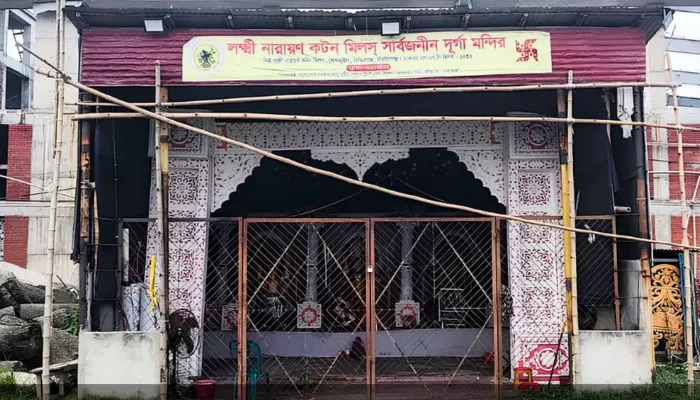
In Siddhirganj, Narayanganj, Bangladesh, the Durga temple inside the Lakshminarayan Cotton Mill was vandalised, and devotees were blocked from accessing it. It occurred amid a longstanding land dispute with the Knit Concern Group. On Tuesday evening, November 10, 2026, the existing lock on the temple gate was removed, and a new lock was installed, preventing entry into the temple. Temple committee General Secretary Tarun Lal Begi stated that individuals associated with the Knit Concern Group installed the new lock, defying administrative instructions. He further stated that the group's director, Monir Hossain Molla, and other members damaged the decorations and pandal inside the temple. Residents protested against the conduct, following which the group left the premises. On Wednesday afternoon, November 11, 2026, Siddhirganj Police Station took Monir Hossain Molla and the group's security in-charge, Ibrahim, into custody for questioning over the obstruction of entry and vandalism. Narayanganj Additional Superintendent of Police (Crime) Tarek Al Mehedi confirmed their custody at around 5:45 pm. Police Inspector (Investigation) Mojibur Rahman said the idol inside the temple had not been vandalised, but the cloth decorations and pandals had been removed. Police had also received a complaint concerning obstruction of entry to the temple, and further action was to be taken under the directions of senior authorities. The incident followed earlier tensions over the temple's land. On October 4, 2026, the temple committee decided not to immerse the Durga Puja idol in protest against the Knit Concern Group's attempts to occupy temple land. The idol was eventually immersed at the last moment following assurances from the local administration and public representatives. On October 26, district administration officials met the temple committee and Hindu community leaders. After the meeting, committee president Mintu Chandra Das said the administration had directed a halt to construction of new structures in the area until the land dispute was permanently resolved. Law enforcement agencies were also instructed to ensure the safety of the temple and devotees. The gazette protected the land belonging to the school, mosque and temple, and the Knit Concern Group was also warned. In October, the temple committee submitted a letter to the Deputy Commissioner and Superintendent of Police stating that the Knit Concern Group had been attempting to take control of the temple, pond and surrounding field. The committee said the temple was registered with the Bangladesh Hindu Religious Welfare Trust and that a boundary wall had been erected around it, restricting entry to traditional Hindu devotees. The letter also referred to an earlier incident of vandalisation at the temple on June 17, 2023. Tarun Lal Begi said the committee had repeatedly approached the administration for a permanent resolution, but the matter remained unresolved. He further stated that vandalisation and attacks on shareholders' houses had occurred on several previous occasions. He also attributed the lack of administrative cooperation to the group's association with the previous Awami League government. The matter was taken to the Prime Minister's Office through the Bangladesh Sanatan Party, while local Hindu community leaders met Narayanganj Deputy Commissioner Md. Raihan Kabir regarding the attempts to take control of the temple land and incidents of vandalism. After a prolonged period of losses, the government transferred ownership of the factory to 510 workers and employees in 2000. In 2012, the Knit Concern Group joined the factory's management as an investor. The ongoing dispute concerns the temple, its surrounding land, pond, and field within the mill premises. Knit Concern Group Managing Director Joynal Abedin Mollah did not respond to multiple attempts to contact him regarding the matters raised by the temple committee.
Why it is Hate Crime ?
This case has been added to the tracker under the primary category: Attack on Hindu religious representations. The sub-category selected is: Desecration of Hindu religious symbols. Icons and symbols or a religious representation of a spiritual ideal are widely revered in Hinduism. Iconography is of vital significance in the Hindu milieu. It helps connect people’s spiritual beliefs with the real world. Iconography within the Hindu faith takes several shapes and forms. Murtis are of most significance to Hindus, to which daily rituals, prayers and offerings are done. Besides the murtis, there are several other symbols which have deep significance in the Hindu faith – the Om and Swastika for example. Since these Hindu religious symbols hold paramount importance in Hinduism, any desecration of symbols, icons, murtis, religious representations and manifestations, is driven by animosity towards the faith itself which manifests itself through these murtis, icons and symbols. Therefore, any desecration of these Hindu religious symbols and representations is considered religiously motivated hate crimes under this category. The other sub-category selected here is: Encroachment or illicit takeover of temple land/land near temple. In Hinduism, a temple is the abode of the Deity. The Deity in the Temple is consecrated, thereby, making it a real, breathing entity. Hindus believe that not just the Deity but the temple premises itself are sacred to Hindus since Hindus hold the faith that the entire Temple space is an amalgamation of the divine energy of the deity. Not only the Temple but the Temple premises in its entirety are considered sacred by Hindus. In several cases, the premises of the Temple and/or religious centre are illicitly taken over by institutions belonging to other faiths – like the Waqf board or the Church. Other times, the temple property, land or the property of religious centres are illicitly encroached by non-Hindu groups. Any illicit take over or encroachment is a crime an initio, however, when non-Hindu groups illicitly take over or encroach the sacred land of Hindus, it is an affront to the Hindu community and is therefore classified as a religiously motivated hate crime under this category. The religious significance of this incident lies in the repeated interference with a Hindu place of worship and the community's ability to access and maintain it. The replacement of the temple's lock, obstruction of devotees and dismantling of its religious decorations directly interfered with the Hindu community's right to worship. Although the idol was not damaged, removing the temple's religious arrangements and barring devotees from entering the temple premises to offer prayers showed disregard for its sacred character and the faith of Hindu devotees. Hindu religious customs include collective worship, festival preparations and the observance of rituals at designated sacred places. By locking the temple gate and removing its decorations and pandal, the perpetrators disrupted these religious customs and interfered with the Hindu community's ability to observe its faith at the temple. Their actions therefore amounted to the defiling of Hindu religious customs and practices. A Hindu temple is not merely a physical structure; it is a sacred space that serves as the centre of worship and religious activity for its devotees. Temple land, including its associated pond and surrounding grounds, is closely connected with the functioning and preservation of the religious institution. The temple committee had repeatedly raised concerns about attempts by the Knit Concern Group to take control of the temple property, pond and field. The dispute, the restriction of Hindu devotees' access and the earlier incident of vandalism in June 2023 reflected a continuing threat to the community's access to and control over its place of worship. The recurring nature of these incidents points to a sustained pattern of hostility towards the temple and the religious community associated with it. The timing of the latest incident is particularly significant. It took place on November 10, 2026, during Diwali and Kali Puja, when Hindu communities were observing important religious festivals. The obstruction of access to the temple and dismantling of its decorations during this period further disrupted Hindu religious life. This also followed the interference faced by the temple committee during Durga Puja in October, when the community had nearly withheld the immersion of the Durga idol in protest against attempts to take control of temple land. Despite administrative assurances that the temple and its devotees would be protected, the interference continued. The repeated disruption of Hindu religious observances during consecutive major festivals underscores the profound disregard Islamists harbour towards the Hindus and their faith. The incident must also be viewed against the wider climate of insecurity faced by religious minorities, particularly Hindus, in Bangladesh. Reports of attacks on Hindu temples, vandalism of religious idols, occupation of temple property and intimidation of minority communities have repeatedly highlighted the vulnerability of Hindu religious institutions. In this context, the continued interference with the Lakshminarayan Cotton Mill temple reflects broader concerns about the security of Hindu places of worship and the ability of minority communities to protect their religious and cultural spaces. While the dispute involves questions of land ownership, such disagreements do not justify obstructing devotees, dismantling religious arrangements or denying a community access to its place of worship. The fundamental concern is the repeated targeting of a Hindu religious institution and the disruption of its religious activities. The timing of the latest interference during the Diwali and Kali Puja period, following similar disruption during Durga Puja, reinforces the pattern of hostility towards Hindu religious observance. In the wider context of minority insecurity in Bangladesh, the incident highlights the vulnerability of Hindu communities and their religious institutions to continued interference and intimidation.


Case Status
Complaint filed


Perpetrators Details
Perpetrators
Muslim Extremists
Perpetrators Range
From 2 To 5
Perpetrators Gender
male
 Sources



