Hindu youth shot by four Muslim men over minor dispute on Diwali night in Farrukhabad
 Saharsa, Bihar, India
 10 November, 2026
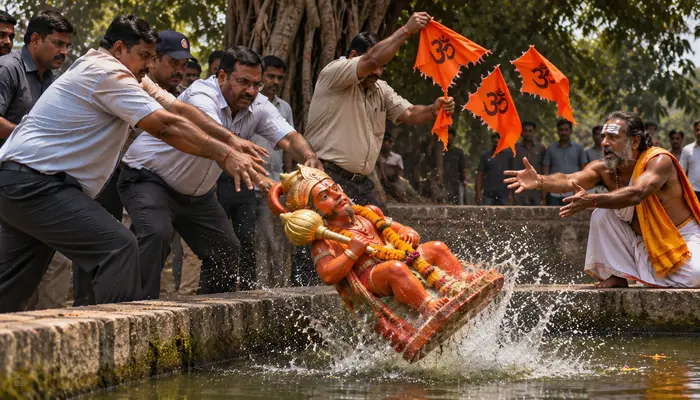
Case Summary
In Saharsa, Bihar, a consecrated idol of Lord Hanuman was disrespectfully thrown into a pond by local administrative officials. They also uprooted a Hindu religious flag, tore it into three pieces and discarded it. A Hindu priest who opposed the desecration was physically manhandled, pushed away from the site and threatened with imprisonment by the officials. According to media reports, the incident took place under the pretext of beautification work at the Chhath Puja ghat. The idol of Lord Hanuman had been consecrated and installed beneath an ancient banyan tree situated in front of the Civil Court premises. A video of the incident subsequently went viral on social media, in which Hindu activists and the priest stated that the idol of Lord Hanuman was barely one foot tall and neither the idol nor the religious flag obstructed the Chhath Puja celebrations or the beautification work. Despite this, the authorities removed and desecrated the religious symbols. Hindu organisations and local residents strongly objected to the act, maintaining that Hindu religious flags and consecrated idols could not be desecrated in this manner. Following the incident, workers of the Vishva Hindu Parishad (VHP) and Bajrang Dal expressed strong resentment and submitted a memorandum to the District Magistrate, demanding a high-level investigation into the matter and appropriate action against the officials responsible, including the concerned Additional District Magistrate. The organisations also demanded that closed-circuit television (CCTV) footage from cameras installed around the site be immediately secured to facilitate an impartial investigation. They further urged the administration to ensure that devotees and religious representatives were consulted before removing any religious structure, idol or symbol in the future. The workers demanded action against the officials for mistreating the priest, pushing him away and threatening him with imprisonment when he objected to the removal of the idol. They warned that if appropriate action was not taken, Vishva Hindu Parishad and Bajrang Dal workers would be compelled to launch a peaceful protest through democratic and constitutional means, for which they held the administration responsible.
Why it is Hate Crime ?
This case is being added to the tracker under the primary category: Attack on Hindu religious representations. The subcategory selected is: Desecration of Hindu religious symbols. Icons and symbols or a religious representation of a spiritual ideal are widely revered in Hinduism. Iconography is of vital significance in the Hindu milieu. It helps connect people’s spiritual beliefs with the real world. Iconography within the Hindu faith takes several shapes and forms. Murtis are of most significance to Hindus, to which daily rituals, prayers and offerings are done. Besides the murtis, there are several other symbols which have deep significance in the Hindu faith – the Om and Swastika for example. Since these Hindu religious symbols hold paramount importance in Hinduism, any desecration of symbols, icons, murtis, religious representations and manifestations, is driven by animosity towards the faith itself which manifests itself through these murtis, icons and symbols. Therefore, any desecration of these Hindu religious symbols and representations is considered religiously motivated hate crimes under this category. This incident is a clear example of a religiously driven hate crime, as local administrative officials desecrated a consecrated idol of Lord Hanuman and a Hindu religious flag by throwing the idol into a pond and tearing the flag into three pieces. Idols of Hindu deities hold immense religious and spiritual significance in Hinduism, as they represent sacred manifestations of the divine and serve as objects of worship and devotion. Lord Hanuman is particularly revered as the embodiment of strength, courage, devotion, loyalty and selfless service. His consecrated idols are worshipped with deep reverence by devotees. Installing idols of Hindu deities beneath trees, particularly banyan trees, is also a longstanding and common Hindu practice, as such trees are themselves considered sacred and are often associated with places of worship. Similarly, Hindu religious flags are important symbols of Hindu faith, identity and devotion. They are commonly displayed at temples, religious gatherings and places of worship, representing the community's religious beliefs and spiritual identity. Desecrating these sacred representations directly hurts the religious sentiments of Hindus. A consecrated idol is not an ordinary object that can be discarded at will, but a sacred object of worship, while a Hindu religious flag carries religious and cultural significance for the community. Disrespecting and destroying such symbols amounts to an affront to Hindu faith and the devotional beliefs of its followers. If the administrative officials had an objection to the idol and flag being installed at that location or considered their removal necessary for beautification work, they could simply have approached the priest and the local Hindu community and requested that they be respectfully relocated to a suitable place, such as a temple. Instead, they threw the consecrated idol into a pond and uprooted the religious flag before tearing it into three pieces and discarding it. This treatment of sacred Hindu symbols demonstrated an utter disregard for the religious sentiments of the local Hindu community and reflected contempt for their faith and religious practices. The justification of beautification work for the Chhath Puja ghat did not warrant such treatment of Hindu religious symbols. The work could have proceeded without desecrating the idol or the flag. Moreover, Hindu activists and the priest stated in a video that subsequently went viral on social media that the idol of Lord Hanuman was barely one foot tall, and neither the idol nor the religious flag obstructed the Chhath Puja celebrations or the beautification work. The officials could therefore have facilitated their respectful relocation without disrupting the proposed work. Their decision to instead dispose of the idol and tear apart the flag demonstrated a blatant disregard for Hindu religious sentiments that went far beyond any purported requirement of beautification. The incident thus reflected religious hostility towards Hinduism and constituted a clear example of a religiously driven hate crime. The physical manhandling of the temple priest, pushing him away from the site and threatening him with imprisonment for opposing the desecration further demonstrated hostility towards Hindu religious identity and faith. Instead of respecting his objection to the desecration of a consecrated idol, the officials resorted to intimidation and physical force to silence a Hindu devotee attempting to protect a sacred object of worship. Such treatment reflected blatant animosity towards Hindu religious sentiments and an utter disregard for the right of Hindus to defend and preserve their religious symbols. Overall, since this case met the parameters of a hate crime, it was added to the hate crime database of the Hinduphobia Tracker. Disclaimer: The Hinduphobia Tracker records incidents based on the date on which the crime occurred, rather than the date on which it was reported by the media. In this case, media reports did not specify the exact date of the incident. Therefore, 11 November 2026, the date on which the incident was reported in the media, has been adopted as the indicative incident date for documentation purposes only.


Case Status
Complaint filed


Perpetrators Details
Perpetrators
State and Establishment
Perpetrators Range
Unknown
Perpetrators Gender
unknown
 Sources



