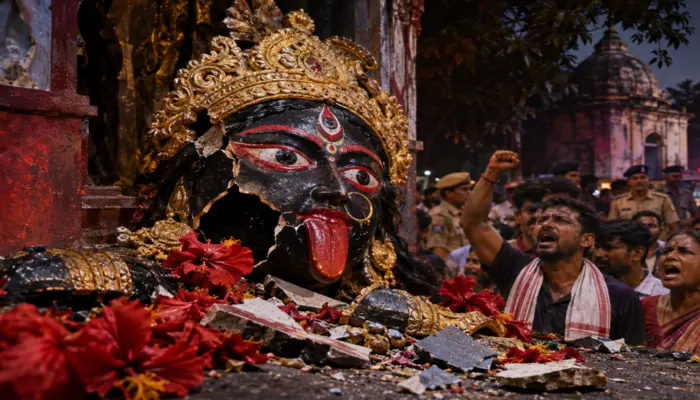
Sacred idol of Goddess Kali desecrated my unknown miscreants amid festivities in South 24 Parganas, West Bengal
 North 24 Parganas district, West Bengal, India
 9 November, 2026
Case Summary
In Palbari, South 24 Parganas district, West Bengal, the sacred idol of Goddess Kali was desecrated by unidentified miscreants on the night of 10th November 2026. The incident came to light on 11 November 2026, when residents discovered the vandalised idol, triggering outrage among the Hindu community. Residents expressed deep anguish over the desecration, citing the religious significance of Goddess Kali and the importance of Kali Puja in Bengali culture. Several elderly residents said the incident had deeply hurt their religious sentiments and amounted to an affront to their faith and dignity. After the discovery, members of the local Hindu community gathered on the Basanti Highway and staged a protest, blocking the road. They raised slogans against the desecration and demanded the immediate arrest of those responsible, along with a swift, impartial investigation. Police personnel reached the spot and attempted to bring the situation under control. The local administration held discussions with the protesters and assured them that their demands would be addressed. Protesters also expressed concerns over similar incidents in the past, demanding exemplary action against the perpetrators and increased security to prevent further incidents. Police subsequently launched an investigation to identify those responsible. Personnel from the local police station visited the spot and recorded statements from eyewitnesses. Investigators began tracing the perpetrators and stated that closed-circuit television (CCTV) footage would be examined if available.
Why it is Hate Crime ?
This case has been added to the tracker under the primary category of - Attack on Hindu religious representations. Within it, the sub-category selected here is - Desecration of Hindu religious symbols. Icons and symbols or a religious representation of a spiritual ideal are widely revered in Hinduism. Iconography is of vital significance in the Hindu milieu. It helps connect people’s spiritual beliefs with the real world. Iconography within the Hindu faith takes several shapes and forms. Murtis are of most significance to Hindus, to which daily rituals, prayers and offerings are done. Besides the murtis, there are several other symbols which have deep significance in the Hindu faith – the Om and Swastika for example. Since these Hindu religious symbols hold paramount importance in Hinduism, any desecration of symbols, icons, murtis, religious representations and manifestations, is driven by animosity towards the faith itself which manifests itself through these murtis, icons and symbols. Therefore, any desecration of these Hindu religious symbols and representations is considered religiously motivated hate crimes under this category. The incident constituted a hate crime because the object of the vandalism was a sacred representation of Goddess Kali, one of the principal deities worshipped by Hindus. An attack on a Hindu deity's idol inside a place of worship went beyond ordinary property damage, as it directly affected an object of religious reverence and struck at the faith, beliefs and collective religious identity of the Hindu community. Hindu idols are not merely decorative or material objects; they are consecrated representations of deities and occupy a central place in Hindu worship. Their deliberate destruction therefore carries a distinct religious significance and cannot be assessed solely as an act of physical vandalism. The targeting of an idol of Goddess Kali was particularly significant given the central place of Kali worship in Bengal's Hindu religious and cultural traditions. Kali Puja is one of the most important Hindu religious observances in the region, and the goddess is deeply revered by Bengali Hindus. The desecration of her idol consequently represented an attack on an important expression of Hindu religious life. Such an act violated the sanctity of Hindu worship and demonstrated disregard for the religious sentiments of the community. The damage inflicted on a sacred idol also had consequences beyond the immediate physical destruction, as it disrupted the community's ability to worship and maintain an important site of religious devotion. The communal significance of the incident was reflected in the response of local Hindus, whose anger and distress stemmed from the desecration of an object central to their faith. The destruction of sacred Hindu objects created an atmosphere of intimidation among worshippers by making religious sites and expressions of faith appear vulnerable to deliberate attacks. It also undermined the community's sense of security in practising and preserving its religious traditions. Even though the perpetrators remained unidentified, the deliberate vandalism of a sacred Hindu idol provided a clear religious dimension to the incident. The case was therefore categorised as a hate crime on account of the targeting of a Hindu religious object.


Case Status
Complaint filed


Perpetrators Details
Perpetrators
Unknown
Perpetrators Range
Unknown
Perpetrators Gender
unknown
 Sources



