Sacred Hindu idol vadalised in Chhattisgarh's Nariyra, accused severes idol's head, break arms and throws worship materials
 Champa, Chhattisgarh, India
 9 November, 2026
Case Summary
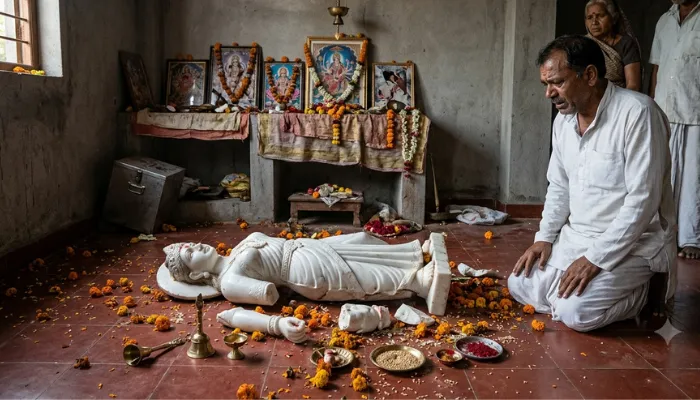
The idol of Veerangna Maharani Maa Bilasa Devi was vandalised into four pieces on Tuesday, 10 November 2026, in Ward No. 15 of Nariyra Nagar Panchayat, Chhattisgarh. The perpetrators severed the head of the idol from its body, broke both arms of the idol, threw the torso onto the ground, and scattered sacred worship materials across the community hall premises. The incident came to light after Nauman Kaivart, who had installed the statue with the assistance of ward residents, received a call from people in the neighbourhood. He had returned home after the regular prayers held at the premises. After learning of the vandalism, he immediately returned to the site and found the idol destroyed. The statue had been installed in the community hall, which had since become a centre for religious activities and daily worship. Devotees regularly visited the site for darshan, with larger gatherings on Tuesdays and Saturdays. Following the incident, residents gathered at the site and demanded the immediate arrest of the person responsible. Residents brought the matter to the attention of Mulmula Police Station in-charge Shivanand. A police team visited the location, inspected the scene, and spoke with residents. The police initiated an investigation into the vandalism.
Why it is Hate Crime ?
This case has been added to the tracker under the primary category: Attack on Hindu religious representations. The sub-category selected is: Desecration of Hindu religious symbols. Icons and symbols, or religious representations of a spiritual ideal, are widely revered in Hinduism. Iconography is of vital significance in the Hindu milieu. It helps connect people’s spiritual beliefs with the real world. Iconography within the Hindu faith takes several shapes and forms. Murtis are of the most significance to Hindus, to which daily rituals, prayers, and offerings are done. Besides the murtis, there are several other symbols which have deep significance in the Hindu faith – the Om and Swastika, for example. Since these Hindu religious symbols hold paramount importance in Hinduism, any desecration of symbols, icons, murtis, religious representations, and manifestations is driven by animosity towards the faith itself, which manifests itself through these murtis, icons, and symbols. Therefore, any desecration of these Hindu religious symbols and representations is considered religiously motivated hate crimes under this category. The other sub-category selected here is: Violence against religious structures or centres In Hinduism, a religious structure is also considered divine. Hindus believe that not just the Deity but the religious structure itself is sacred. In this sub-category, we would document attacks against religious structures that are not consecrated temple spaces. Such religious spaces could be temporary in nature – for example – the religious spaces erected specifically for festivals like Durga Puja, etc. This category would also document cases of attacks against religious centres. These spaces in their own right may not be ‘sacred’ per se; however, they are often spaces where religious gurus live, religious teaching is imparted, or they belong to religious institutions. Any attack against religious structures is a result of animosity towards the religion itself, which manifests itself through the religious spaces; therefore, such attacks are considered religiously motivated hate crimes. Religious centres are also manifestations of the religion, its teachings, or gurus, and therefore, attacks against such centres would be considered religiously motivated hate crimes. The other sub-category selected here is: Attack on temples. In Hinduism, a temple is the abode of the Deity. The Deity in the Temple is consecrated, thereby making it a real, breathing entity. Hindus believe that not just the Deity but the temple premises itself are sacred to Hindus since Hindus hold the faith that the entire Temple space is an amalgamation of the divine energy of the deity. Given the central significance of Temples in Hindu Dharma, any attack against a Hindu Temple or its peripheral premises is an attack on the faith itself and is born out of animosity towards the faith, of which the Temple is a central tenet. Any manner of attack against a Temple and/or its premises would therefore be considered a religiously motivated hate crime. The incident constituted a targeted attack on a Hindu place of worship and a sacred religious object, making it relevant for classification as a hate crime against Hindus and the violation of a place where devotees regularly practised their faith. An idol serves as a sacred representation through which devotees express their devotion and establish a connection with the divine. Its destruction therefore carries religious significance beyond the physical damage. Because sacred idols serve as the living centre of Hindu devotional life, the deliberate decapitation and dismemberment of the deity, accompanied by the scattering of ritual offerings across the premises, constituted an unmistakable act of religious hostility. Rather than ordinary vandalism, the targeted mutilation of a revered spiritual representation directly assaulted the core religious practices of the local Hindu community. The timing of the assault immediately following regular Tuesday prayers directly disrupted a well-established routine of collective devotion and darshan. This targeted desecration inflicted deep psychological and religious distress upon the local Hindu society, undermining their sense of security and freedom to maintain sacred spaces within their own neighbourhood. The fundamental motivation behind this hate crime stemmed from deep-seated animosity toward Hinduism itself, wherein the perpetrators targeted and desecrated a consecrated idol, a primary manifestation of the Hindu faith, to demean sacred iconography, intimidate devotees, and attack the religious identity of the Hindu society. It is important to mention here that, though the last update was that the miscreants were unknown, regardless, the action stemmed from animosity against Hinduism and resulted in the desecration of the sacred idol and space and would therefore be considered a religiously motivated hate crime.


Case Status
Complaint registered


Perpetrators Details
Perpetrators
Unknown
Perpetrators Range
Unknown
Perpetrators Gender
unknown
 Sources



