Kali Puja idol immersion procession targeted, Hindu devotees brutally assaulted in Munger, Bihar
 Munger, Bihar, India
 10 November, 2026
Case Summary
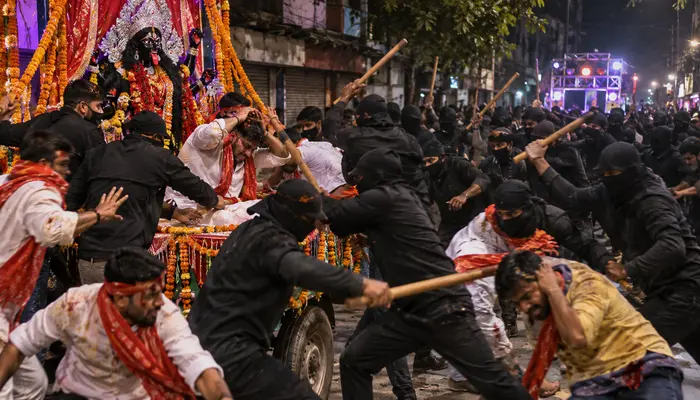
In Munger, Bihar, a Kali Puja idol immersion procession was targeted and Hindu devotees were brutally attacked by a mob of 30–50 unidentified men wielding sticks and batons. According to media reports, the incident occurred on the evening of 11 November 2026 at Kora Maidan Chowk, under the jurisdiction of Kasim Bazar police station. The immersion procession carrying the Bam Kali idol of Gandhi Chowk Lagna Market had commenced that evening. The procession was proceeding towards Badi Bazar via Bekapur and Shadipur, passing through the Kasturba Water area. When it reached Kora Maidan Chowk, more than 30-50 unidentified men suddenly arrived and began assaulting the members seated on the trolley carrying the idol. Hindu devotees dancing to music played by a disc jockey (DJ) were also attacked with sticks and batons. Several puja committee members and devotees sustained injuries. The sudden assault triggered panic among the Hindu devotees, who began running in different directions to escape the attackers. Other people passing along the road also fled in fear. In protest against the attack, Puja committee members halted the idol immersion procession on the road for approximately 45 minutes, demanding the identification of the attackers, action against them and an investigation into the incident. The stoppage disrupted vehicular movement and resulted in a traffic jam. Upon receiving information about the incident, Kotwali Station House Officer Rajiv Kumar Tiwari arrived at the scene with police personnel. Police from Kasim Bazar police station also intervened and managed to bring the situation under control. The police pacified the committee members and subsequently facilitated the continuation of the procession under police protection. The idol was taken through the town and immersed at Sojhi Ghat under police security. The assault was captured by a closed-circuit television (CCTV) camera installed at a nearby shop, and footage of the incident subsequently circulated on social media. Committee members Amit, also known as W Kumar, and Rajesh Kumar stated that a group of 30–50 unidentified men had suddenly attacked the procession. They further stated that they would submit a written complaint at the police station on 12 November 2026, after the immersion, seeking action against those responsible. At the time of writing this report, the police had begun gathering information about the incident, and an investigation was under way. Notably, this was not the first such incident of an attack on a Hindu religious procession in Munger. The Hinduphobia Tracker had previously documented an incident in October 2026 in Jamalpur, Munger district, Bihar, during which miscreants attempted to vandalise the idol of Goddess Kali during a Durga Puja immersion procession following a minor dispute with Hindu devotees over dancing.
Why it is Hate Crime ?
This case is being added to the tracker under the primary category: Attack not resulting in death. The subcategory selected is: Attack on religious procession. The outward celebration and display of religious symbols in an intrinsic part of Hinduism. Religious processions on various festivals are age-old traditions and a way to manifest faith and form a part of the religious practices of Hindus. On several occasions, such religious processions come under attack by non-Hindu mobs, in a manifestation of their animosity towards Hinduism and their practices. The reasons cited for such violent attacks are many and range from crossing a non-Hindu resident-dominated area to playing loud music, crossing from an area where there is a religious structure of another faith etc. The violent attacks are triggered by the outward display of religiosity by Hindus. The attacks are mainly a manifestation of religious supremacist doctrine which believes that idolatry, essentially the Hindu faith, is one that deserves to be annihilated since the very tenets of Hinduism, its practices and traditions are considered a sin in those doctrines. Since these attacks emanate from intrinsic and doctrinal animosity towards Hindus and Hinduism, it is considered a religiously motivated hate crime under this category. The other subcategory selected is: Attack against Hindu devotees. Hindu devotees are a few of the easiest targets of religiously motivated hate crimes because during the festival/procession/puja etc, for non-Hindus it is easy to profile their victims on the basis of religion. Hindu devotees come under attack on several occasions by individual non-Hindus or mobs of non-Hindus owing to their animosity against Hinduism, its symbols and tradition/practices. There are several instances of Hindu devotees being attacked while they worship in temples or temporary religious structures, during religious processions, doing bhajan/kirtan/puja in their own homes, in the residential society etc. These attacks are perpetrated by non-Hindus primarily because of their animosity towards Hindus and their faith. In some cases, the trigger for the violence may be non-religious, however, there are two elements that make these hate crimes. First, the Hindus who come under attack are attacked violently while indulging in religious activity. Whether they are in a place of worship or not is immaterial to the crime. When individuals are attacked while indulging in religious practices, the attack in itself is a hindrance to their freedom to practice religion and therefore constitutes a hate crime. Secondly, religious supremacist doctrines and ideologies deem religious practices of Hindus to be offensive ab initio since they are considered “sinful” by these ideologies, worthy to be annihilated by force or coercion. Driven by these religious supremacist ideologies and doctrines, the attacks against Hindu devotees stem from intrinsic animosity towards Hinduism. In some cases, the trigger for the violence may be non-religious, however, it develops into a religiously motivated crime during the course of the violence. Since these attacks stem from animosity towards Hindus and Hinduism, they are considered religiously motivated hate crimes under this category. This incident was a clear example of a religiously driven hate crime, as a mob of men armed with sticks and batons attacked a Kali Puja idol immersion procession and brutally assaulted Hindu devotees participating in the sacred religious celebration. Kali Puja holds immense religious significance for Hindus, particularly in eastern India, including West Bengal, Bihar and the North-eastern states, as well as in Bangladesh, where the festival is celebrated on the same night as Diwali. Dedicated to Goddess Kali, a powerful manifestation of Adi Shakti, the festival celebrates the Goddess as the destroyer of evil and the protector of her devotees. Elaborate pandals are erected, beautifully decorated idols of Goddess Kali are installed, and Hindu devotees gather to offer prayers, perform rituals and participate in night-long worship. Following the celebrations, the idols are taken through the streets in religious processions and immersed in water bodies, marking the conclusion of the festivities. The procession targeted in this incident was precisely such a sacred Hindu religious procession, carrying the idol of Goddess Kali for immersion following the Puja celebrations. Therefore, the deliberate targeting of a Kali Puja immersion procession demonstrates deep-seated hostility towards Hinduism and Hindu religious expression. Such an attack directly undermines the religious sentiments of the Hindu community and displays complete disregard for the sacred significance of the occasion, the idol of Goddess Kali and the devotees participating in the procession. The perpetrators further demonstrated their hostility by brutally assaulting Hindu devotees with sticks and batons, turning a religious celebration into an episode of violence and intimidation. Such attacks instil fear within the Hindu community and discourage devotees from freely participating in their religious traditions, conveying that even practising their faith in public can expose them to physical violence. The circumstances of the attack further demonstrated that this was not a random altercation or an isolated occurrence of street violence. A mob of 30–50 unidentified men, armed with sticks and batons, descended upon the procession and launched a coordinated assault on the devotees and those accompanying the idol. The fact that a large group of men arrived together, armed with weapons, and collectively targeted a Hindu religious procession demonstrates the deliberate nature of the attack. Their actions displayed a clear intention to target the procession and assault Hindu devotees participating in a religious celebration. The collective assault, the use of weapons and the deliberate targeting of a sacred Hindu gathering demonstrate organised violence driven by religious hostility. This was a premeditated anti-Hindu attack that showcased the perpetrators' deep-seated animosity towards Hindu religious expression and their willingness to employ violence against the Hindu community. The fact that a similar attack occurred just a month earlier in Munger, when miscreants attempted to vandalise the idol of Goddess Kali during a Durga Puja immersion procession in Jamalpur, further demonstrates that this was not an isolated occurrence. The repeated targeting of Hindu religious processions on two separate religious occasions within a short span of time exposes a pattern of hostility towards Hindu religious expression and the Hindu community. These successive incidents reinforce the religious dimension of such attacks and demonstrate how Hindu religious gatherings and processions have repeatedly become targets of violence and intimidation. Overall, this case met several parameters of a religiously motivated hate crime. Although the identities and religious affiliations of the perpetrators had not been established at the time of writing this report, their actions, specifically targeting a Kali Puja immersion procession and brutally assaulting Hindu devotees, demonstrated hostility towards Hinduism and the Hindu community. Therefore, this case is being added to the hate crime database of the Hinduphobia Tracker. Disclaimer: Although multiple Hindu devotees were assaulted and several sustained injuries in this incident, the total number of victims was not specified. Hence, the victim count has been recorded as 'Unknown'.


Case Status
Unknown


Perpetrators Details
Perpetrators
Unknown
Perpetrators Range
From 10 to 100
Perpetrators Gender
male
 Sources



