Hindu villagers pressured to convert to Christianity through inducements under guise of prayer meeting; objectionable remarks made against Hinduism
 Narsinghgarh, Madhya Pradesh, India
 4 November, 2026
Case Summary
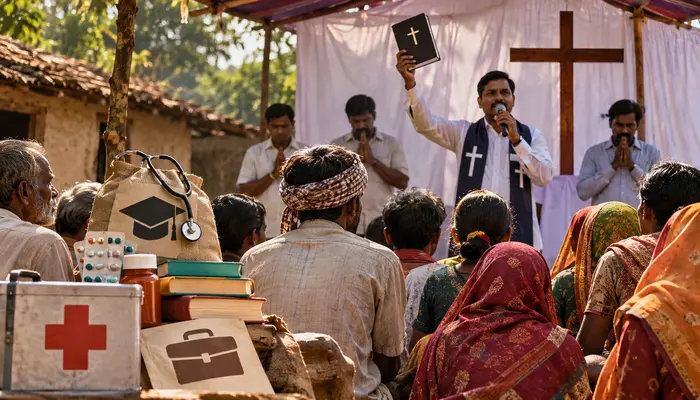
In Mungwani village, Narsinghpur district, Madhya Pradesh, Hindu villagers from the Scheduled Caste and Scheduled Tribe communities were pressured to convert to Christianity through inducements under the guise of a prayer meeting. During the gathering, objectionable remarks were made against Hindu culture, religious beliefs, traditions and practices. On 5 November 2026, three individuals, identified as Radhe Jhariya, a resident of Lameta in Jabalpur; Nilesh Kakodiya, a resident of Gorakhpur in Narsinghpur; and Pritam Uike, a resident of Seoni, Madhya Pradesh, organised a gathering in Mungwani village without obtaining prior permission from the government or the local administration. They assembled people for the meeting, where members of the Scheduled Caste and Scheduled Tribe communities were offered inducements to abandon Hinduism and convert to Christianity. During the meeting, objectionable remarks were made about Sanatan Hindu culture, religious beliefs and traditions. On 10 November 2026, residents submitted a memorandum addressed to the District Collector of Narsinghpur, Additional Collector Arvind Singh, seeking action against the three individuals. They demanded an impartial investigation into the unauthorised gathering, the inducements offered to members of the Scheduled Caste and Scheduled Tribe communities, the objectionable remarks concerning Hindu culture and religious traditions, and the criminal record of Radhe Jhariya. They further urged the administration to initiate appropriate legal proceedings and take preventive measures to stop similar incidents in the future and safeguard social harmony in the area.
Why it is Hate Crime ?
The primary category selected in this case is: Predatory Proselytisation. Within this, the subcategory selected is: Conversion/ attempts to convert by inducement. Predatory Proselytisation is not just limited to threat, harassment, force and violence, but it also has contours of stealth. In several cases, the Hindu victim is exploited to convert, with non-Hindus taking advantage of their poverty. In such cases, the Hindu victim who is suffering financially is offered monetary benefits, including lucrative offers for jobs, health treatment, education, etc, to induce the victim into changing his/her religion. In such cases, the religious identity of the victim and the aim to disenfranchise him from his faith form the heart of the crime. Also, taking advantage of and exploiting an individual’s economic vulnerabilities is widely acknowledged as exploitation, forms of which are often penalised by law. Such cases therefore are considered religiously motivated hate crimes since the victim’s religious identity forms the very heart of the crime itself. The other subcategory is: Attempting to convert/converting by denigrating Hinduism. In several cases, Hindus are converted or an attempt is made to convert Hindus by denigrating their faith, Hinduism. In such cases, the Hindus associate with the non-Hindu perpetrators often by choice and then, the attempt to convert them by insulting their faith, showing the faith down etc begins. An example of this would be a non-Hindu gathering where the Hindus are attending the gathering of their own free will. However, once they attend the gathering, there is an explicit attempt to convert them by abusing their faith and hailing the faith of the perpetrator. The denigration of the Hindu faith is often based on misrepresentation of the Hindu faith, its doctrine and scriptures and insult to espoused traditions if not blatant lies about Hindu beliefs and ways. Such conversions or attempts at conversions are driven by animosity towards the Hindu faith and are therefore documented as religiously motivated hate crimes. This case constituted a religiously driven hate crime because members of the Hindu community were specifically targeted for conversion to Christianity through inducements during an organised prayer meeting. The incident was not presented as a general gathering unrelated to religion. Rather, residents stated that members of the Scheduled Caste and Scheduled Tribe communities were being brought together and encouraged towards religious conversion through inducements. The religious nature of the activity, combined with the targeting of members of the Hindu community for conversion, demonstrated that the conduct was directed at their religious identity. Offering inducements, especially when directed at vulnerable marginalised individuals, shows that these incentives are not acts of kindness or charity. Instead, they are calculated moves to exploit vulnerable Hindus on religious grounds. By offering inducements in connection with religious conversion, the accused were effectively exploiting those who might have been seeking assistance or hope. Such instances are seen in many cases where members of Christian missionary groups target socially and economically vulnerable Hindus to further their agenda of religious conversions. This form of coercion strips people of their agency and dignity and results in coerced conversions. These are not random or isolated incidents, but rather cases deeply rooted in religious animosity towards Hindu victims. Furthermore, what was presented as a simple prayer gathering was in reality a covert attempt at religious conversion. These were not genuine community prayers but calculated efforts to exploit the trust of Hindus and manipulate them into abandoning their faith. The organisers deliberately held the meeting in secrecy and without permission from the administration, indicating a deliberate and deceptive strategy designed to avoid public attention and scrutiny. By conducting such gatherings covertly, the Christian missionaries sought to manipulate vulnerable Hindus, taking advantage of their emotional and social circumstances to push them towards conversion. The objectionable remarks made during the meeting against Sanatan Hindu culture, beliefs, traditions and practices directly hurt the religious sentiments of the Hindu community. Sanatan Hindu culture has been an integral part of Hindu life for generations, with its customs, rituals, religious beliefs and traditions passed down and preserved over centuries. Making disparaging comments about these practices showed disrespect towards the faith of Hindus and the cultural heritage they continue to uphold. Such remarks not only hurt the sentiments of Hindu villagers but also insulted traditions that hold deep religious and personal significance for them. Targeting Hindu beliefs and customs in this manner amounted to an attack on their religious identity and showed disregard for the faith and traditions that remained central to their community life. The incident also highlights a growing pattern in organised conversion networks, where individuals who have embraced Christianity continue to retain their Hindu names while practising Christianity. This allows these crypto Christians to seamlessly integrate into Hindu communities, gain the confidence of unsuspecting families, and carry out conversion activities without immediately revealing their religious identity. In this case, too, the converted Christians operated under the Hindu names Radhe Jhariya, Nilesh Kakodiya, and Pritam Uike, illustrating how continuing to use a Hindu identity can facilitate access to communities that might otherwise be wary of conversion efforts. The Christian faith, by its very theological foundations, places a strong emphasis on proselytisation. In pursuit of conversion objectives, Christian evangelists often employ unethical means, ranging from psychological pressure and misinformation to inducements such as money or jobs. In such cases, Christian missionary groups often target and brainwash socially and economically vulnerable Hindus to further their agenda of religious conversions. This form of coercion strips Hindus of their agency and dignity and enforces forced conversions. These are not random or isolated incidents, but rather premeditated efforts to undermine the Hindu faith, persuade Hindus to discard their own faith, and convert to Christianity. Such acts are deeply rooted in religious animosity towards Hindu victims, and thus amount to a clear instance of a religiously motivated crime.


Case Status
Complaint filed


Perpetrators Details
Perpetrators
Christian Extremists
Perpetrators Range
From 2 To 5
Perpetrators Gender
male
 Sources



