Diwali celebrations disrupted; Muslim woman purposely throws water at devotees gathared at Old Dhaka's Shani temple to celebrate their faith
 Dhaka, Dhaka District, Bangladesh
 9 November, 2026
Case Summary
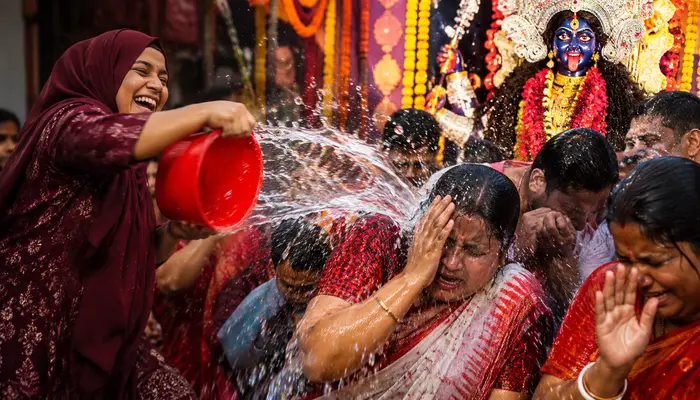
Hindu devotees gathered near a Shani temple in Old Dhaka's Shankharibazar area were targeted while celebrating Diwali/Kali Puja. Kali Puja takes place on the same night as Diwali. A Muslim woman identified as Ayesha Akter (or Ayesha Akhter Lipi) threw water from her upper-floor balcony onto devotees gathered near the temple to celebrate their festival. In a video she posted on her personal Facebook account, the woman is seen standing on her balcony overlooking the decorated Hindu religious venue for Kali Puja. Speaking in Bengali, she laughs and encourages her minor children to throw water at Hindu devotees celebrating the festival. She asks one of the children to get a bucket of water, then pours some into a mug and deliberately splashes water at Hindu devotees from her balcony while laughing and rejoicing with her children. The incident sparked widespread outrage among Hindu devotees, following which Ayesha Akter Lipi posted a separate video on her Facebook account apologising for her actions. At the time of writing, no independently verified information was available about a police investigation, official response, or legal action related to the incident.
Why it is Hate Crime ?
The primary category selected in this case is: Attack not resulting in death. The subcategory selected is: Attack against Hindu devotees. Hindu devotees are a few of the easiest targets of religiously motivated hate crimes because during the festival/procession/puja etc, for non-Hindus it is easy to profile their victims on the basis of religion. Hindu devotees come under attack on several occasions by individual non-Hindus or mobs of non-Hindus owing to their animosity against Hinduism, its symbols and tradition/practices. There are several instances of Hindu devotees being attacked while they worship in temples or temporary religious structures, during religious processions, doing bhajan/kirtan/puja in their own homes, in the residential society etc. These attacks are perpetrated by non-Hindus primarily because of their animosity towards Hindus and their faith. In some cases, the trigger for the violence may be non-religious, however, there are two elements that make these hate crimes. First, the Hindus who come under attack are attacked violently while indulging in religious activity. Whether they are in a place of worship or not is immaterial to the crime. When individuals are attacked while indulging in religious practices, the attack in itself is a hindrance to their freedom to practice religion and therefore constitutes a hate crime. Secondly, religious supremacist doctrines and ideologies deem religious practices of Hindus to be offensive ab initio since they are considered “sinful” by these ideologies, worthy to be annihilated by force or coercion. Driven by these religious supremacist ideologies and doctrines, the attacks against Hindu devotees stem from intrinsic animosity towards Hinduism. In some cases, the trigger for the violence may be non-religious, however, it develops into a religiously motivated crime during the course of the violence. Since these attacks stem from animosity towards Hindus and Hinduism, they are considered religiously motivated hate crimes under this category. This case is an example of religiously motivated hostility towards Hindus because a Muslim woman deliberately threw water from an upper-floor residence onto Hindu devotees gathered for the sacred Kali Puja and Diwali celebrations in Shankharibazar, Bangladesh. The incident involved disruption, humiliation and apparent mockery of Hindu devotees and their sacred religious observance. Kali Puja and Diwali hold profound religious and cultural significance for Hindus. Kali Puja is dedicated to Goddess Kali, who is revered as the embodiment of divine feminine power and the destroyer of evil, darkness and negative forces. Diwali, the festival of lights, symbolises the triumph of light over darkness and good over evil, and is celebrated with prayers, rituals, the lighting of lamps and festive gatherings. Both occasions are important expressions of Hindu faith, devotion and religious identity. Throwing water towards devotees gathered for the sacred Kali Puja and Diwali celebrations was a direct act of disrespect towards Hindu religious worship and the people observing these festivals. Devotees had gathered to offer prayers, perform religious rituals and celebrate Diwali and Kali Puja with faith and devotion. Throwing water towards them during such a sacred gathering disrupted their celebrations and humiliated people who had simply come together to practise their religion. It showed a blatant disregard for Hindu religious sentiments and the dignity of worshippers. It was a targeted insult to something deeply connected to their faith, traditions and identity. The laughter accompanying the act, which could be easily heard in the video, made the incident even more insulting, as it added an element of mockery to the disrespect shown towards Hindu devotees. Laughing while throwing water towards people gathered for a sacred religious celebration was deeply humiliating. It turned an occasion of prayer and devotion into an apparent source of amusement at the expense of Hindu worshippers. For those gathered there, Kali Puja and Diwali were deeply meaningful occasions rooted in their religious beliefs and traditions. Watching their celebrations being treated with such apparent contempt was an insult to their faith and religious sentiments. The laughter further intensified the humiliation, making it clear that the disruption of Hindu religious celebrations and the humiliation of devotees were treated with open mockery and contempt. It showed a disturbing lack of respect for devotees' feelings and the importance of their religious traditions. Mocking people while they were gathered to worship and celebrate their faith struck at their dignity as well as their freedom to practise their religion without fear, humiliation or interference. The intent behind the action could only possibly be that of provoking Hindus and showing disrespect towards their faith. Equally disturbing is the manner in which the accused involved her minor children. Rather than teaching them to respect the religious practices of their neighbours, she encouraged them to participate in an act intended to humiliate Hindu devotees. By turning the incident into something to laugh about and celebrate with her children, she was normalising disrespect towards another community's religious observance at a tender age. Children learn how to view other communities, their beliefs and their festivals from the behaviour of adults around them. Such acts risk sowing the seeds of religious hatred in young minds, teaching children that the humiliation of people belonging to another faith is acceptable. This is how prejudice is passed from one generation to the next. The concern becomes even greater when such conduct reflects the influence of extremist ideologies that promote religious supremacy and hostility towards Hinduism, particularly in societies where Hindu minorities have repeatedly faced discrimination and attacks on their religious identity. The incident also raises serious questions about the treatment of Hindu religious practices and the hostility directed towards Hindu minorities. Deliberately disrupting a Hindu festival, mocking devotees and encouraging children to participate in their humiliation cannot be dismissed as harmless mischief. The subsequent apology does not change the nature of the act or the message it conveyed. Since such callous behaviour can only stem from a profound contempt for the Hindu religion, this case deserves to be recorded in this hate tracker. Disclaimer: The Hinduphobia Tracker records incidents based on when an event occurred or when the victim's ordeal began. None of the media sources covering this case has specified the exact date the incident occurred. Therefore, for documentation purposes, we have recorded the date based on when the incident was first reported in the media, 10 November 2026.


Case Status
Unknown


Perpetrators Details
Perpetrators
Muslim Extremists
Perpetrators Range
One Person
Perpetrators Gender
female
 Sources



