Hindu festival celebrations mocked: Influencer calls Diwali firecracker users ‘gawaar’ and demand they be jailed

 8 November, 2026
Case Summary
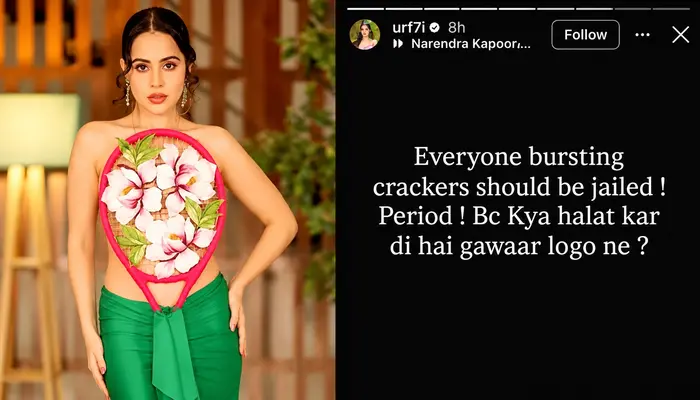
Actress and social media personality Urfi Javed launched a sharp attack on Diwali celebrants, calling those bursting firecrackers 'gawaar' and demanding that they be sent to jail, while weaponising pollution concerns to vilify and demean festive celebrations. Her remarks came shortly after Diwali, a sacred Hindu religious festival. On Monday, 9 November 2026, Urfi took to her Instagram Stories and wrote, "Everyone bursting crackers should be jailed! Period! Bc, kya halat kar di hai gawaar logon ne?" She directed her criticism at people bursting firecrackers under the pretext of environmental concern, condemning the auspicious Diwali celebrations. Several other celebrities, including Bhumi Pednekar, Dia Mirza and Soni Razdan, also targeted firecracker use, criticising traditional Diwali celebrations and citing rising pollution to denounce Hindu festive practices. Their remarks further brought Hindu festive celebrations under scrutiny, with firecracker use once again becoming the focal point of criticism after the festival.
Why it is Hate Crime ?
This case has been added to the tracker under the primary category of: Hate speech against Hindus. The sub-category selected here is: Anti-Hindu slurs, mocking faith. Anti-Hindu slurs and the deliberate mocking of the Hindu faith owing to religious animosity involve the usage of derogatory terms, stereotypes, or offensive references to religious practices, symbols, or figures. One of the common anti-Hindu slurs used against Hindus is “cow-worshipper” and “cow piss drinker”. The intention of using this term is to demean and mock Hindus as a group and their religious beliefs since Hindus consider the cow holy. Additionally, some symbols and the slurs attached to them have a historical context that exacerbates the insult, hate, stereotyping, dehumanisation and oppression against Hindus. Cow worship has been used for centuries to denigrate Hindus, insult their faith and oppress Hindus specifically as a religious group. There has been overwhelming documentation about how cow slaughter has been used to persecute Hindus with cow meat being thrown in temples and places of worship. There has also been overwhelming documentation where cow meat (beef) has been force-fed to Hindus to either forcefully convert them to Islam or denigrate their faith. Apart from cow worship, the Swastika – which holds deep religious significance for the Hindus – has also been misinterpreted and distorted to use as a slur against Hindus. Similarly, the worship of the Shivling has been used by supremacist ideologies and religions to denigrate Hindus owing to religious animosity. Such slurs and denigration stem out of inherent animosity and hate towards Hindus and their faith, therefore, it is categorised as hate speech targeted at Hindus specifically owing to their religious identity. This case has been added to the tracker because of the manner in which the discussion targeted Hindu religious celebrations and practices, particularly Diwali firecracker traditions, while portraying Hindu-specific festive participation as environmentally irresponsible and demanding punitive action against those observing such practices. Under the pretext of environmental concerns, the influencer used derogatory remarks, calling firecracker celebrants 'gawaar' and demanding their imprisonment, while portraying traditional Hindu festive practices as environmentally irresponsible. Diwali holds profound religious and cultural significance for Hindus as it symbolises the triumph of good over evil, the victory of light over darkness and the return of Lord Rama to Ayodhya after 14 years of exile and his victory over Ravana. The celebration traditionally involves lighting diyas, decorating homes, performing prayers and worshipping Goddess Lakshmi and Lord Ganesha. Bursting firecrackers is also a widely practised part of Diwali festivities, with fireworks adding to the celebratory atmosphere and marking the occasion with collective joy. For Hindu families, these customs form an integral part of their religious traditions, cultural heritage and collective expression of faith. Diwali celebrations, particularly the traditional practice of bursting firecrackers, are often deliberately targeted and subjected to harsh public criticism, reflecting the selective hostility directed towards Hindu religious festivities and their associated customs. Rather than restricting criticism to environmental concerns, Urfi Javed resorted to derogatory language, branding Hindu celebrants bursting firecrackers as 'gawaar' and demanding that they be sent to jail. Such remarks demeaned Hindu devotees and portrayed their participation in traditional festive celebrations as an act deserving punishment. The targeting of firecracker celebrations also brought Hindu religious customs under disproportionate scrutiny, while the religious and cultural significance of Diwali was disregarded. The episode therefore reflected how Hindu religious festivities and their associated practices are singled out, demeaned and portrayed negatively in public discourse. By using pollution concerns as a shield to attack traditional Diwali celebrations, the perpetrator directed hostility towards Hindu religious practices while disguising their criticism as environmental activism. Instead of limiting her concerns to pollution and responsible firecracker use, she resorted to insulting Hindu celebrants, ridiculing their customs and demanding punitive action against those participating in the festivities. Such selective outrage turns environmental concerns into a means of condemning Hindu traditions, while disregarding the deep religious and cultural significance these celebrations hold for Hindus. Moreover, branding celebrants as 'gawaar' and demanding their imprisonment further exposed her hostile intent, as she targeted people practising a traditional aspect of a Hindu festival rather than merely addressing an environmental issue. For these reasons, this case deserves to be added to the hate crime database.


Case Status
Unknown


Perpetrators Details
Perpetrators
Muslim Extremists
Perpetrators Range
One Person
Perpetrators Gender
female
 Sources



