Rural Hindus pushed toward conversion with healing promises and inducements by Christian pastor in Korba, Chhattisgarh
 Korba, Chhattisgarh, India
 31 October, 2026
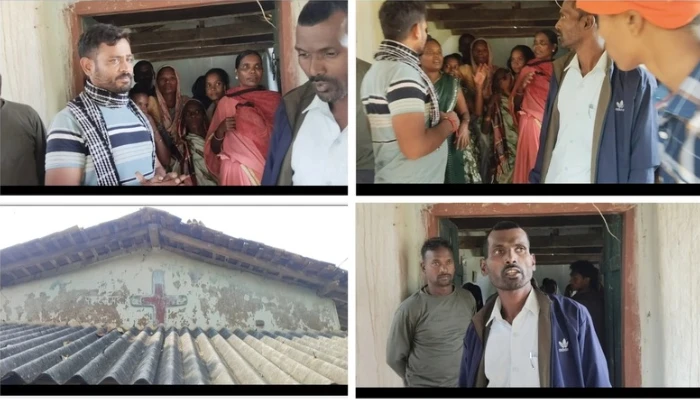
Case Summary
In Pahadjamni village in the Pali region of Korba district, Chhattisgarh, rural Hindu women and their families were targeted for religious conversion to Christianity through inducements by a pastor named Same Lal. The pastor also conducted Christian healing prayer meetings (Changai Sabhas) in the village, while a church-like structure used for religious activities stood on land identified as government property. According to reports, Kanha Patel of the Bajrang Dal received information that the accused was organising healing prayer meetings (Changai Sabhas) in Pahadjamni. Some villagers objected to the activities conducted during these meetings and raised concerns over attempts to influence rural women and families to convert to Christianity. After receiving this information, activists from Hindu organisations reached the spot and protested the religious activities. They demanded an investigation into the conversion activities and the construction of church-like structures in the area. They also sought verification of the land records, land-use permissions, and construction approvals. The matter also involved a building bearing a Christian cross on its wall, where Christian religious activities were being conducted. Villagers said the structure stood on government land, raising questions about its ownership and the permissions obtained for its construction. Following the information provided by the activists, a Dial 112 police team reached the location and took the accused to the police station. After questioning him, the police issued him a notice seeking an explanation.
Why it is Hate Crime ?
This case has been added to the tracker under the primary category: Predatory Proselytisation. Within this, the subcategory selected is Conversion/attempts to convert by inducements. Predatory Proselytisation is not just limited to threats, harassment, force, and violence, but it also has contours of stealth. In several cases, the Hindu victim is exploited to convert, with non-Hindus taking advantage of their poverty. In such cases, the Hindu victim who is suffering financially is offered monetary benefits, including lucrative offers for jobs, health treatment, education, etc.c, to induce the victim to change his/her religion. In such cases, the religious identity of the victim and the aim to disenfranchise him from his faith form the heart of the crime. Also, taking advantage of and exploiting an individual’s economic vulnerabilities is widely acknowledged as exploitation, and the law often penalises its forms. Such cases, therefore, are considered religiously motivated hate crimes since the victim’s religious identity forms the very heart of the crime itself. This case was included in the tracker because it involved a deliberate and organised effort to persuade rural Hindu villagers to abandon their faith and adopt Christianity through inducements and on the pretext of healing prayer meetings (Changai Sabhas). The conduct was directed specifically at members of the Hindu community and was aimed at securing a change in their religious identity. The issue was therefore not merely the expression of Christian belief, but the use of incentives and promised benefits to encourage the abandonment of Hinduism and the adoption of another religion. The conduct was directed at members of the Hindu community and involved the use of Christian religious gatherings and promises of healing to influence their religious choices. The issue was therefore not merely the expression of Christian belief or the organisation of prayer meetings, but the use of spiritual healing as an inducement to encourage Hindus to leave their ancestral faith and adopt another religion. The religious motivation was evident from the nature of the programme that was organised. The healing claims and the inducements were not presented as unconditional acts of charity available irrespective of religious affiliation. Instead, they were linked to participation in Christian prayer and the acceptance of Christian doctrine. This demonstrated that the objective was not social welfare or community assistance, but religious conversion. The fact that spiritual healing was tied to a Christian prayer meeting revealed a deliberate attempt to influence the religious choices of Hindu individuals through external spiritual pressure rather than personal spiritual conviction. Conversion through such methods was particularly significant because it targeted individuals at points of vulnerability. Further, the activities were directed at Hindu women and rural families in a village, making the targeting of members of the Hindu community a significant aspect of the case. The use of organised healing meetings provided a setting in which Christian religious beliefs were propagated among Hindu residents. Rather than remaining confined to the personal practice of Christianity, these gatherings became a means of influencing the religious choices of people belonging to another faith. The conduct also reflected the significance of spiritual inducements in efforts to secure religious conversion. Healing and divine intervention carry considerable emotional and spiritual importance, particularly when individuals are seeking relief from suffering. Using these circumstances to manipulate Hindus to abandon their religious identity and embrace Christianity sought to make the acceptance of another faith appear inseparable from the prospect of receiving spiritual benefits. Furthermore, the success of the entire effort depended upon the abandonment of Hindu beliefs and practices, which revealed a clear and deliberate religious motive. The gathering was arranged under a shelter with mostly rural women, indicating planning and coordination rather than spontaneous evangelism. The Christian faith, by its very theological foundations, places a strong emphasis on proselytisation. In pursuit of conversion objectives, Christian evangelists often employ unethical means, ranging from psychological pressure and misinformation to inducements such as money or jobs. In such cases, Christian missionary groups often target and brainwash socially and economically vulnerable Hindus to further their agenda of religious conversions. This form of coercion strips Hindus of their agency and dignity and enforces forced conversions. These are not random or isolated incidents, but rather premeditated efforts to undermine the Hindu faith, persuade Hindus to discard their own faith, and convert to Christianity. Such acts were deeply rooted in religious animosity towards Hindu victims, and thus, this case was added to the tracker. Therefore, this case was added to the Hinduphobia Tracker's hate crime database. Disclaimer: The Hinduphobia Tracker records incidents based on when an event occurred or when the victim's ordeal began. The report does not specify the exact date when the accused first lured the victims. Therefore, for documentation purposes, we recorded the date as when the incident was reported in the media: 1 November 2026.


Case Status
Arrested


Perpetrators Details
Perpetrators
Christian Extremists
Perpetrators Range
One Person
Perpetrators Gender
male
 Sources



