Sacred Hindu temples, Trimbakeshwar and Saptashrungi threatened with bomb attacks amid Diwali festivities
 Nashik, Maharashtra, India
 7 November, 2026
Case Summary
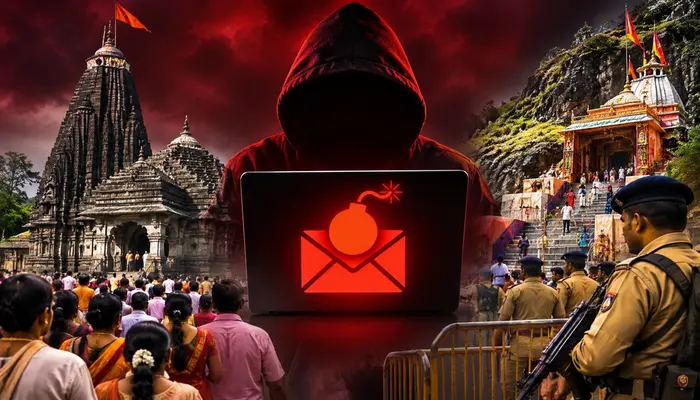
Hindu religious sites were threatened with bomb attacks amid Diwali festivities as threatening emails were sent to the official email addresses of the Shri Trimbakeshwar Temple Trust and the Shri Saptashrungi Gad Temple Trust. The communications warned of attacks and damage to two prominent Hindu religious establishments: Trimbakeshwar Temple, one of the twelve Jyotirlingas of Lord Shiva, and Saptashrungi Devi Temple, one of Maharashtra's three-and-a-half Shakti Peethas. Similar threatening emails were also received by several other prominent temples across Maharashtra. The threats came amid a significant influx of devotees during the consecutive Diwali holidays for Lakshmi Pujan, Padwa and Bhaubeej. Trimbakeshwar Temple witnessed heavy crowds on 8 and 9 November due to Somvati Amavasya, with devotees waiting four to five hours for darshan. Saptashrungi Gad also experienced substantial footfall, with long queues and a shortage of drinking water. The incident followed similar threatening emails received by the Nashik District Court and other district courts in Maharashtra approximately a week earlier. Those threats were subsequently found to be hoaxes after extensive searches. Following the temple threats, Nashik Rural Police and Nashik City Police strengthened security at Trimbakeshwar and Saptashrungi Gad, deploying more than 50 personnel at each location, including armed police personnel. They introduced entry checks, metal detector screening, CCTV surveillance, and intensified patrolling. Security was also strengthened at Kalaram Temple in Panchavati, where the Bomb Detection and Disposal Squad (BDDS) and dog squads conducted a thorough search. Other religious locations, including Kapaleshwar Temple and Sita Gufa, were also kept under heightened vigilance. Nashik Superintendent of Police Dr D. S. Swami confirmed receipt of the threatening emails and said a senior-level investigation had begun to identify the sender and trace the origin of the communications. Trimbakeshwar Police Inspector Pritam Chaudhary and Dindori Police Inspector Pradeep Deshmukh also confirmed receipt of the threats by the respective temple trusts. Assistant Commissioner of Police Sandeep Mitke said Nashik City Police had strengthened surveillance through CCTV monitoring and additional security deployment, including along the Godavari riverfront (Godakath), which was seeing increased crowds after the Simhastha Kumbh Mela flag-hoisting ceremony and Godavari Aarti.
Why it is Hate Crime ?
This case has been added to the tracker under the primary category of: Hate speech against Hindus. Within it, the subcategory selected here is: Violent threats. Violent threats, explicit, implicit or implied, is the most dangerous form of hate speech since it goes beyond discriminatory and prejudicial language to express the intent of causing harm to an individual or a group of people based on their religious identity and faith. There could be several different kinds of threats that are issued to Hindus based on religious animosity. An explicit threat would mean the direct threat of violence towards an individual Hindu, a group of Hindus or Hindus at large. Physical violence, death threats, threats of destruction of property belonging to Hindus and threats of genocide would mean explicit threats against Hindus for their religious identity. Implicit threats may not be a direct threat but implied through the use of symbols of actions – for example – in the Nupur Sharma case, other than explicit threats, there were also implicit threats when Islamists took to the streets to burn and beat her effigies. It implies that they want to do the same to Nupur Sharma – thereby is considered an implicit threat. Violent threats can be delivered in person, through letters, phone calls, graffiti, or increasingly through social media and other online platforms. It would be important to understand that a threat – explicit or implicit, online or offline – to an individual who happens to be a Hindu does not qualify as a religiously motivated threat. Such a threat, while vile and dangerous, could be owing to non-religious reasons and/or personal animosity. To qualify as a religiously motivated threat, it would need to exhibit an indication that the individual is being targeted for religious reasons and/or owing to his/her religious identity as a Hindu. This case has been added to the Hinduphobia Tracker because the threatening emails explicitly identified Hindu places of worship in Nashik district as targets for attacks and damage, seeking to intimidate the Hindu community through threats against its religious institutions. The messages specifically targeted Trimbakeshwar Temple and Saptashrungi Gad Temple, two prominent Hindu pilgrimage sites, during the Diwali festivities, when large numbers of devotees were visiting them. The deliberate selection of Hindu religious sites as targets demonstrated hostility towards Hindu religious institutions and threatened the community's ability to practise its faith and visit its sacred places without fear. These threats carried particular significance because Trimbakeshwar and Saptashrungi Gad are among the most prominent and sacred centres of Hindu worship in Maharashtra, holding immense religious and spiritual importance for Hindus across the country. Trimbakeshwar Temple is revered as one of the twelve Jyotirlingas of Bhagwan Shiva, while Saptashrungi Devi Temple is recognised as one of Maharashtra's three-and-a-half Shakti Peethas. Both temples attract lakhs of Hindu pilgrims and devotees and hold an important place in Hindu religious traditions, pilgrimage and worship. Targeting these two sacred establishments therefore carried significance far beyond threats against individual buildings. It amounted to intimidation directed at important centres of Hindu faith, threatening the religious security of devotees and seeking to instil fear across the wider Hindu community. The timing of these threats further underscored their deliberate attack on Hindu religious life, as they were issued during Diwali, one of the holiest festivals in Hinduism, when millions of Hindus observe religious rituals, visit temples and undertake pilgrimages. The consecutive holidays for Lakshmi Pujan, Padwa and Bhaubeej, coinciding with Somvati Amavasya, had drawn large numbers of devotees to Trimbakeshwar and Saptashrungi Gad. Targeting these sacred Hindu establishments during this auspicious period amounted to a direct assault on Hindu religious practices, as the threats sought to create fear among devotees, disrupt temple visits and intimidate Hindus while they celebrated their most significant religious festivities. By threatening two major centres of Hindu worship at a time of heightened religious activity, the perpetrators struck at the community's freedom to practise its faith and observe its traditions without fear. Ultimately, deploying bomb threats against Hindu places of worship was a calculated tactic of religious intimidation. The severe nature of the threats aimed not just to disrupt worship at Trimbakeshwar and Saptashrungi Gad, but to instil widespread fear within the broader Hindu community. This deliberate effort to suppress the religious freedom of Hindus through the threat of extreme violence firmly established the incident as a religiously motivated hate crime.


Case Status
Complaint filed


Perpetrators Details
Perpetrators
Unknown
Perpetrators Range
Unknown
Perpetrators Gender
unknown
 Sources



