Hindu man killed while celebrating Diwali in Surat; Muslim attackers chose the Hindu festival to settle scores
 Surat, Gujarat, India
 7 November, 2026
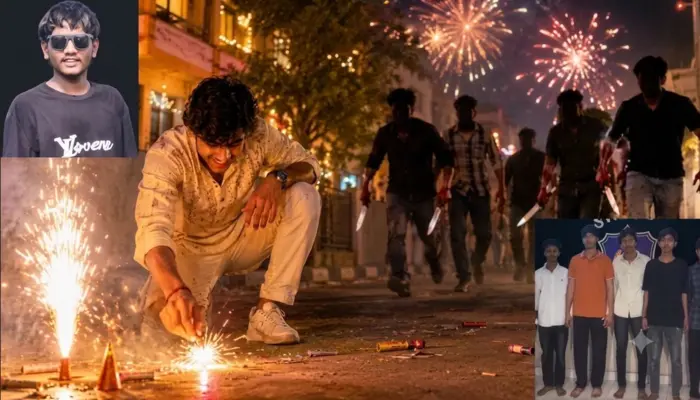
Case Summary
An 18-year-old Hindu youth was stabbed to death by a Muslim man, Shahid, and his associates on the occasion of Diwali, while bursting crackers on Diwali night in the Bhatar area of Surat. The victim, who was bursting crackers with children from the neighbourhood, was suddenly attacked by Shahid along with several other men, who stabbed him five times in the chest with a sharp-edged weapon. According to media reports, the deceased, Prasad Santosh More, alias Sunny, worked as a painter to support his family. On the day of Diwali, 8 November 2026, the victim was celebrating Diwali with children in the locality when Shahid and members of his family arrived and began verbally abusing him. Sunny attempted to leave the place to avoid a confrontation, but the group did not let him leave. According to the deceased's friend, Dharmendra, Shahid and his 6-7 associates surrounded Sunny as he attempted to leave and launched an attack from behind. The Muslim attackers stabbed him five times in the chest with sharp-edged weapons, leaving him critically injured and lying in a pool of blood. Sunny's friends immediately rushed him to New Civil Hospital in an autorickshaw. However, owing to the severity of his injuries, particularly the deep wounds to his chest, doctors declared him dead shortly after he was brought to the hospital. According to eyewitnesses and Sunny's friends, Shahid and his associates were involved in the illegal sale of liquor and ganja in the area. They further stated that the accused already had an ongoing enmity with Sunny, frequently abused him whenever they encountered him and had previously threatened to kill him. The incident was captured on CCTV cameras installed in the locality. Following the murder, the incident triggered considerable anger and resentment among residents of the Bhatar area. Khatodara police registered a murder case and seized the CCTV footage to identify those involved. Subsequently, police arrested all five accused in connection with Sunny's murder. They were identified as Javed alias Nawab Sheikh, Hansraj Kushwaha, Shakib Maniyar, Shahid Sheikh and Piyush Sahu. Police used technical surveillance and information from their informant network to trace and arrest the five men.
Why it is Hate Crime ?
This incident has been added to the tracker under the category: Attack resulting in death. Under this, the subcategory selected is Attacked for Hindu identity. In several cases, Hindus are attacked merely for their Hindu identity without any perceived provocation. A classic example of this category of religiously motivated hate crime is a murder in 2016. 7 ISIS terrorists were convicted for shooting a school principal in Kanpur because they got ‘triggered’ seeing the Kalava on his wrist and tilak that he had put. In this case, the Hindu victim had offered no provocation except for his Hindu religious identity. The motivation for the murder was purely religious, driven by religious supremacy. Such cases where Hindus are targeted merely for their religious identity would be documented as a hate crime. Under this category, cases where the attack led to the death of the Hindu victim/s would be documented. This case was added to the Hinduphobia Tracker because a Hindu youth was brutally murdered on the day of Diwali, while he was celebrating the festival and bursting firecrackers. Diwali, also known as Deepavali, is one of the most important festivals in Hinduism and is celebrated as the festival of lights, symbolising the triumph of good over evil and light over darkness. The festival holds immense religious and cultural significance for Hindus, with families and communities gathering to worship deities, light lamps, decorate their homes and celebrate through traditional festivities, including bursting firecrackers. Participating in these celebrations is an expression of Hindu religious and cultural identity, and Sunny was exercising this customary festive practice when the incident occurred. His presence in the neighbourhood, bursting firecrackers with other children on the night of Diwali, was an ordinary part of the festival's celebrations. The religious context of the incident is significant because the violence was inflicted upon a Hindu youth when he was engaged in the public expression of his religious and cultural observance on the very day of the festival. At the outset, there was no provocation from the victim. He was peacefully celebrating Diwali and did not initiate any confrontation with the accused. When the Muslim perpetrators began abusing him, the victim attempted to leave rather than engage in an argument. However, the attackers did not allow him to leave. They surrounded him, attacked him from behind, and stabbed him to death. This sequence is particularly significant in understanding the intention behind the assault. The victim's willingness to withdraw from the confrontation was disregarded, and the attackers instead ensured that he did not escape their violence. Their actions went beyond an angry exchange or a spontaneous response to an argument. They deliberately pursued and cornered a young man who was attempting to avoid a fight, before subjecting him to a fatal knife attack. Moreover, the timing and circumstances of the murder cannot be separated from the religious occasion on which it took place. Diwali is not merely a social celebration but a festival deeply rooted in Hindu religious belief, tradition, and cultural identity. The victim was killed while participating in this very observance. The fact that the attackers chose to subject him to such extreme violence in the midst of a peaceful Hindu festival celebration gives the incident a distinct communal dimension. The decision to carry out such a brutal murder on the very day of Diwali was significant in itself. It transformed the killing into an act that, beyond taking the life of an individual, carried a wider message of intimidation and hostility towards Hindu religious celebration and the public expression of Hindu identity. Importantly, the prior threats against the victim further reinforce the seriousness of the hostility involved. This history of intimidation, culminating in a coordinated and fatal assault on Hindu religious festival, demonstrated the severity of the hostility directed towards the victim and his Hindu identity. Moreover, carrying out such a brutal murder while Sunny was celebrating Diwali added a further dimension to the incident. This deliberate contrast between a festival of celebration and an act of brutal violence reflected a disturbing disregard for Hindu religious sentiments. The choice of Hindu festival to carry out the attack conveys an assertion of dominance, as the timing of the violence reflected religious hostility towards the Hindu festival and the community celebrating it. It sends an intimidating message to others about the hostility directed towards Hindu religious celebrations and the expression of Hindu identity. The intention evident from the manner and timing of the assault was not merely to intimidate or silence the victim during an argument but to subject him to fatal violence in the midst of an important Hindu festival. The fact that the Muslim perpetrators chose to carry out the attack on this very occasion, despite the existence of a prior personal dispute, adds a significant communal dimension to the murder. If the hostility stemmed solely from an existing personal dispute, the choice to unleash such extreme violence specifically on the night of Diwali, when the victim was peacefully participating in Hindu festival celebrations, becomes particularly significant. The timing of the attack placed the violence directly within the context of a major Hindu religious observance, giving the murder a communal dimension that was rooted in religious animosity. The murder therefore cannot be viewed merely as an ordinary neighbourhood dispute detached from its religious context. The religious occasion, the nature of the victim's activity, the attackers' conduct, and the extreme violence inflicted together establish serious indicators of hostility directed at a Hindu individual in the context of his religious celebration. These circumstances warrant the incident's inclusion in the Hinduphobia Tracker. Disclaimer: The media report mentioned that 6-7 people attacked the victim. However, the police has arrested five named individuals in connection with the incident. Accordingly, the perpetrator count has been documented as five (5) for the purposes of the Tracker.
Victim Details
Total Victim
1
Deceased
1
Gender
- Male 1
- Female 0
- Third Gender 0
- Unknown 0
Caste
- SC/ST 0
- OBC 0
- General 0
- Unknown 1
Age Group
- Minor 0
- Adult 1
- Senior Citizen 0
- Unknown 0


Case Status
Arrested


Perpetrators Details
Perpetrators
Muslim Extremists
Perpetrators Range
From 2 To 5
Perpetrators Gender
male
 Sources



