Hindu temple desecrated, Lord Hanuman’s image torn down by miscreants who forcibly entered premises while religious program was underway
 Mumbai, Maharashtra, India
 6 November, 2026
Case Summary
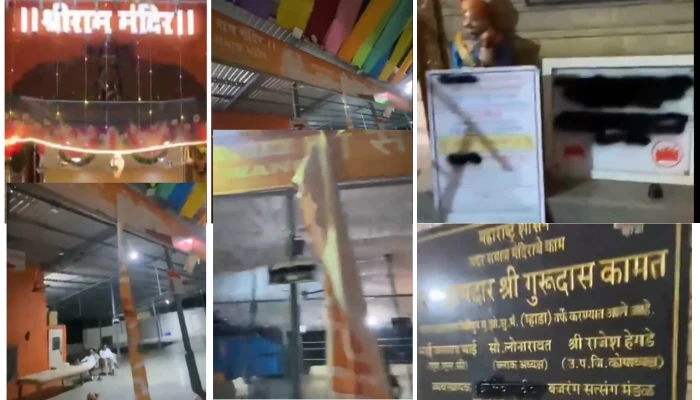
A Ram temple in Marol, Andheri East, Mumbai, was targeted by a group of 30 to 40 people who entered its premises during a Hindu religious programme on November 7, 2026, and vandalised religious photographs and signboards. The incident took place while members of the Sakal Hindu Samaj were conducting a community programme at the temple near Marol Naka. According to the FIR registered at Aarey police station, the group entered the temple around 5:30 pm and disrupted the ongoing programme. The complainant, 46-year-old Jayesh Ambavi Patel, stated that the intruders damaged photographs of Lord Hanuman (Bajrangbali) and created a disturbance on the premises. He further told police that the incident was part of an ongoing dispute involving attempts to disrupt religious activities at the temple. According to Gautam Ravaria of the Bajrang Dal, one of the accused had uploaded a Facebook post on November 4 announcing that the Hindu Rakshak Sena would organise a Hanuman Chalisa recitation and Maha Aarti at the temple on November 7. Around 30 to 40 people subsequently gathered at the premises between 5 pm and 5:30 pm. During the gathering, one of the accused reportedly abused the temple security guard, Nandlal Kewat, and demanded that he switch on all the lights inside the temple. When Kewat objected, the man allegedly grabbed him by the collar and threatened to kill him. According to the complaint, he was told: "You are alone in the temple at night. We will chop you up and throw you into the forest." After the Hanuman Chalisa recitation and Maha Aarti, group members defaced a signboard on the temple wall by spraying it with black paint. They also used an iron ladder to pull down a board installed on a shed within the temple premises. The board carried the inscription 'Shri Leva Patidar Bajrang Satsang Mandal (Marol)' along with an image of Lord Hanuman. The FIR names 15 persons, including Amit Pathak, Arjun Yadav, Pradeep Bhosale, Sanju Yadav, Vinod Mishra, Ashwini Rai, Manish Shukla, Naveen Upadhyay, Sudhanshu Mishra and Dinesh Yadav. Aarey police registered a case under Sections 189(2), 190, 298, 352, 351(2), 324 and 356(1) of the Bharatiya Nyaya Sanhita (BNS). The charges cover unlawful assembly, offences committed in furtherance of a common object, injuring or defiling a place of worship, intentional insult, criminal intimidation, mischief and defamation. The incident has also raised concerns among local residents about the temple's safety and property. Residents have claimed that certain individuals have been intimidating locals, grabbing land, constructing unauthorised shanties and subsequently selling them. The complainant has informed the police that CCTV footage of the November 7 incident is available. Residents suspect that the vandalism and repeated disruption of religious activities are connected to an attempt to take over the temple land. This claim remains part of the complaints and concerns raised by locals, and requires further investigation.
Why it is Hate Crime ?
This case has been added to the tracker under the primary category: Attack on Hindu religious representations. The sub-category selected is: Desecration of Hindu religious symbols. Icons and symbols, or religious representations of a spiritual idea,l are widely revered in Hinduism. Iconography is of vital significance in the Hindu milieu. It helps connect people’s spiritual beliefs with the real world. Iconography within the Hindu faith takes several shapes and forms. Murtis are one of the most significant objects to Hindus, to which daily rituals, prayers, and offerings are done. Besides the murtis, there are several other symbols which have deep significance in the Hindu faith – the Om and Swastik, for example. Since these Hindu religious symbols hold paramount importance in Hinduism, any desecration of symbols, icons, murtis, religious representations, ns and manifestations is driven by animosity towards the faith itself, which manifests through these murtis, icons, and symbols. Therefore, any desecration of these Hindu religious symbols and representations is considered religiously motivated hate crimes under this category. The other sub-category selected is: Breaking rules of place of worship. Sanatan Dharma is not a religion of one book, which is to say that while it has religious scriptures that form the central tenets of the faith, there are several traditions followed through thousands of years, mostly passed from generation to generation orally. One of these oral traditions or written traditions is the rules of specific temples. Certain temples have rules that are traditional, dependent on the worship of the presiding deities. These rules and traditions have been followed for thousands of years, whether or not they find scriptural mention. Such traditions are based on the nature and rules of worship of the presiding deity of that temple. Any non-compliance with these traditions owing to animosity towards the faith or for the sake of activism stems not only from the lack of faith in the presiding deity but also from disregard for the faith of the devotees of that deity/temple and implicit bias against the faith, the tradition, and the deity itself. Since these specific traditions are central to the faith of the devotees of that specific temple and presiding deity, any non-compliance with these traditional rules would be considered a religiously motivated hate crime. The other sub-category selected here is - Attack on Temples. In Hinduism, a temple is the abode of the Deity. The Deity in the Temple is consecrated, thereby making it a real, breathing entity. Hindus believe that not only the Deity but also the temple premises are sacred, since the entire Temple space is seen as an amalgamation of the deity's divine energy. Given the central significance of Temples in Hindu Dharma, any attack against a Hindu Temple or its peripheral premises is an attack on the faith itself and is born out of animosity towards the faith, of which the Temple is a central tenet. Any manner of attack against a Temple and/or its premises would therefore be considered a religiously motivated hate crime. The other subcategory is: Encroachment or illicit takeover of temple land/land near temple. In Hinduism, a temple is the abode of the Deity. The Deity in the Temple is consecrated, thereby, making it a real, breathing entity. Hindus believe that not just the Deity but the temple premises itself are sacred to Hindus since Hindus hold the faith that the entire Temple space is an amalgamation of the divine energy of the deity. Not only the Temple but the Temple premises in its entirety are considered sacred by Hindus. In several cases, the premises of the Temple and/or religious centre are illicitly taken over by institutions belonging to other faiths – like the Waqf board or the Church. Other times, the temple property, land or the property of religious centres are illicitly encroached by non-Hindu groups. Any illicit take over or encroachment is a crime an initio, however, when non-Hindu groups illicitly take over or encroach the sacred land of Hindus, it is an affront to the Hindu community and is therefore classified as a religiously motivated hate crime under this category. The religious motivation behind this incident is reflected in the deliberate targeting of Hindu worship and religious representations. A temple is not merely a property or a physical structure. It is a sacred space where devotees gather to practise their faith. Disrupting a Hanuman Chalisa recitation and Maha Aarti, damaging photographs of Lord Hanuman and defacing signboards bearing his image directly attack the religious character of that space. Such acts show contempt for Hindu religious symbols and disregard for the right of Hindus to worship without interference. The intimidation of the temple guard adds another dimension to this hostility. Threatening someone responsible for protecting a Hindu place of worship creates fear among those who maintain the temple and those who visit it. It sends a message that even routine religious activities and the protection of sacred spaces can be met with intimidation and violence. The repeated disruption of religious programmes, alongside residents' concerns about attempts to take over temple land, also points to a wider attempt to undermine the temple's presence and functioning. Targeting its religious symbols and interfering with worship cannot be reduced to ordinary vandalism or a property dispute. It strikes at the religious rights of the Hindu community and the sanctity of its place of worship. The incident is therefore being included in the Hinduphobia Tracker.


Case Status
Complaint filed


Perpetrators Details
Perpetrators
Others
Perpetrators Range
From 10 to 100
Perpetrators Gender
male
 Sources



