Diwali celebrations targeted; Muslim man desecrates sacred Kolam at a hospital in Selangor, Malaysia
 Klang, Selangor, Malaysia
 23 October, 2022
Case Summary
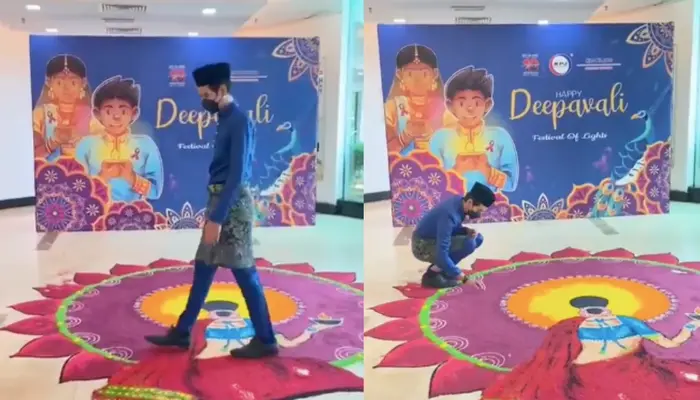
In Klang, Selangor, Malaysia, amidst the Diwali celebrations, a sacred Hindu kolam, also known as rangoli, was deliberately desecrated by a Muslim man. The accused repeatedly walked over the kolam, destroyed its intricate lines and patterns, and further defaced it using his fingers. A second individual, described as his female companion, recorded the act while laughing and referring to the incident as vandalism. The footage emerged amid Diwali celebrations held on 24 October 2022, when Malaysians came together to celebrate the revered Hindu festival. An approximately 30-second viral video captured the man repeatedly walking over the kolam, destroying its intricate patterns while looking towards the camera. He was dressed in traditional Malay attire, including a baju Melayu, a songkok (a traditional cap worn by Muslim men) and a sampin. Meanwhile, his female companion continued recording the act and was heard laughing. The video was initially uploaded on TikTok before circulating widely across other social media platforms, including Twitter (now X). Following the circulation of the footage, KPJ Klang Specialist Hospital issued a statement confirming that it had been informed of a video involving one of its employees. The hospital stated that it did not condone any form of disrespectful behaviour by its staff within its premises and confirmed that an internal investigation had been initiated. It further assured the public that stern action would be taken if the employee was found to have been involved. The hospital reiterated its commitment to upholding the highest standards of professionalism and ethical conduct and stated that further updates would be communicated through its official channels. Subsequently, KPJ Healthcare Berhad issued a separate media statement condemning the conduct captured in the video. The organisation stated that the behaviour did not reflect its culture, values or practices and expressed disappointment over the irresponsible actions of the individuals involved. It also confirmed that both individuals concerned had been suspended pending further investigation. Additionally, the organisation lodged a police report and stated that it would continue to cooperate with the relevant authorities in the investigation. Following the police complaint lodged by KPJ Healthcare Berhad, the Klang Utara police initiated an investigation into the incident. The Chief of the Bandar Baru Klang Police Station had also filed a separate report concerning the video, which had initially circulated on TikTok. The case was investigated under Section 298A of the Malaysian Penal Code, which concerns causing disharmony, disunity, or feelings of enmity, hatred or ill-will, or prejudicing the maintenance of harmony or unity on religious grounds. Assistant Commissioner S. Vijaya Rao, the Klang Utara District Police Chief, confirmed that an investigation had been opened and stated that the accused would be summoned to provide a statement at the Klang Utara District Police Headquarters. The police also urged members of the public to exercise caution in their actions and behaviour to avoid undermining the country's religious and social harmony. On 30 October 2022, both individuals involved in the incident appeared at the North Klang Police Headquarters, where they were arrested. They comprised the man who had desecrated the sacred Hindu kolam and the woman who had recorded the act. The arrests were confirmed by Assistant Commissioner S. Vijaya Rao. Both individuals were subsequently remanded for three days to assist the police with the investigation.
Why it is Hate Crime ?
This case has been added to the tracker under the prime category: Attack on Hindu religious representations. The subcategory selected in this case is: Desecration of Hindu religious symbol. Icons and symbols or a religious representation of a spiritual ideal are widely revered in Hinduism. Iconography is of vital significance in the Hindu milieu. It helps connect people’s spiritual beliefs with the real world. Iconography within the Hindu faith takes several shapes and forms. Murtis are of most significance to Hindus, to which daily rituals, prayers and offerings are done. Besides the murtis, there are several other symbols which have deep significance in the Hindu faith – the Om and Swastika for example. Since these Hindu religious symbols hold paramount importance in Hinduism, any desecration of symbols, icons, murtis, religious representations and manifestations, is driven by animosity towards the faith itself which manifests itself through these murtis, icons and symbols. Therefore, any desecration of these Hindu religious symbols and representations is considered religiously motivated hate crimes under this category. This case is a clear example of a religiously driven hate crime, as the Muslim perpetrator deliberately trampled upon and vandalised a sacred Hindu kolam during Diwali celebrations. The act demonstrated disrespect towards the Hindu faith and its sacred symbols, as the man targeted a religiously and culturally significant representation associated with the Hindu festival. Diwali, also known as Deepavali, is one of the most significant Hindu festivals celebrated across India and by Hindu communities worldwide. The festival symbolises the triumph of light over darkness and good over evil and is deeply rooted in Hindu religious and cultural traditions. It is celebrated with prayers, rituals, lighting of lamps, festive gatherings and traditional decorations, including kolam, also known as rangoli, which are intricate decorative designs created using rice flour and coloured materials. For Hindus, Diwali carries profound religious and cultural significance and is an important occasion for celebrating their faith, traditions and heritage. The kolam, also known as rangoli, is a traditional decorative artwork prepared by Hindus as an integral part of Diwali (Deepavali) celebrations. It is created using rice flour, coloured powders and other materials arranged in intricate patterns, often displayed at the entrances of homes, temples and other public or community spaces. The artwork carries religious and cultural significance and forms an important part of the rituals and traditions associated with Diwali. Its preparation is also considered an expression of devotion and reverence towards the festival and the traditions associated with it. The act of vandalising the kolam amounted to the desecration of a sacred Hindu cultural and religious symbol and constituted an act of hurting Hindu religious sentiments during the celebration of their sacred festival. The fact that the man deliberately trampled upon the kolam with his feet, repeatedly walked over it and defaced its intricate patterns further demonstrated sheer disrespect towards a sacred Hindu symbol. In Hindu religious and cultural traditions, treating sacred objects and religiously significant decorations with one's feet is considered disrespectful and is regarded as inappropriate in the context of reverence. Deliberately trampling upon and destroying a religiously significant decorative artwork therefore constituted an act of desecration. The nature of the act demonstrated hostility towards Hinduism and amounted to a clear case of religiously motivated hostility. A careful examination of the video further showed that the vandalism did not occur accidentally or as a result of the man inadvertently stepping on the kolam. The man was seen deliberately trampling upon the artwork, repeatedly walking over its intricate patterns and using his fingers to deface it before looking towards the camera. The intentional manner in which the act was carried out made it clear that the vandalism was neither accidental nor spontaneous, but a deliberate act of disrespect towards a sacred Hindu tradition, directly hurting the religious sentiments of the Hindu community. This deliberate targeting of a religiously significant symbol during a sacred festival further established the act as an expression of hostility towards Hindu religious and cultural traditions. The fact that the female perpetrator recording the incident could be heard laughing while the Muslim man deliberately vandalised the kolam further demonstrated the sheer disregard and disrespect shown towards Hindu religious and cultural sentiments. Rather than expressing disapproval or attempting to prevent the destruction of the sacred artwork, the accused continued recording the act while laughing and referring to it as vandalism. This reaction further compounded the humiliation and insult directed towards the Hindu community, reflecting a lack of respect for their religious traditions and the cultural significance of the kolam during Diwali celebrations. The intent behind the action was to provoke Hindus and show disrespect towards their faith and religious symbols. Since such callous behaviour stems from profound contempt for the Hindu religion, this case is being added to the hate crime database of the Hinduphobia Tracker. Disclaimer: The Hinduphobia Tracker records incident dates based on when the crime occurred rather than when it was reported by the media. In this case, the incident was reported by the media on 30 October 2022; however, it emerged during the Diwali celebrations on 24 October 2022. Hence, 24 October 2022 has been selected as the indicative incident date for documentation purposes. In this case, although the primary perpetrator was identified as a Muslim man, the religious identity of the female accomplice who recorded the incident remains unknown. However, as the Hinduphobia Tracker records the religious identity of perpetrators under a single identity for each case, the perpetrator identity has been recorded as Muslim, based on the primary accused. The total perpetrator count has been recorded as two. This approach ensures that both the religious identity of the primary perpetrator and the total number of individuals involved are accurately reflected in the database.


Case Status
Arrested


Perpetrators Details
Perpetrators
Muslim Extremists
Perpetrators Range
From 2 To 5
Perpetrators Gender
both
 Sources



