Hindu deities insulted, temple priest abused with caste-based slurs for performing his religious duties by church pastor
 Jogulamba Gadwal, Telangana, India
 7 November, 2026
Case Summary
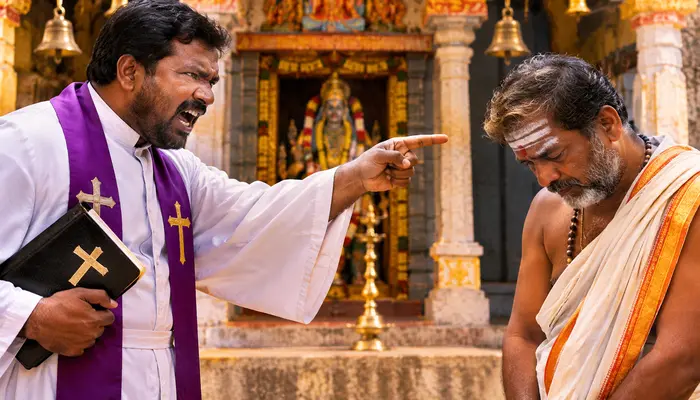
In Jammula Madugu, Waddepalley Municipality, Jogulamba Gadwal district, Telangana, Hindu deities were insulted, while a Hindu temple priest was subjected to verbal abuse, public humiliation and caste-based slurs for performing his religious duties by a church pastor, Ashirwadam. At approximately 7:00 am, the church pastor arrived at Sri Dattatreya Swamy Temple and confronted its priest, Pakkirappa, aggressively questioning his authority to conduct worship at the temple. He demanded to know who had authorised him to perform worship there and questioned why he was conducting prayers. The pastor further directed abusive and insulting language towards the priest and objected to the religious practices being carried out at the temple. Following the incident, workers of the Bharatiya Janata Party (BJP) from Waddepalley Mandal, members of the Rashtriya Swayamsevak Sangh (RSS) and the Vishwa Hindu Parishad (VHP), Ayyappa devotees and residents gathered at the spot to condemn the incident. They emphasised that they were not opposed to any religion and respected all faiths equally, but strongly objected to the use of abusive language against Hindus and acts of caste-based discrimination. They also declared that they would continue to pursue the matter until justice was delivered to temple priest Pakkirappa. The groups demanded that the pastor issue a public apology to Pakkirappa for the humiliation and refrain from making provocative remarks against Hindu devotees and Hindu deities. They further urged steps to prevent similar incidents and preserve the longstanding religious harmony and communal peace in Jammula Madugu. Meanwhile, after temple priest Pakkirappa lodged a complaint, Sub-Inspector Naga Shekhar Reddy arrived at the scene and assessed the situation. He assured the residents that the incident would be thoroughly investigated, appropriate action would be taken to ensure justice for Pakkirappa, and necessary measures would be implemented to prevent similar caste-related disputes and maintain communal harmony in the area.
Why it is Hate Crime ?
The primary category selected in this case is: Hate Speech against Hindus. The subcategory selected is: Anti-Hindu slurs, mocking faith. Anti-Hindu slurs and the deliberate mocking of the Hindu faith owing to religious animosity involve the usage of derogatory terms, stereotypes, or offensive references to religious practices, symbols, or figures. One of the common anti-Hindu slurs used against Hindus is “cow-worshipper” and “cow piss drinker”. The intention of using this term is to demean and mock Hindus as a group and their religious beliefs since Hindus consider the cow holy. Additionally, some symbols and the slurs attached to them have a historical context that exacerbates the insult, hate, stereotyping, dehumanisation and oppression against Hindus. Cow worship has been used for centuries to denigrate Hindus, insult their faith and oppress Hindus specifically as a religious group. There has been overwhelming documentation about how cow slaughter has been used to persecute Hindus with cow meat being thrown in temples and places of worship. There has also been overwhelming documentation where cow meat (beef) has been force-fed to Hindus to either forcefully convert them to Islam or denigrate their faith. Apart from cow worship, the Swastika – which holds deep religious significance for the Hindus – has also been misinterpreted and distorted to use as a slur against Hindus. Similarly, the worship of the Shivling has been used by supremacist ideologies and religions to denigrate Hindus owing to religious animosity. Such slurs and denigration stem out of inherent animosity and hate towards Hindus and their faith, therefore, it is categorised as hate speech targeted at Hindus specifically owing to their religious identity. The incident was included in the Hinduphobia Tracker as it involved derogatory and abusive remarks directed at Hindu deities and a Hindu temple priest by a church pastor, which constituted an attack on the religious sentiments of Hindus. In Hinduism, deities are not merely symbolic or cultural figures but are regarded as divine manifestations worthy of the highest reverence and worship. They occupy the central place in the religious life of Hindus, with millions offering daily prayers, performing rituals, observing festivals, and organising their spiritual lives around devotion to these deities. Consequently, obscene or derogatory remarks directed at Hindu deities are an insult and a direct attack on the faith itself. Such remarks have the effect of denigrating beliefs that are sacred to Hindus, hurting the religious sentiments of devotees, and fostering an atmosphere of disrespect towards Hinduism and its core objects of worship. Furthermore, questioning the priest's authority to perform worship and objecting to religious activities directly attacked the religious freedom and dignity of Hindus. Worship, prayers and the performance of traditional rituals form the foundation of Hindu religious practice, while temples serve as sacred places where devotees exercise their faith and maintain their spiritual traditions. By questioning who had given the priest the authority to worship at the temple and why he was conducting prayers there, the pastor openly challenged the legitimacy of Hindu worship and the priest's right to perform his religious duties. Such remarks showed blatant disrespect towards Hindu religious traditions and the sanctity of the temple. Questioning a Hindu priest's right to worship in a Hindu temple also amounted to interference with the community's religious practices and undermined the freedom of Hindus to follow their faith. The remarks struck at the very right of Hindus to worship their deities, maintain their traditions and carry out religious rituals without being intimidated or humiliated. Directing abusive and insulting language at a temple priest while he was performing his religious duties was a direct attack on the dignity of a Hindu religious representative. A temple priest holds an important position in Hindu religious life, as he conducts daily worship, performs rituals, offers prayers to deities and serves devotees. Pakkirappa was carrying out these religious responsibilities when he was subjected to verbal abuse and humiliation. Insulting him for his temple duties did not merely demean him as an individual; it also showed contempt for the religious role he represented and the Hindu traditions he upheld. Such treatment undermined the respect accorded to Hindu priests and sent a deeply insulting message to the devotees who depended on them to maintain the temple's religious practices. Abusing a priest for performing Hindu rituals directly attacked the dignity of Hindu religious service and hurt the sentiments of the wider Hindu community. Moreover, directing caste-based derogatory remarks at the priest further aggravated the humiliation inflicted upon him and attacked his dignity as a Hindu temple priest. Instead of respecting his religious service and responsibilities, the remarks subjected him to caste-based insults and discrimination. Such language was particularly offensive because it targeted a person while he was serving at a Hindu temple and carrying out duties connected with the worship of Hindu deities. Caste-based humiliation of a temple priest also affected the dignity of the Hindu religious community that he served, as it attempted to undermine his standing through discriminatory language rather than recognise his contribution to religious life. These remarks reinforced caste prejudice, degraded a person performing Hindu religious duties and insulted the dignity of Hindu worship. Targeting a Hindu priest with caste-based slurs in connection with his religious service was therefore an attack not only on an individual but also on the respect and dignity of the Hindu community. It can be argued that a caste-specific slur was aimed at the micro identity of the priest and not his Hindu identity itself. However, in Abrahamic religions, the micro identities of caste, region, and language are secondary. It is the religious identity that drives the animosity of the perpetrator against the Hindu victim. In this case, while teh accused hurled caste abuses at the victim, the animosity was driven by his animosity towards Hinduism and Hindus. Therefore, the fact that caste slurs were hurled at the victim by the perpetrator adds another layer to the religiously motivated hate crime. Such incidents also contribute to the normalisation of hostility towards Hindu religious symbols, places of worship, and objects of faith. Public dissemination of derogatory or inflammatory content directed at sacred Hindu institutions risks fostering an environment in which contempt for Hindu beliefs becomes increasingly acceptable in public discourse. Over time, repeated instances of such rhetoric desensitise society to prejudice against Hindus, encourage similar expressions of hostility, and erode respect for their religious identity. Recording such incidents is therefore important not only because of their immediate impact on the sentiments of Hindu devotees but also because they reflect a broader pattern in which hostility towards Hindu religious symbols is expressed in a manner capable of deepening communal divisions and undermining the dignity and equal religious rights of the Hindu community. Disclaimer: The Hinduphobia Tracker records incidents based on when an event occurred or when the victim's ordeal began. None of the media sources covering this case has specified the exact date the incident occurred. Therefore, for documentation purposes, we recorded the date as when the incident was first reported in the media: 8 November 2026.
Victim Details
Total Victim
1
Deceased
0
Gender
- Male 1
- Female 0
- Third Gender 0
- Unknown 0
Caste
- SC/ST 0
- OBC 0
- General 0
- Unknown 1
Age Group
- Minor 0
- Adult 0
- Senior Citizen 0
- Unknown 1


Case Status
Complaint filed


Perpetrators Details
Perpetrators
Christian Extremists
Perpetrators Range
One Person
Perpetrators Gender
male
 Sources



