Attack on Hindu sentiments: Hindu students served chicken curry mixed with beef gravy without their knowledge at Muslim-owned hotel in Bangladesh
 Rajshahi, Rajshahi District, Bangladesh
 7 November, 2026
Case Summary
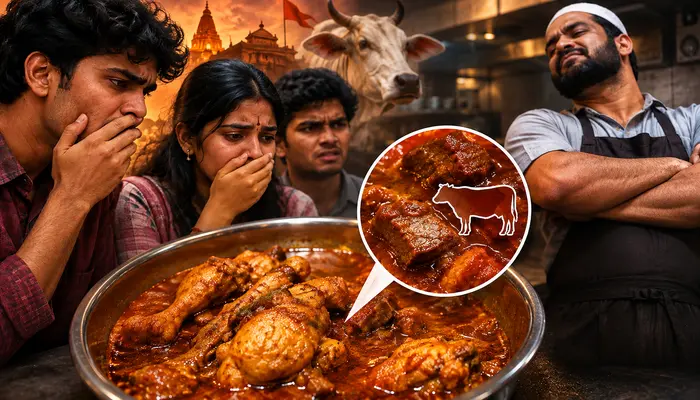
At a Muslim-owned hotel near Rajshahi University in Bangladesh, Hindu students were served chicken curry mixed with beef (cow meat) gravy without their knowledge. The food outlet, known as Bhabir Hotel (Bhabi Hotel), was located in front of Madar Bakhsh Hall and was owned by a local Muslim man named Babu Bhai, alias Babu Miya. When the students discovered that beef gravy had been mixed into the chicken curry served to them, they expressed outrage, describing the incident as an attack on their religious sentiments and dietary restrictions. On the day of the incident, the students visited Bhabir Hotel for lunch. While the food was being served, they noticed the suspicious behaviour of a hotel employee. Upon closer inspection, they discovered that beef gravy had been mixed into the chicken curry being served to them. The students immediately objected to the practice and confronted the employee, demanding an explanation. In response, the hotel employee neither apologised nor expressed any remorse. Instead, he dismissed their objections, claiming that mixing different food items and gravies was a routine practice at the establishment, particularly towards the end of the day. He further justified the practice by explaining that it was done to prevent food wastage and manage leftover stock. The employee's response, coupled with the hotel's food-serving practices, triggered widespread anger and resentment among Hindu students at Rajshahi University. The incident sparked strong reactions across the university campus, with students expressing serious concerns over the disregard for their religious beliefs and dietary restrictions. Members of the Hindu student community called for greater vigilance and accountability from the concerned authorities in addressing such sensitive matters. The students also demanded immediate intervention from the university administration to prevent the recurrence of similar incidents. They called for strict attention to religious freedom, respect for dietary practices and the protection of the fundamental rights of students belonging to the Hindu community. The incident further raised concerns among students that serving cow meat to Hindu students without their knowledge constituted a deliberate attempt to undermine their religious beliefs and practices. This incident occurred against the broader backdrop of the longstanding persecution of Hindus in Bangladesh. The Hindu minority has faced discrimination, targeted violence and religious hostility over decades, with attacks intensifying during periods of political and social instability. The latest major escalation began after the ouster of Sheikh Hasina’s government in August 2024, continued after the death of Sharif Osman Bin Hadi in December 2025, and resurfaced immediately after Bangladesh’s 13th National Parliamentary Election in 2026. Following Sheikh Hasina’s ouster, attacks on Hindu homes, temples and religious institutions were reported alongside intimidation, arson and mob violence targeting Hindu localities. The Hinduphobia Tracker recorded 336 incidents involving the Hindu minority during this period, reflecting the scale of the escalation and the vulnerability of Hindus amid the political upheaval. Another spurt of violence followed the death of Sharif Osman Bin Hadi, a Muslim political activist and student leader known for his anti-Hindu and anti-India rhetoric, in December 2025. In the aftermath, Hindu communities faced retaliatory violence, with Hindu homes and properties selectively attacked and several families reportedly forced to flee. Among the victims was Dipu Chandra Das, who was lynched and whose body was subsequently set ablaze by a Muslim mob over false blasphemy allegations. The Hinduphobia Tracker documented 51 incidents of anti-Hindu violence in the period following Hadi’s death alone, illustrating how hostility towards the Hindu minority intensified amid communal mobilisation. During this period, posters and written material calling for the extermination of Hindus were also displayed in public spaces. Viewed alongside reports of arson, vandalism, assault and targeted intimidation, such rhetoric pointed to a recurring pattern in which hostility towards Hindus intensified during periods of unrest. The most recent escalation followed the 13th National Parliamentary Election in 2026. In the immediate aftermath of the election results, Hindu families in districts including Noakhali, Rangpur, Nilphamari, Sylhet, Thakurgaon and Dinajpur faced attacks involving arson, looting, assault and vandalism of Hindu homes and temples. In several instances, Hindu properties were reportedly singled out, and families faced threats of displacement.
Why it is Hate Crime ?
The first primary category selected for this case is: Attack not resulting in death. The subcategory selected for this case is: Attacked for Hindu identity. In several cases, Hindus are attacked merely for their Hindu identity without any perceived provocation. A classic example of this category of religiously motivated hate crime is a murder in 2016. 7 ISIS terrorists were convicted for shooting a school principal in Kanpur because they got ‘triggered’ seeing the Kalava on his wrist and the tilak that he had put. In this case, the Hindu victim had offered no provocation except for his Hindu religious identity. The motivation for the murder was purely religious, driven by religious supremacy. Such cases where Hindus are targeted merely for their religious identity would be documented as a hate crime under this category. The second primary category selected for this case is: Attack on Hindu religious representations. The subcategory selected for this case is: Defiling religious customs. Sanatan Dharma is not a religion of one book, which is to say that while it has religious scriptures that form the central tenets of the faith, there are several traditions followed through thousands of years, mostly passed from generation to generation orally. There are several such customs and traditions that are followed by various Hindus and Hindu sects. Defiling of these traditions and customs is a breach of an individual or group’s religious practices. Such practices can range from dietary restrictions like not eating non-vegetarian food for a certain period of the year, not eating non-vegetarian food at all, not eating beef since the cow is considered holy in Hinduism, the sanctity of religious customs followed in the house (like many ISCKON devotees), etc. Any malicious action leading to the breach of such traditions or defilement of these traditions owing to animosity towards the faith or for the sake of activism stems not only from the lack of faith in the religion itself but also from disregard for the faith of the devotees who follow the customs/traditions and implicit bias against the faith, the tradition itself. Since these specific traditions are central to the faith of the devotees of that specific sect of Hindus, any non-compliance with these traditional rules would be considered a religiously motivated hate crime. This case constituted a clear example of a religiously driven hate crime targeting Hindu students on account of their faith and identity. The students had specifically ordered chicken curry but were deliberately served chicken mixed with beef (cow meat) gravy without their knowledge or consent, demonstrating an intentional violation of their religious dietary restrictions and an attack on their religious sentiments. The religious significance of the cow in Hinduism makes this violation particularly grave. The cow is regarded as sacred and revered as a symbol of motherhood, nourishment, compassion and selfless giving. In the Vedas, the cow is described as 'Aghnya', a Sanskrit term meaning 'that which must not be killed', reflecting the religious injunction against harming or slaughtering the animal. Cow protection and abstention from beef consumption hold deep religious and cultural significance for Hindus. For Hindus, consuming beef constitutes a serious religious transgression that violates sacred traditions and principles of faith. Therefore, deceptively serving Hindu students chicken curry mixed with cow meat gravy, knowing that they had specifically ordered chicken, demonstrated deep-seated religious hostility and a deliberate disregard for Hindu beliefs. Making them unknowingly consume the meat of an animal they revere as sacred amounted to an act meant to defile their religious customs, desecrate their faith and undermine their Hindu identity. The act showcased hostility towards Hinduism and a blatant disregard for the religious sentiments of the Hindu community. The hotel employee's response further demonstrated the hostility and disregard towards Hindu religious sentiments. When the students questioned why they had been served chicken curry mixed with beef gravy despite specifically ordering chicken and adhering to religious dietary restrictions, the employee neither apologised nor expressed remorse. Instead, he dismissed their objections and justified the practice as a routine measure to prevent food wastage. This response trivialised the students' religious convictions and demonstrated a complete lack of respect for their right to observe their faith. The dismissive conduct, combined with the deliberate serving of beef-tainted food to Hindu students, showcased the religious hostility underlying the incident. It demonstrated how little regard the hotel staff had for Hindu beliefs, sacred traditions and the religious sentiments of the Hindu community. It is also important to note that deceptively feeding beef to Hindus and using cow slaughter or beef consumption to attack their religious identity have historical precedents. Historical accounts of religious persecution documented several instances in which Hindus were subjected to forced or deceptive consumption of beef by Muslim extremists, with the intention of violating their religious convictions, desecrating their sacred customs and weakening their religious identity. Such practices were also used to alienate individuals from their religious and cultural roots and make them more vulnerable to religious conversion. The underlying objective was to use the violation of deeply held religious beliefs as a means of religious humiliation and coercion. In the present case, the deliberate serving of beef-tainted chicken curry to Hindu students who had specifically ordered chicken demonstrated the same contempt for Hindu religious beliefs and customs. The incident was therefore a clear manifestation of anti-Hindu hostility, targeting the students' faith, religious identity and sacred traditions, and constituted a religiously driven hate crime. Therefore, this case is being added to the hate crime database of the Hinduphobia Tracker. Disclaimer: The Hinduphobia Tracker records incidents based on when an event occurs rather than when it is reported by the media. It is important to clarify that none of the media sources covering this case has specified the exact date when the incident occurred. Therefore, for documentation purposes, we have recorded the date based on when the incident was reported in the media, 8 November 2026.


Case Status
Unknown


Perpetrators Details
Perpetrators
Muslim Extremists
Perpetrators Range
One Person
Perpetrators Gender
male
 Sources



