Diwali celebrations disrupted in Seattle: Christian activists hurl anti-Hindu slurs, display 'Deport All Dot Heads' placards mocking Hindu religious symbols like Tilak-Bindi
 Seattle, Washington, United States
 6 November, 2026
Case Summary
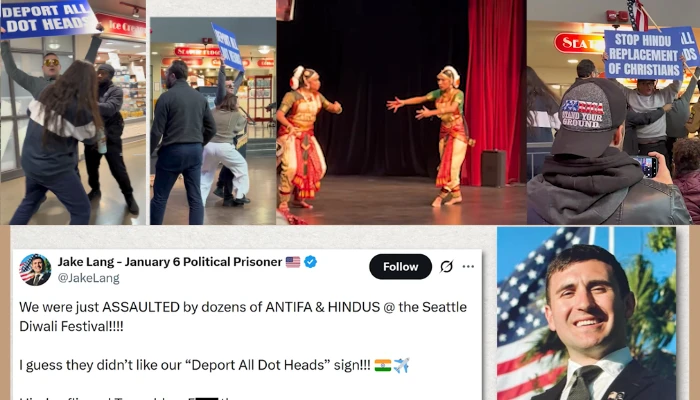
In the United States, a Hindu Diwali celebration in Seattle, Washington, was targeted and disrupted by Christian activist Jake Lang, Thomas Allen and a group of protesters. The offenders demeaned Hindus and carried placards reading “Deport All Dot Heads” and “Stop Hindu Replacement of Christians”. The protesters used explicitly anti-Hindu and racial slurs to intimidate the Hindu community gathered for the festival. The incident occurred on Saturday, 7 November 2026, when Lang and a group of protesters, including Thomas Allen, tried to disrupt the Diwali festivities in Seattle. They entered the event carrying placards bearing the messages “Deport All Dot Heads” and “Stop Hindu Replacement of Christians”. The term “dot heads” was a derogatory racial reference mocking Hindus who wear religious marks such as tilak and bindi on their foreheads. The protesters were subsequently removed from the premises. Following the incident, Lang posted photographs of the attempted disruption on X and launched an abusive tirade against Hindus. He accused Hindus of being responsible for turning Texas towards the Democrats, extending his hostility towards the community beyond the Seattle event. Lang headed an organisation called White Replacement and had participated in the 6 January 2021 attack on the US Capitol. He had served four years in prison before receiving a presidential pardon from Donald Trump on the first day of his second presidency in 2025. US Congresswoman Pramila Jayapal condemned the incident, describing it as a racist display and stating that the Indian-American community should be able to celebrate Diwali without fear. Indian-American businessman Ajay Jain Bhutoria also condemned the protesters, calling their actions bigotry and stating that racial slurs targeting Hindus and Indian immigrants had no place in the United States. The Coalition of Hindus of North America (CoHNA) also condemned the disruption and issued a community alert for Seattle and surrounding areas. The organisation said children were performing at the Diwali celebration when activists entered with anti-Hindu placards. It further warned that the activists had announced plans to disrupt other Diwali celebrations and urged community members to remain vigilant.
Why it is Hate Crime ?
The primary category selected in the case is: Attack not resulting in death. Within this, the subcategory selected is Attacked for Hindu identity. In several cases, Hindus are attacked merely for their Hindu identity without any perceived provocation. A classic example of this category of religiously motivated hate crime is a murder in 2016. 7 ISIS terrorists were convicted for shooting a school principal in Kanpur because they got ‘triggered’ seeing the Kalava on his wrist and tilak that he had put. In this, the Hindu victim had offered no provocation except for his Hindu religious identity. The motivation for the murder was purely religious, driven by religious supremacy. Such cases where Hindus are targeted merely for their religious identity would be documented as a hate crime under this category. The other primary category selected here is: Hate speech against Hindus. Under this, the subcategory selected is: Anti-Hindu slurs, mocking faith. Anti-Hindu slurs and the deliberate mocking of the Hindu faith owing to religious animosity involve the usage of derogatory terms, stereotypes, or offensive references to religious practices, symbols, or figures. One of the common anti-Hindu slurs used against Hindus is “cow-worshipper” and “cow piss drinker”. The intention of using this term is to demean and mock Hindus as a group and their religious beliefs since Hindus consider the cow holy. Additionally, some symbols and the slurs attached to them have a historical context that exacerbates the insult, hate, stereotyping, dehumanisation and oppression against Hindus. Cow worship has been used for centuries to denigrate Hindus, insult their faith and oppress Hindus specifically as a religious group. There has been overwhelming documentation about how cow slaughter has been used to persecute Hindus with cow meat being thrown in temples and places of worship. There has also been overwhelming documentation where cow meat (beef) has been force-fed to Hindus to either forcefully convert them to Islam or denigrate their faith. Apart from cow worship, the Swastika – which holds deep religious significance for the Hindus – has also been misinterpreted and distorted to use as a slur against Hindus. Similarly, the worship of the Shivling has been used by supremacist ideologies and religions to denigrate Hindus owing to religious animosity. Such slurs and denigration stem out of inherent animosity and hate towards Hindus and their faith, therefore, it is categorised as hate speech targeted at Hindus specifically owing to their religious identity. This incident involved a deliberate targeting of Hindus on account of their religious identity, with their sacred festival, visible religious markers, and collective religious expression made the objects of hostility and ridicule. The conduct went beyond racial abuse or opposition to a public gathering. It sought to demean the Hindu faith, stigmatise the visible expression of Hindu identity and intimidate Hindus for openly practising and celebrating their religion. The use of religiously charged slogans invoking Christian identity to oppose Hindus further demonstrated the supremacist nature of the hostility. Diwali is one of the most significant festivals in Hinduism, symbolising the victory of light over darkness and good over evil. It is a sacred occasion associated with the worship of deities, prayers, lighting of diyas and the celebration of spiritual renewal. For Hindus, Diwali carries profound religious, cultural and communal significance, bringing families and communities together in the observance of their faith. Public celebrations are an important expression of this collective religious identity, allowing Hindus to practise their traditions openly and pass them on to younger generations. Targeting a Diwali gathering therefore amounts to targeting a central expression of Hindu religious life. The hostility was particularly evident in the placards reading “Deport All Dot Heads”. The term “dot heads” was a derogatory reference to the bindi and tilak traditionally worn by Hindus on their foreheads. The bindi and tilak are deeply rooted in Hindu religious and cultural traditions and serve as visible expressions of Hindu identity. By using this slur at a Hindu religious gathering, the offenders specifically mocked and demeaned the religious markers through which Hindus visibly express their identity. The demand to deport those wearing these markers further conveyed that Hindus were unwelcome and did not belong. This was not a generic racial insult detached from religion; it directly invoked a visible marker of Hindu identity to humiliate and target the community. The slogan “Stop Hindu Replacement of Christians”, displayed by Christian activists at a Hindu religious celebration, was particularly significant. It portrayed the gathering as though Hindus had assembled to convert Christians or displace their religious community, when they were simply celebrating their own sacred festival. It is important to note that Hindus have never been identified anywhere in the world as a community engaged in organised religious violence or conversion-driven activities, yet the protesters portrayed them as religious aggressors and a threat to Christians. This deliberate projection of Hindus as offenders, without any basis in the activities taking place at the event, sought to attach a narrative of religious aggression to a peaceful Hindu gathering. By portraying the celebration of Diwali as a threat to Christianity, the protesters turned the public expression of Hindu faith into a pretext for religious hostility and exclusion. The attempt to disrupt the Diwali celebration was intended to convey to Hindus that their religious practices and public expression of faith were unwelcome. Targeting a specifically Hindu religious gathering sought to make devotees feel that they were not free to celebrate their own festival without facing hostility or intimidation. Such deliberate interference with a religious celebration creates fear within the community and conditions Hindus to associate the open observance of their faith with the risk of humiliation and confrontation. Lang's subsequent abusive tirade extended this hostility beyond the gathering to Hindus as a community. The targeting was therefore not confined to those present at the event but reinforced a message of hostility towards Hindu religious identity more broadly. The intention was to intimidate Hindus, discourage the public expression of their faith and make them feel unwelcome for practising their religion. Taken together, the conduct demonstrated targeted religious hostility through interference with a Hindu religious celebration, denigration of Hindu identity and intimidation of devotees. It sought to undermine the freedom of Hindus to practise and publicly express their faith without fear. Disclaimer: In this case, the number of perpetrators recorded was two (2) for documentation purposes, as two individuals were specifically identified by name in the available reports. The actual number of perpetrators involved may be higher.


Case Status
Unknown


Perpetrators Details
Perpetrators
Christian Extremists
Perpetrators Range
From 2 To 5
Perpetrators Gender
male
 Sources



