Hindu woman coerced into Islamic conversion, indoctrinated with Kalma textbooks and Islamic practices, forced to wear burqa and taken to multiple mosques
 Junagadh, Gujarat, India
 30 October, 2021
Case Summary
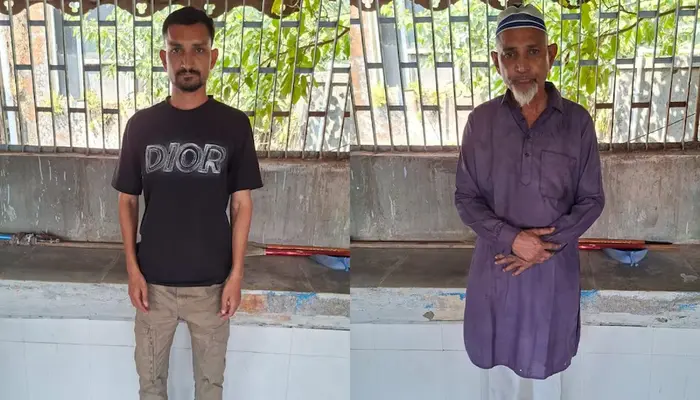
In Junagadh, Gujarat, a Hindu woman was coerced into Islamic conversion by Javid Karim Sheikh, the caretaker (Mujawar) of Monisha Pir Dargah in Sanghediya Bazaar. He addressed her as his daughter, introduced her to Islamic religious practices and gave her a Kalma book and other Islamic religious literature. She was made to wear a burqa, follow Islamic practices and participate in religious rituals. His son, Wahid Javid Sheikh, also exploited her illness and personal difficulties, promising that accepting Islam would cure her illness and remove her suffering. The father and son took her to several mosques, including Unawa, Miran Datar, Jambur, Una, and Ajmer, where they made her offer Salaami (an Islamic religious greeting) and participate in religious activities. The Hindu woman herself gave a statement before the court detailing the forced religious conversion, visits to multiple dargahs, Islamic practices imposed on her, repeated rape, physical assault, knife attack and death threats. The woman, who lived alone in Junagadh, suffered from various illnesses and came into contact with Monisha Pir Dargah in 2021, after a relative suggested visiting to seek religious assistance. During these visits, she met Wahid Javid Sheikh, son of the mosque's caretaker, Javid Karim Sheikh. Wahid proposed marriage, but she refused. Following her refusal, he assaulted her with punches and kicks, attacked her with a knife and repeatedly raped her. He also threatened to kill her and circulate photographs and videos of her among her relatives and family members. The woman then approached Javid Karim Sheikh, informed him of his son’s conduct, and sought his intervention. Instead of helping her, Javid threatened her. Following these incidents, she lodged a complaint at A Division Police Station in Junagadh on 28 October 2026, naming Javid Karim Sheikh and Wahid Javid Sheikh in connection with rape, physical assault and criminal intimidation. Police Inspector A.B. Chaudhary of A Division Police Station initially handled the investigation. Police subsequently arrested both accused and produced them before the court, which remanded them to judicial custody. During the investigation, the police recorded the woman’s statement, which was also placed before the court. Her statement brought a religious-conversion angle to the attention of the investigating authorities. She described how the father and son had taken her to several mosques, including those at Unawa, Una, Jambur, Miran Datar and Ajmer, where she was made to participate in religious rituals and offer salaami. Police took photographs and videos relating to these visits into their custody. They also searched her residence and seized several religious materials and other items connected with the investigation, including a Kalma book, a burqa, a prayer mat, green-colored flags, photographs of mosques and Islamic religious literature. Following these developments, Junagadh police invoked Section 4(1) and amended Section 4(2) of the Gujarat Freedom of Religion Act, 2003, against Javid Karim Sheikh and Wahid Javid Sheikh. Deputy Superintendent of Police (DySP) Hitesh Dhandhalya submitted a report to the court seeking to add these provisions. The court accepted the police report and allowed the religious-conversion provisions to be incorporated into the case. Given the seriousness of the case, Inspector General of Police Rajendrasinh Chudasama and Superintendent of Police Subodh Odedara ordered the formation of a five-member Special Investigation Team (SIT). DySP Hitesh Dhandhalya was appointed to lead the team. Its other members were A Division Police Inspector A.B. Chaudhary, Local Crime Branch (LCB) Police Sub-Inspector B.K. Patel, A Division Police Sub-Inspector Y.M. Solanki and Women Police Station Police Sub-Inspector J.J. Mahak.
Why it is Hate Crime ?
This case has been added to the tracker under the primary category: Predatory Proselytisation. Within this, the subcategory selected is: Conversion/attempts to convert by inducement. Predatory Proselytisation is not just limited to threat, harassment, force and violence, but it also has contours of stealth. In several cases, the Hindu victim is exploited to convert, with non-Hindus taking advantage of their poverty. In such cases, the Hindu victim who is suffering financially is offered monetary benefits, including lucrative offers for jobs, health treatment, education, etc, to induce the victim into changing his/her religion. In such cases, the religious identity of the victim and the aim to disenfranchise him from his faith form the heart of the crime. Also, taking advantage of and exploiting an individual’s economic vulnerabilities is widely acknowledged as exploitation, forms of which are often penalised by law. Such cases therefore are considered religiously motivated hate crimes since the victim’s religious identity forms the very heart of the crime itself. The other subcategory selected is: Harassment, threats, coercion for conversion. Harassment covers a wide range of behaviours of an offensive nature. It is commonly understood as behaviour that demeans, humiliates, and intimidates a person, including threats and coercion. Harassment and threats, in this case, find their root on discriminatory grounds which has the effect of nullifying a person’s rights or infringing upon his freedom to exercise his right specifically owing to the victim’s religious identity. Verbal and physical threats and psychological or physical harassment are often used against Hindu victims because they choose to practice their professed religion. Religious harassment also includes forced and involuntary conversions by harassment, threats or coercion. Coercion includes intimidatory tactics like force-feeding a Hindu victim beef to convert to another religion, forceful circumcision etc. In several cases documented, non-Hindu perpetrators or those who harbour specific animosity towards Hinduism, harass victims simply based on their religious identity. Such cases often also include harassment to ensure the Hindu victim abandons his/her professed religion and adopts the religion of the perpetrator. Such cases where Hindu victims are harassed to convert to the perpetrator’s religion are rooted in animosity towards the victim’s religious identity and are therefore documented as religiously motivated hate crimes. The other subcategory selected is: Proselytisation by grooming, brainwashing, manipulation or subtle indoctrination. The tertiary categories selected are: Rape and sexual assault/harassment. Religious brainwashing essentially means the often subtle and forcible indoctrination to induce someone to give up their religious beliefs to accept contrasting regimented ideas. Religious grooming or brainwashing also involves propaganda and manipulation. It involves the systematic effort, driven by religious malice and indoctrination, to persuade “non-believers’ to accept allegiance, command, or doctrine to and of a contrasting faith. Cases of such grooming or brainwashing are far more nuanced than direct threats, coercion, inducement and violence. In such cases, it is often seen that there is repeated, subtle and continual manipulation of the victim to induce disaffection towards their own faith and acceptance of the contrasting faith of the perpetrator. While subtle indoctrination is widely acknowledged as predatory, an element which is often understated in such conversions or the attempts of such conversion is the role of loyalty and trust which might develop between the perpetrator and the victim. Fiduciary relationships are often abused to affect such religious conversion. For example, an educator transmitting religious doctrine of a competing faith to a Hindu student. The Hindu student is likely to accept what the teacher is transmitting owing to existence of the fiduciary relationship. The exploitation of the fiduciary relationship to religiously indoctrinate victims would also be included in this category. Since the underlying animosity towards the victim’s faith forms the basis of predatory proselytization, such cases are considered religiously motivated hate crimes. This case has been added to the tracker because a Hindu woman was subjected to repeated rape, physical assault and threats, while being coerced into Islamic religious practices and conversion by the Muslim accused, Javid Karim Sheikh and his son, Wahid Javid Sheikh. They introduced her to Islamic teachings, gave her a Kalma book and other Islamic literature, made her wear a burqa, follow Islamic practices and participate in religious rituals, and took her to multiple dargahs where she was made to offer salaami. These acts were directed at replacing her Hindu religious practices with Islamic beliefs and observances, thereby undermining her religious identity and freedom to practise her faith. Firstly, the accused established contact with the victim by exploiting her medical vulnerability and promising that accepting Islam would cure her illnesses and relieve her personal difficulties. This enabled him and his father to gain her trust and subsequently subject her to religious pressure and exploitation. This inducement used her hope of recovery and relief from suffering to influence her religious beliefs and persuade her to embrace Islam. By presenting conversion as a means of curing her ailments and resolving her problems, the accused exploited her vulnerable circumstances to encourage her to abandon her Hindu faith. This deliberate use of false promises of healing to influence her religious choice constituted coercive religious inducement. The act of pressuring her to convert to Islam itself showcased religious animosity, as it directly threatened her religious autonomy by seeking to replace her Hindu identity with another faith through coercion. Coercive religious conversion represents a profound attack on an individual's fundamental right to practise their faith freely, without interference or compulsion. This aggression reflects hostility towards the victim's Hindu religious identity, evident in the pressure to abandon her beliefs, rituals and cultural ties associated with Hinduism, and the attempts to impose Islamic teachings, practices and observances upon her. Such actions inherently qualify as a religiously motivated hate crime, since they originate from prejudice and hostility against one specific religion, here, Hinduism, coupled with a zealous drive to supplant it entirely, undermining the victim's personal and communal religious sovereignty. Furthermore, Wahid Javid Sheikh proposed marriage to the victim. When she rejected his proposal, he subjected her to physical assault, attacked her with a knife, repeatedly raped her, threatened to kill her and threatened to circulate her photographs and videos among her relatives and family members. This demonstrated the perpetrators' readiness to cross every limit, resorting to extreme violence, sexual assault and death threats to intimidate the victim and break her resistance. These acts intensified the brutality of the crime and exposed the perpetrators' determination to punish her for rejecting the marriage proposal. Coupled with the coercion into Islamic religious practices and conversion, the violence formed part of a pattern of intimidation and exploitation directed against the victim. The nature of the pressure went beyond verbal persuasion and extended to attempts to introduce the Hindu victim to the Kalma. Providing her with a Kalma book and other material relating to the Kalma sought to influence her religious beliefs despite her Hindu identity. In the context of the broader pressure to convert her to Islam, this demonstrated that the harassment was directed not only at persuading her to change her religion but also at influencing her religious beliefs and identity. Following the conversion efforts, the victim was made to wear a burqa, an Islamic garment that covers the body. This imposition of Islamic attire sought to embed Islamic practices into her daily life and alter the outward expression of her Hindu identity. It represented a further infringement of her religious autonomy by imposing religious dress associated with another faith upon her. The act formed part of the broader pattern of pressure to abandon her Hindu religious identity and adopt Islamic practices. Moreover, the act of taking a Hindu woman to multiple Islamic mosques is significant from this viewpoint because religious visits and rituals are closely connected with personal faith, religious traditions and identity. Taking her to dargahs at Unawa, Miran Datar, Jambur, Una and Ajmer, where she was made to participate in religious activities and offer salaami, exposed her to Islamic religious observances despite her Hindu identity. The use of pressure or coercion to make her participate in these practices represents an infringement of her religious autonomy and an attempt to draw her away from her Hindu religious environment. The recovery of a Kalma book, Islamic religious literature, a burqa, a prayer mat, green-coloured flags and photographs of dargahs from the victim’s residence highlighted the extent of Islamic religious material and symbols present in her possession. These articles were significant in the context that the accused had introduced her to Islamic teachings and practices and pressured her to accept Islam. The Kalma book and Islamic literature represented the religious teachings introduced to her, while the burqa and prayer mat were associated with Islamic dress and worship. The green flags and dargah photographs further reflected the religious environment connected with the visits to Islamic shrines. The repeated exposure to Islamic religious practices served as a means of making the Hindu victim more susceptible to conversion. By introducing her to the Kalma through a book, providing Islamic religious literature, taking her to multiple mosques, and making her offer salaami and participate in religious rituals, the accused sought to familiarise her with and involve her in practices outside her own faith. Thus, the use of Islamic religious practices alongside direct conversion inducements demonstrated a broader strategy of religious influence rather than a single instance of religious persuasion. The victim’s own statements established a sustained pattern of religious-conversion pressure, with the accused repeatedly attempting to influence her faith through Islamic teachings, a Kalma book, religious literature, visits to multiple mosques and participation in Islamic religious practices. These were not isolated instances of religious persuasion but repeated efforts to draw her away from her Hindu faith and impose Islamic beliefs and observances upon her. The persistent nature of this conduct demonstrated a deliberate campaign to undermine her Hindu religious identity and exert control over her religious choices. This sustained coercion heightened the gravity of the case, exposing the systematic efforts to influence and change her religious affiliation. Such actions stem from inherent hostility towards the victim's professed faith, since Abrahamic faiths believe that any non-adherent to the faith is subject to being dehumanised till they convert. Such acts were not merely personal crimes; they were rooted in a desire to dominate and erase the religious identity of the victim. Since such predatory actions stem from doctrinal animosity towards the Hindu faith and its adherents, this case is being documented as a religiously motivated hate crime. Disclaimer: None of the media reports covering this case specifies the exact date the victim’s ordeal began. However, a media report mentions that she started visiting Monisha Pir Dargah in 2021 after a relative suggested seeking religious assistance for her illnesses. To document this case, we used an indicative date, 31st October 2021, as a placeholder for the beginning of her suffering. While media coverage of the incident emerged on 31st October 2026, the Hinduphobia Tracker records the incident based on when the victim’s ordeal began, not when it was reported.
Victim Details
Total Victim
1
Deceased
0
Gender
- Male 0
- Female 1
- Third Gender 0
- Unknown 0
Caste
- SC/ST 0
- OBC 0
- General 0
- Unknown 1
Age Group
- Minor 0
- Adult 0
- Senior Citizen 0
- Unknown 1


Case Status
Arrested


Perpetrators Details
Perpetrators
Muslim Extremists
Perpetrators Range
From 2 To 5
Perpetrators Gender
male
 Sources



