Hindu families restricted from celebrating Kali Puja in Muslim majority neighborhood in Naihati, West Bengal
 North 24 Parganas district, West Bengal, India
 5 November, 2026
Case Summary
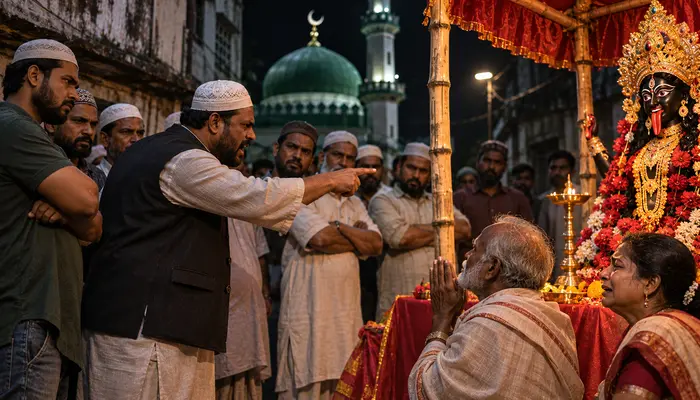
Two Hindu families residing in Karigarpara, a Muslim-majority neighbourhood in Naihati, North 24 Parganas, West Bengal, were restricted from celebrating Kali Puja for several decades due to opposition from sections of the local Muslim community. The Naihati neighbourhood was a Muslim-majority neighbourhood and had only two Hindu households. Members of the Hindu community were unable to organise the traditional worship of Maa Kali despite wishing to continue the religious practice. According to reports, Kali Puja had been organised in the locality since 1966 and had once attracted devotees from the surrounding areas. However, the celebration was subsequently discontinued following objections from sections of the local majority community, leaving the two Hindu families unable to organise the annual worship for years. In November 2026, the Hindu families attempted to revive the long-discontinued Kali Puja, but the preparations faced opposition from sections of the local Muslim community. A Muslim man named Mohammed Amin, a Congress Jute Workers' Union leader, objected to the organisation of the puja, citing the presence of a mosque nearby. The matter came to the attention of local BJP leaders, following which Naihati MLA Sumitra Chattopadhyay and Bijpur MLA Sudipta Das visited Karigarpara on the night of 4 November 2026, accompanied by BJP minority leader Akhtar Ali. The legislators met the residents and intervened in support of the Hindu families' right to organise the religious celebration. Sudipta Das also highlighted the situation in a Facebook post, stating that only two Hindu households lived in the Muslim-majority locality and that they had been unable to celebrate Kali Puja for years. Akhtar Ali expressed his support for the families and stated that he would personally participate in organising the puja. Sumitra Chattopadhyay assured the residents that the worship would take place, alongside the locality's other religious observances, including Namaz and Eid celebrations. Following the intervention and assurances from the legislators, preparations for the Kali Puja resumed, paving the way for the revival of a religious celebration that had remained discontinued for several decades.
Why it is Hate Crime ?
This case has been added to the tracker under the primary category of - Restriction/ban on Hindu practices. Within it, the sub-category selected here is - Restriction on expression of Hindu identity. An example of the state-affected prejudicial and targeted orders against the Hindu community would be a government denying the right of a Hindu or a group of Hindus to hold a religious procession owing to the animosity of non-Hindu groups. Denial of the religious right of the Hindus to assuage the non-Hindu group which harbours animosity to a point where it could lead to violence against Hindus is not only a failure of law and order but is a prejudicial order against Hindus, denying them their fundamental rights to express their religious identity. An example of a hate crime against Hindus by a non-Hindu would be a non-Hindu institution forcing its Hindu employees to abandon religious symbols that a Hindu would wear as an expression of faith owing to inherent prejudice against the faith professed by the victim or a non-Hindu group of people restricting a Hindu group from constructing a place of worship simply because the demography of the area in which the temple is being built is dominated by non-Hindus. Such actions are driven by religious animosity and/or prejudice against Hindus and their faith and would therefore be categorized as a hate crime. The other sub-category selected here is - Attack not resulting in death. Within it, the sub-category selected here is - Attacked for crossing 'Muslim area'. One of the reasons that Hindus get attacked unprovoked specifically by Islamists is for crossing ‘Muslim areas’. Essentially, Muslim mobs often attack Hindus crossing or present in certain areas which have a majority Muslim population. It has often been cited as one of the reasons to blame Hindus for attacks against themselves, signalling that Hindus displaying religious symbols, taking our religious processions or crossing any area which is dominated by Muslim residents is a provocation in and of itself. These areas are mostly ghettoized areas where mobs mobilize quickly to attack Hindus for a variety of reasons like playing music during a religious procession, crossing a mosque, wearing a tilak or any other religious symbol in a Muslim-dominated area, praying at a local temple in that area etc. There have been cases where the few local Hindus of that area have been attacked on their way to the Temple for prayers as well, simply because the area is considered a Muslim-dominated area. Several times, it is entirely possible that the immediate trigger for the violence against Hindus was non-religious in nature, however, the violence became religiously motivated in nature because the area was Muslim dominated and the residents on the whole harboured animosity towards Hindus, evidenced from the actions of the mob, the slogans, and the nature of the attack. Such crimes are motivated by the religious identity of the victims and are therefore classified as hate crimes under this category. The incident constituted a hate crime because the restriction was directed at the exercise of a fundamental Hindu religious practice and prevented Hindu residents from freely observing their faith in their own neighbourhood. The opposition was not merely a disagreement over the organisation of a public event or a routine neighbourhood dispute. It concerned the ability of two Hindu households to worship Maa Kali and maintain a religious tradition. Kali Puja is an important Hindu religious festival dedicated to the worship of Maa Kali, a revered form of the Divine Mother associated with the destruction of evil, the protection of devotees and the triumph of divine power over negative forces. Celebrated particularly in West Bengal and other parts of eastern India, the festival is observed through the installation and worship of the deity's idol, prayers, devotional rituals and community gatherings. For Bengali Hindus, Kali Puja holds deep religious and cultural significance, providing an occasion for collective worship, the preservation of religious traditions and the expression of devotion to Maa Kali. Preventing Hindu families from organising this festival therefore affected not merely a social or cultural gathering but their ability to observe an important religious occasion and practise their faith. The fact that the families were unable to celebrate the puja for several decades demonstrated the prolonged nature of the restriction and its impact on their religious freedom. Their ability to practise their faith was effectively made conditional on the approval of sections of the local Muslim community, creating an environment in which the Hindu families could not freely observe their religious customs. The religious dimension of the opposition was particularly significant. The objection to the puja preparations was justified by citing the presence of a nearby mosque. This placed the observance of a Hindu religious festival in opposition to the existence of a Muslim place of worship, as though the proximity of a mosque provided grounds to prevent Hindu residents from conducting their own religious ceremonies. The presence of a mosque cannot mean that Hindu residents lose their right to celebrate their own religious festivals. If the mere presence of a mosque was considered sufficient reason to obstruct Kali Puja, it effectively meant that the religious observances of the Hindu families were being made subordinate to the religious character and preferences of the local majority. There was no justification for treating the worship of Maa Kali as incompatible with the existence of a mosque nearby. The right to offer Namaz does not come at the expense of the right to worship Maa Kali, just as the presence of a mosque cannot be used as a veto over Hindu religious celebrations. By invoking the mosque's proximity to oppose the puja, those resisting the celebration sought to impose precisely such an unequal standard on the two Hindu households, denying them the same freedom to observe their faith that members of other religious communities exercised. The prolonged inability of the families to organise the puja also gave the incident a wider dimension of religious exclusion. The fact that the locality had only two Hindu households made their position particularly vulnerable, as they belonged to a small religious minority within the neighbourhood. Their inability to sustain a traditional Hindu celebration for decades demonstrated that opposition from Muslims had a direct and enduring effect on their ability to practise their religion. Such restrictions on the public observance of Hindu festivals marginalise the Hindu community by conveying that its religious customs are unwelcome or subordinate to the local Muslim majority. The incident was therefore not simply about one disrupted celebration; it was the denial of equal space and freedom to Hindu residents to maintain their religious traditions. In areas with a majority Muslim population, Hindus often face hostility since the tenets of Islam harbour antagonism towards the Hindu faith and the adherents of Hinduism. Such religious and doctrinal animosity manifests in violence and restrictions against Hindu individuals when they outwardly display their faith in areas with a Muslim majority. Since the violence was a product of religious animosity, this case is being categorised as a religiously motivated hate crime. The Muslims opposed the presence of Hindus practising their faith in “their” area. This pattern of restricting Hindus from celebrating their religious festivals merely for being visibly religious in Muslim-dominated zones shows a territorial religious supremacy, where Hindu presence itself is deemed unacceptable. This transforms the space into one where Hindu faith is not tolerated, and the act of crossing such a space becomes a trigger for violence. Such selective intolerance reflected unequal treatment of Hindu religious expression in shared public spaces The incident therefore constituted targeted obstruction of Hindu religious worship, in which the families were denied the freedom to practise their faith on equal terms. Therefore, this case has been added to the hate crime database.


Case Status
Unknown


Perpetrators Details
Perpetrators
Muslim Extremists
Perpetrators Range
Unknown
Perpetrators Gender
unknown
 Sources



