Hindu sentiments outraged; social media influencer makes derogatory remarks against revered Hindu deity
 Gonda, Uttar Pradesh, India
 11 September, 2026
Case Summary
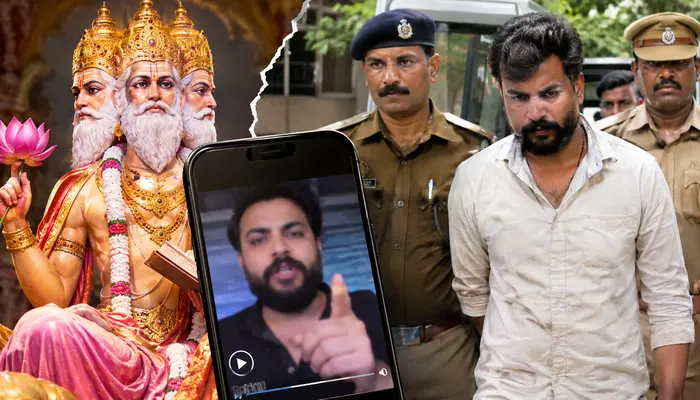
In Gonda, Uttar Pradesh, a social media influencer named Swaminath Verma made derogatory remarks against the revered Hindu deity Lord Brahma. According to media reports, the accused uploaded a video denigrating Lord Brahma on Facebook. Subsequently, on 12 September 2026, Harishchandra, a resident of Sakri Kolhua village, lodged a complaint at the Motiganj police station over Verma's objectionable remarks against the deity. Following public opposition to the video, Verma uploaded another recording in which he abused several respected local community members and made derogatory remarks against them. The police initiated legal proceedings under the relevant provisions for disturbing public order through his derogatory social media posts. Verma, who had approximately 73,000 followers on Facebook, regularly created and uploaded videos criticising people on various issues. Following the registration of the case, Verma remained absconding for nearly two months, prompting the deployment of several police teams to trace him. According to the police, he had been working away from home for an extended period and had returned to his village during Diwali. The Motiganj police arrested Verma at around 7 pm on Thursday, 5 November 2026. Photographs of his arrest surfaced the following morning. Sadar Circle Officer Abhishek Davachya confirmed his arrest and stated that he had been sent to jail. Motiganj Station House Officer Tej Narayan Gupta stated that action would be taken against those making objectionable remarks against Hindu deities and respected individuals. Verma was subsequently produced before a court.
Why it is Hate Crime ?
This case is being added to the tracker under the primary category: Hate Speech against Hindus. The subcategory selected is: Anti-Hindu slurs, mocking faith. Anti-Hindu slurs and the deliberate mocking of the Hindu faith owing to religious animosity involve the usage of derogatory terms, stereotypes, or offensive references to religious practices, symbols, or figures. One of the common anti-Hindu slurs used against Hindus is “cow-worshipper” and “cow piss drinker”. The intention of using this term is to demean and mock Hindus as a group and their religious beliefs since Hindus consider the cow holy. Additionally, some symbols and the slurs attached to them have a historical context that exacerbates the insult, hate, stereotyping, dehumanisation and oppression against Hindus. Cow worship has been used for centuries to denigrate Hindus, insult their faith and oppress Hindus specifically as a religious group. There has been overwhelming documentation about how cow slaughter has been used to persecute Hindus with cow meat being thrown in temples and places of worship. There has also been overwhelming documentation where cow meat (beef) has been force-fed to Hindus to either forcefully convert them to Islam or denigrate their faith. Apart from cow worship, the Swastika – which holds deep religious significance for the Hindus – has also been misinterpreted and distorted to use as a slur against Hindus. Similarly, the worship of the Shivling has been used by supremacist ideologies and religions to denigrate Hindus owing to religious animosity. Such slurs and denigration stem out of inherent animosity and hate towards Hindus and their faith, therefore, it is categorised as hate speech targeted at Hindus specifically owing to their religious identity. This case constituted a clear example of a religiously driven hate crime, as the perpetrator made derogatory remarks against the revered Hindu deity Lord Brahma on social media. His conduct demonstrated open hostility towards Hindu religious beliefs and sentiments, reflecting anti-Hindu prejudice. Hindu deities hold profound religious and spiritual significance within the Hindu tradition, representing various aspects of the divine and serving as objects of devotion, worship and reverence for millions of Hindus. Lord Brahma occupies a particularly significant position as the creator deity and one of the principal members of the Hindu Trimurti, alongside Lord Vishnu and Lord Shiva. He is revered in Hindu scriptures and traditions as the divine creator of the universe and all living beings. Making derogatory remarks against a deity of such religious significance demonstrated a blatant disregard for Hindu beliefs and sentiments. Such denigration of a revered religious figure reflected hostility towards Hinduism, making this a clear instance of religiously motivated hate speech. Furthermore, the fact that the perpetrator disseminated these derogatory remarks through social media demonstrated his deliberate decision to take his religious denigration beyond a private setting and broadcast it publicly. As a social media influencer with approximately 73,000 followers on Facebook, he had a substantial audience and a platform capable of amplifying his remarks. His decision to publish such content on a public platform exposed a wider audience to his denigration of a Hindu deity and demonstrated a deliberate disregard for the religious sentiments of the Hindu community. The public dissemination of such content, particularly by an influencer with a considerable following, further reinforced the religiously hostile nature of the incident. This constituted an instance of religiously motivated hate speech rooted in anti-Hindu hostility. Overall, as this incident met the parameters of a religiously motivated hate crime, it was included in the hate crime database of the Hinduphobia Tracker. Disclaimer: The Hinduphobia Tracker records incident dates based on when the crime occurred, rather than when it was reported in the media. However, in this case, media reports did not specify the exact date on which the offence took place. They only stated that a complaint was filed on 12 September 2026. Therefore, 12 September 2026 has been selected as the indicative incident date for documentation purposes only.


Case Status
Arrested


Perpetrators Details
Perpetrators
Others
Perpetrators Range
One Person
Perpetrators Gender
male
 Sources



