Minor Hindu child discriminated against for wearing Tilak, pressured to conceal his religious identity in Britain
 London Borough of Ealing, United Kingdom
 6 November, 2025
Case Summary
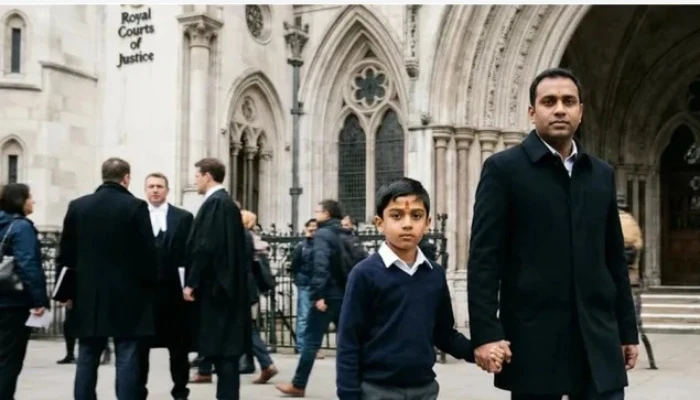
In Britain, a minor Hindu boy was prohibited from wearing the sacred Tilak-Chandlo, a religious mark associated with his Swaminarayan Hindu faith, at his primary school in London. His father subsequently filed a lawsuit against the school, accusing it of religious discrimination and harassment after school staff objected to the religious mark, removed the child from the school council, and introduced a uniform policy prohibiting religious symbols. The matter came to light when details of the lawsuit filed in the High Court's King's Bench Division emerged. The nine-year-old boy, a British-Indian Hindu, had been studying at Vicar's Green Primary School, a state school in Alperton, in the London Borough of Ealing. The dispute concerned his practice of wearing the tilak-chandlo, a religious mark worn on the forehead to express his Swaminarayan faith. According to the court documents, the incident began in November 2025, when the child was eight years old. School staff questioned him about the tilak and told him that it was not permitted. His parents wrote to the school, explaining that their son had been wearing the religious mark for four years and that the school's existing uniform policy contained no provision prohibiting it. On 12 December 2025, the school removed the child from the school council, where he served as his class representative. The school subsequently introduced a new uniform policy prohibiting religious symbols. In January 2026, his parents withdrew him from the school. The boy's father, acting as his son's legal representative and receiving financial support from the UK Hindu network Action for Harmony, filed a lawsuit against the school's governing body seeking £25,000 in compensation. He accused the school of breaching the Public Sector Equality Duty and violating his son's rights under Articles 9 and 14 of the European Convention on Human Rights, which protect freedom of religion and prohibit discrimination. The school denied the claims and maintained that prohibiting the tilak did not prevent the child from practising Hinduism. It argued that wearing a tilak was not mandatory in Hinduism and questioned whether the child followed the Swaminarayan faith. The school also said allowing the mark could have serious negative consequences, including disrupting interactions among students. Its staff also suggested that the child could apply the mark on a part of his body covered by clothing, a suggestion his parents rejected. Ambarish Limbachia, director of Ashray Law, who represented the father, said the case raised important questions about religious freedom and equality in the British education system.
Why it is Hate Crime ?
This case has been added to the tracker under the first primary category: Attack not resulting in death. Within this, the subcategory selected is Attacked for Hindu identity. In several cases, Hindus are attacked merely for their Hindu identity without any perceived provocation. A classic example of this category of religiously motivated hate crime is a murder in 2016. 7 ISIS terrorists were convicted for shooting a school principal in Kanpur because they got ‘triggered’ seeing the Kalava on his wrist and tilak that he had put. In this, the Hindu victim had offered no provocation except for his Hindu religious identity. The motivation for the murder was purely religious, driven by religious supremacy. Such cases where Hindus are targeted merely for their religious identity would be documented as a hate crime under this category. Another primary category selected is- Restriction/ban on Hindu religious practice. Within this, the subcategory selected is- Restriction on expression of Hindu identity. An example of the state-affected prejudicial and targeted orders against the Hindu community would be a government denying the right of a Hindu or a group of Hindus to hold a religious procession owing to the animosity of non-Hindu groups. Denial of the religious right of the Hindus to assuage the non-Hindu group which harbours animosity to a point where it could lead to violence against Hindus is not only a failure of law and order but is a prejudicial order against Hindus, denying them their fundamental rights to express their religious identity. An example of a hate crime against Hindus by a non-Hindu would be a non-Hindu institution forcing its Hindu employees to abandon religious symbols that a Hindu would wear as an expression of faith owing to inherent prejudice against the faith professed by the victim or a non-Hindu group of people restricting a Hindu group from constructing a place of worship simply because the demography of the area in which the temple is being built is dominated by non-Hindus. Such actions are driven by religious animosity and/or prejudice against Hindus and their faith and would therefore be categorized as a hate crime. The other primary category selected here is- Predatory Proselytisation. Under this, the sub-category selected is- Proselytisation by grooming, brainwashing, manipulation or subtle indoctrination. Religious brainwashing essentially means the often subtle and forcible indoctrination to induce someone to give up their religious beliefs to accept contrasting regimented ideas. Religious grooming or brainwashing also involves propaganda and manipulation. It involves the systematic effort, driven by religious malice and indoctrination, to persuade “non-believers’ to accept allegiance, command, or doctrine to and of a contrasting faith. Cases of such grooming or brainwashing are far more nuanced than direct threats, coercion, inducement and violence. In such cases, it is often seen that there is repeated, subtle and continual manipulation of the victim to induce disaffection towards their own faith and acceptance of the contrasting faith of the perpetrator. While subtle indoctrination is widely acknowledged as predatory, an element which is often understated in such conversions or the attempts of such conversion is the role of loyalty and trust which might develop between the perpetrator and the victim. Fiduciary relationships are often abused to affect such religious conversion. For example, an educator transmitting religious doctrine of a competing faith to a Hindu student. The Hindu student is likely to accept what the teacher is transmitting owing to existence of the fiduciary relationship. The exploitation of the fiduciary relationship to religiously indoctrinate victims would also be included in this category. Since the underlying animosity towards the victim’s faith forms the basis of predatory proselytization, such cases are considered religiously motivated hate crimes. This incident involved institutional discrimination against a minor Hindu child for openly expressing his religious identity through a sacred Hindu symbol. The school objected to his wearing the tilak, removed him from his position as class representative and subsequently introduced a uniform policy prohibiting religious symbols. These actions restricted his freedom to visibly practise his faith and made his Hindu identity a source of exclusion within the school environment. The tilak or chandlo is not merely a decorative mark but an expression of Hindu faith and religious identity, worn by devotees as part of their religious practice. It visibly expresses a person's belonging to Sanatan Dharma. By objecting to the mark and prohibiting the child from wearing it, the school treated an established expression of his faith as unacceptable within its environment. The discrimination extended beyond the restriction on the religious mark. The school removed the child from the school council, where he served as his class representative, after the dispute over his religious practice arose. This deprived him of a position of responsibility and participation among his peers. The subsequent introduction of a policy prohibiting religious symbols further formalised the restriction. More importantly, the school's suggestion that he apply the tilak on a part of his body concealed by clothing effectively required him to hide the visible expression of his faith rather than allowing him to practise it openly. The victim was only eight years old when the incident began. At such a formative age, children depend on teachers and school authorities for guidance, acceptance and a sense of security. Being singled out for his religious practice, losing his representative position and being asked to conceal his faith makes a child think that he is being treated differently from other students because he is Hindu. Such treatment undermines a child's confidence, emotional security and sense of belonging, while teaching him to associate the expression of his religious identity with embarrassment, rejection and exclusion. The school's argument that wearing a tilak was not mandatory in Hinduism did not justify prohibiting the child from observing the practice. Religious freedom does not depend on a practice being compulsory for every follower of a faith. More importantly, suggesting that the child conceal the tilak did not amount to accommodation. It sent a deeply troubling message that his Hindu identity was acceptable only when kept out of sight. At such a formative age, this pressure subtly conditions a child to believe that his religious identity is inferior, unwelcome or unworthy of the same acceptance given to others. It places him in a position where he must choose between openly expressing his Hindu identity and fitting in with his peers. This is a form of subtle psychological conditioning that teaches a Hindu child that his religious identity is not appreciated and must be concealed to gain acceptance. Over time, such experiences condition young minds to associate the public expression of Hindu identity with punishment, humiliation, or exclusion. Many children gradually discontinue visible religious practices, not because they have abandoned their beliefs, but because they fear becoming the next target of abuse or disciplinary action. This weakens their confidence to practise their religion openly and gradually distances them from their own religious and cultural traditions. In turn, such alienation makes children increasingly vulnerable to external ideological or religious influences, including future attempts at proselytisation, because they have been conditioned to perceive their own religious identity as a source of disadvantage rather than pride. Ultimately, such conduct normalises prejudice against Hindu religious practices, creates an atmosphere in which Hindu students feel compelled to suppress their faith, and reinforces the perception that openly displaying Hindu religious symbols invites adverse treatment. Viewed in its entirety, the incident constituted a religiously motivated act directed against the victims' Hindu identity and demonstrated clear hostility towards the public expression of the Hindu faith. Here, it is important to mention that in 2022, a massive controversy erupted in Karnataka, which took a national form, after Muslim women insisted that they should be allowed to wear burqas and hijabs in their schools and classrooms. At that time, the argument that was given by several politicians, social commentators, Hindu activists and even the Judiciary was that schools have the right to enforce uniform rules, since wearing uniforms brings harmony and equality in the classroom, and therefore, schools not allowing girls to wear hijabs in the classroom is not religious discrimination, but merely an enforcement of widely accepted uniform norms. The pseudo-seculars and leftist groups may argue that a similar line of reasoning should be applied in this case. However, most uniform codes focus on standardising clothing and accessories such as shoes, belts, and hair. A Tilak does not change the uniform's appearance. This religious symbol is benign and does not cause disruption or harm, raising serious concerns about the motivations behind such enforcement. When an ostensibly secular institution imposes restrictions specifically targeting Hindu religious symbols, it reflects institutional prejudice against Hinduism. This form of targeted suppression echoes broader patterns where Hindu practices are curtailed under the guise of neutrality or discipline, often to appease other religious groups. The actions of the teacher amount to religious discrimination and are consistent with the framework of a hate crime, where Hindus are penalised solely for adhering to their Hindu religious practices. Since this case meets the parameters of a religiously motivated hate crime, it is being added to the hate crime database of the Hinduphobia Tracker. Disclaimer: The Hinduphobia Tracker records the incident date based on when the victim's ordeal began, rather than the date the media reported the incident. In the present case, the victim's ordeal began in November 2025, but the exact date was not specified. The media reported the case on 7 November 2026. Based on the available information, we selected 7 November 2025 as the indicative incident date for documentation purposes only.
Victim Details
Total Victim
1
Deceased
0
Gender
- Male 1
- Female 0
- Third Gender 0
- Unknown 0
Caste
- SC/ST 0
- OBC 0
- General 0
- Unknown 1
Age Group
- Minor 1
- Adult 0
- Senior Citizen 0
- Unknown 0


Case Status
Case sub-judice


Perpetrators Details
Perpetrators
Christian Extremists
Perpetrators Range
Unknown
Perpetrators Gender
unknown
 Sources



