Hindu man lured to convert to Christianity through inducements and religious indoctrination by Christian man in Jodhpur
 Jodhpur, Rajasthan, India
 3 November, 2015
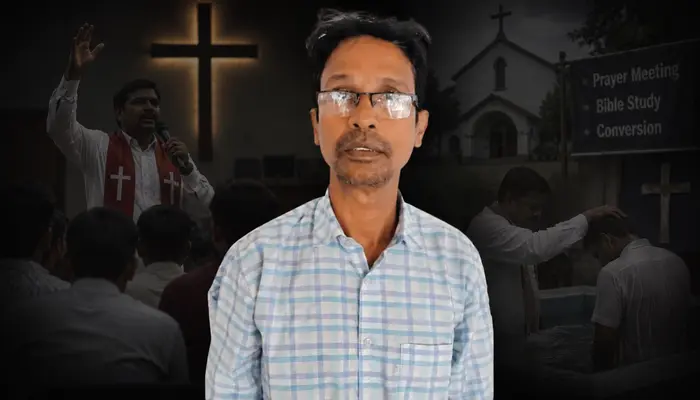
Case Summary
In Jodhpur, Rajasthan, a Hindu man named Prashant Garg was targeted for forced religious conversion by a Christian man named Sujat Hanuman. The accused lured the victim through various inducements, including promises of drug de-addiction, financial assistance, employment, business opportunities and marriage. The victim was also subjected to religious indoctrination and encouraged to attend Christian prayer meetings and undertake Bible studies. According to reports, Prashant suffered from drug addiction and was facing financial difficulties when he came into contact with Sujat, a native of Odisha residing in Bilara, Jodhpur, in 2015–16. Sujat assured him that he would help him overcome his addiction and improve his financial condition. He subsequently encouraged Prashant to attend Christian prayer meetings and religious seminars, promising that accepting Christianity would resolve his problems through miraculous means. During 2018–19, Prashant was sent to a college in Balotra to pursue a Bible-related course and was made a member of the Bible Society of India. Sujat subsequently introduced him to a woman named Gaura under the pretext of helping him establish a tea-leaf business, and Prashant was subsequently married to her. Sujat also used WhatsApp and other social media platforms to propagate Christianity among Hindus and encourage them to attend Christian prayer programmes. He arranged employment for Prashant at an organisation on Pali Road in Jodhpur, where he received a monthly salary of ₹14,000. The organisation distributed Christian religious literature and conducted activities aimed at involving people in Christian religious practices. In September 2026, Sujat took Prashant to the DC Centre in Ajmer in connection with a proposed tea business. A Christian preaching programme was being conducted there by Anand Crore, a resident of Jaipur. Prashant was offered an interest-free loan of ₹40,000 to establish the tea business and was taken to attend the programme. According to Prashant, several Hindus were converted to Christianity during the programme. He was also instructed not to disclose these activities to anyone. On 4 November 2026, Prashant filed a police complaint at Bilara Police Station, bringing the conversion activities to the attention of the authorities. Jodhpur Rural Superintendent of Police Pankaj Yadav stated that Sujat was involved in luring and intimidating people into converting to Christianity. Acting on the Superintendent of Police's directions, a special police team was constituted under the supervision of Additional Superintendent of Police Rameshwar Lal and Bilara Circle Officer Manish Dev, with Station House Officer Sawai Singh Sodha leading the investigation. Following the investigation, the police arrested Sujat Hanuman on 6 November 2026. The police also initiated an investigation into the involvement of other individuals connected with the suspected conversion network.
Why it is Hate Crime ?
The primary category selected in this case is: Predatory Proselytisation. The subcategory selected is: Conversion/ attempts to convert by inducement. Predatory Proselytisation is not just limited to threat, harassment, force and violence, but it also has contours of stealth. In several cases, the Hindu victim is exploited to convert, with non-Hindus taking advantage of their poverty. In such cases, the Hindu victim who is suffering financially is offered monetary benefits, including lucrative offers for jobs, health treatment, education, etc, to induce the victim into changing his/her religion. In such cases, the religious identity of the victim and the aim to disenfranchise him from his faith form the heart of the crime. Also, taking advantage of and exploiting an individual’s economic vulnerabilities is widely acknowledged as exploitation, forms of which are often penalised by law. Such cases therefore are considered religiously motivated hate crimes since the victim’s religious identity forms the very heart of the crime itself. The other subcategory selected is: Proselytisation by grooming, brainwashing, manipulation or subtle indoctrination. The subcategories selected are: Victim says was brainwashed/ groomed, Pattern of targeting Hindus. Religious brainwashing essentially means the often subtle and forcible indoctrination to induce someone to give up their religious beliefs to accept contrasting regimented ideas. Religious grooming or brainwashing also involves propaganda and manipulation. It involves the systematic effort, driven by religious malice and indoctrination, to persuade “non-believers’ to accept allegiance, command, or doctrine to and of a contrasting faith. Cases of such grooming or brainwashing are far more nuanced than direct threats, coercion, inducement and violence. In such cases, it is often seen that there is repeated, subtle and continual manipulation of the victim to induce disaffection towards their own faith and acceptance of the contrasting faith of the perpetrator. While subtle indoctrination is widely acknowledged as predatory, an element which is often understated in such conversions or the attempts of such conversion is the role of loyalty and trust which might develop between the perpetrator and the victim. Fiduciary relationships are often abused to affect such religious conversion. For example, an educator transmitting religious doctrine of a competing faith to a Hindu student. The Hindu student is likely to accept what the teacher is transmitting owing to existence of the fiduciary relationship. The exploitation of the fiduciary relationship to religiously indoctrinate victims would also be included in this category. Since the underlying animosity towards the victim’s faith forms the basis of predatory proselytization, such cases are considered religiously motivated hate crimes. In this case, a Hindu man was targeted for religious conversion by a Christian perpetrator through material inducements, sustained religious indoctrination and psychological influence. The systematic efforts to exploit the victim's personal vulnerabilities and influence his religious beliefs demonstrated a pattern of religiously motivated targeting, making this a clear case of a religiously driven hate crime. Religious conversion can be considered voluntary when it stems from an individual's own conviction and free will. However, in this case, the victim was pressured to embrace Christianity through promises of personal, financial and social benefits rather than through an independent interest in or conviction towards the faith. The circumstances demonstrated that the conversion efforts were directed at changing his existing religious identity through non-consensual measures, rather than facilitating a genuinely voluntary religious choice. The perpetrator exploited Prashant's drug addiction and financial difficulties by offering assistance with de-addiction, financial recovery, employment, business opportunities and marriage. These inducements were presented as means of overcoming his personal hardships and improving his circumstances, while simultaneously drawing him into Christian religious activities. The offers were not acts of genuine goodwill or charity but calculated attempts to exploit his vulnerabilities to influence his religious allegiance. By linking material and personal benefits to his participation in Christian religious activities and encouraging him to associate the prospect of a better life with embracing Christianity, the perpetrator undermined his ability to exercise free and informed religious choice. Such exploitation of personal suffering and economic vulnerability constituted predatory proselytisation, as the victim's need for assistance was used as an opportunity to influence and forcibly change his religious identity. This reflected a deliberate pattern of targeting a vulnerable Hindu individual to secure his conversion rather than extending assistance without religious conditions. Such coercive practices stripped the victim of his religious autonomy and dignity and demonstrated religiously motivated hostility towards his Hindu identity, making this a clear instance of a religiously driven hate crime. The victim was subjected to sustained Christian religious indoctrination through repeated exposure to Christian prayer meetings, religious seminars and Bible studies. He was sent to a college in Balotra to pursue a Bible-related course and was made a member of the Bible Society of India. These were not isolated instances of religious engagement but formed part of a sustained process of introducing Christian doctrines and practices to a Hindu individual with the objective of changing his religious allegiance. Using systematic religious indoctrination and psychological influence to distance a Hindu from his existing faith and steer him towards Christianity demonstrated a deliberate attempt to undermine his Hindu religious identity. Such methods went beyond voluntary religious instruction and, when combined with material inducements and the exploitation of personal vulnerabilities, constituted coercive conversion tactics. The imposition of another religion's doctrines upon a Hindu individual as part of an organised effort to secure his conversion reflected religious animosity towards his existing faith and demonstrated the perpetrator's disregard for the victim's Hindu identity, making this a clear instance of a religiously driven hate crime. Furthermore, the conversion activities extended beyond Prashant to several other Hindus who attended the Christian preaching programme at the DC Centre in Ajmer in September 2026. The victim stated that several Hindus were converted to Christianity during the programme. This demonstrated a wider effort to target Hindu individuals and persuade them to abandon their existing religious identity and embrace Christianity. The organised preaching programme, coupled with the offer of an interest-free loan of ₹40,000 for a proposed business, also highlighted the use of material inducements to facilitate conversion. Such organised attempts to convert multiple Hindus reflected a broader effort to strip them of their religious identity, demonstrating hostility towards their faith and reinforcing the anti-Hindu motivation behind the conversion activities.  These instances of targeted proselytisation activities stem from inherent hostility towards the victims' professed faith, since Abrahamic faiths believe that any non-adherent to their faith is subject to being dehumanised till they convert, making it a religiously motivated crime against Hindus. Therefore, this case is being added to the hate crime database of the Hinduphobia Tracker. Disclaimer: The Hinduphobia Tracker records incident dates based on when the victim's ordeal began rather than the date on which the incident was reported by the media. In this case, the media reports did not specify the exact date on which the victim's ordeal began. They stated that Prashant Garg filed a police complaint on 4 November 2026 and that his ordeal began when he came into contact with the perpetrator in 2015. Hence, an indicative incident date of 4 November 2015 has been selected. This date has been recorded for documentation purposes only. In this case, although the victim stated that several other Hindus were targeted for religious conversion during the Christian preaching programme at the DC Centre in Ajmer, the total number of victims was not specified in the media reports. Hence, an indicative victim count of one has been recorded, referring exclusively to the primary victim, Prashant Garg. This conservative estimate has been adopted for documentation purposes only. Although the main perpetrator, Sujat Hanuman, was identified by name, the police also indicated the involvement of other individuals connected with the conversion network. However, the total number of perpetrators was not specified in the media reports. Hence, a conservative perpetrator count of '1' has been recorded, referring exclusively to the main accused, Sujat Hanuman. This estimate has been adopted for documentation purposes only.
Victim Details
Total Victim
1
Deceased
0
Gender
- Male 1
- Female 0
- Third Gender 0
- Unknown 0
Caste
- SC/ST 0
- OBC 0
- General 0
- Unknown 1
Age Group
- Minor 0
- Adult 1
- Senior Citizen 0
- Unknown 0


Case Status
Arrested


Perpetrators Details
Perpetrators
Christian Extremists
Perpetrators Range
One Person
Perpetrators Gender
male
 Sources



